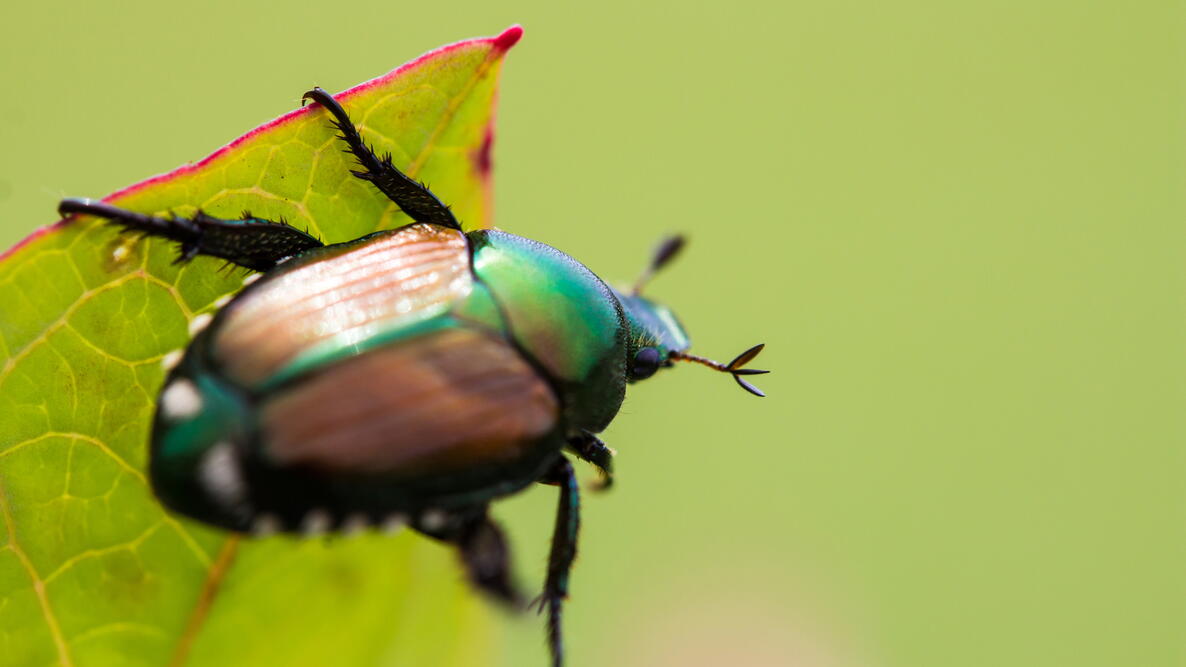
Caption
Use these tips to get rid of Japanese beetles.

Identification
What Does a Japanese Beetle Look Like?
Japanese beetles are ½ inch in length with distinct metallic blue-green heads. They have copper-colored backs, tan wings, and small white hairs lining each side of the abdomen. Japanese beetles usually feed in small groups.
Prior to becoming adult beetles in late June, they are 1-inch-long C-shaped white grubs that live in the soil and feed on the roots of many plants. These grubs are often a problem in lawns.
Once adults, Japanese beetles live only about 40 days, but they are voracious. Japanese beetles attack plants in groups, which is why the damage can be so severe. Most feeding starts in mid- to late June in the North and mid- to late May in the South.
Ladybugs vs. Japanese Beetles
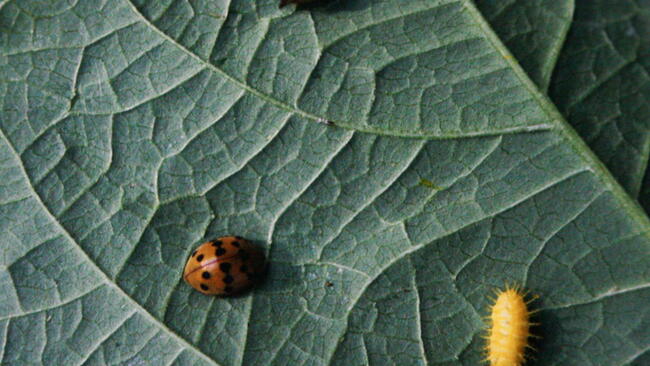
Sometimes, ladybugs and Japanese beetles are confused. Ladybugs are beneficial insects that feed on garden pests like aphids, mites, and scale. Japanese beetles, on the other hand, are harmful garden pests. As adults, they chew through leaves, flowers, and fruit, while their larvae (grubs) damage lawns by feeding on grass roots.
| Feature | Ladybug | Japanese Beetle |
|---|---|---|
| Color | Bright red, orange, or yellow with black spots | Metallic green with shiny copper wings |
| Size | 1/4 inch | 1/2 inch |
| Diet | Eats aphids, mites, and garden pests (beneficial) | Eats leaves, flowers, fruits, and crops (harmful) |
| Impact on Garden | Helps plants by controlling pests | Damages plants, trees, and lawns |
| Native Range | Worldwide (many species native) | Native to Japan, invasive in North America |
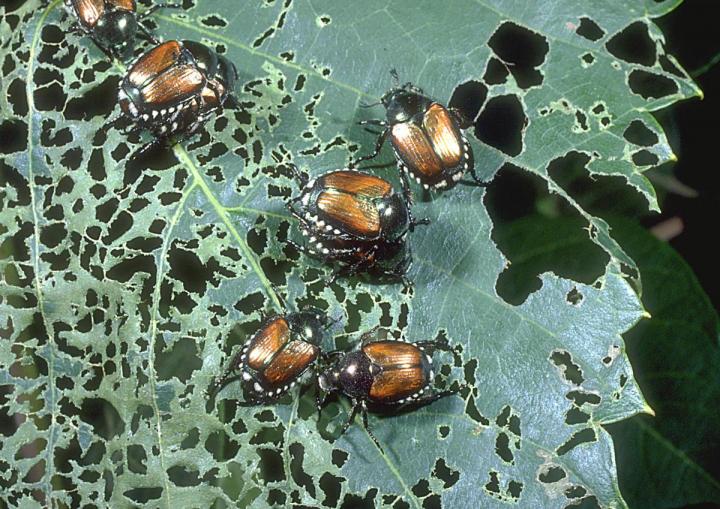
Photo Credit: Ohio State University.
Signs of Japanese Beetle Damage
Japanese beetles feed on a wide variety of flowers and crops (the adult beetles attack more than 300 different kinds of plants), but in terms of garden plants, they are especially common on roses, as well as beans, grapes, and raspberries. Here’s what to look out for:
Unhealthy Brown Patches in Lawn

Photo: GreenThumbShots
First come the Japanese beetle grubs (larvae), which damage grass when overwintering in the soil. The grubs feast on the roots of lawn grasses and garden plants. This can cause brown patches of dead or dying grass to form in the lawn, which will pull up easily thanks to the weakened roots.
Skeletonized Leaves and Flowers
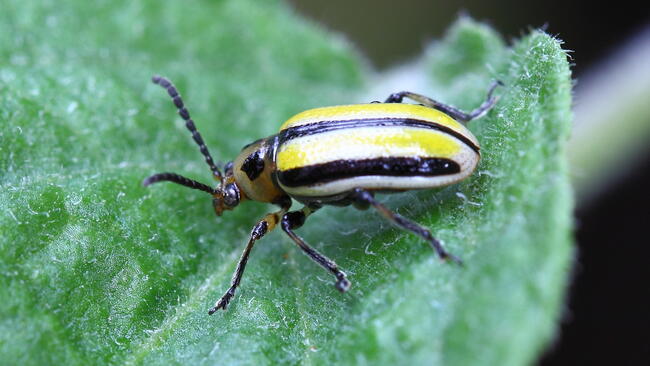
Then come the adult Japanese beetles, which chew leaf tissue from between the veins, leaving a lacy skeleton. You’ll know right away when you see leaves that are “skeletonized” (i.e., only have veins remaining). (Mexican Bean Beetles can also leave foliage skeletonized, though, so be sure to identify the beetle by its appearance as well.)

Photo: Pascal Halder
Control and Prevention
How to Kill Japanese Beetles
To manage Japanese Beetles in yards and gardens, the trick is to start early! Once these insects are present in large numbers, the problem is very difficult to manage.
Consider BTG, or Bacillus thuringiensis galleriae
- It’s most effective to start at the grub stage, usually in late May or early June. BTG, or Bacillus thuringiensis galleriae (e.g., in safe products such as grubGONE!), uses naturally occurring soil bacteria. This bacillus ONLY targets certain lawn insect pests, such as Japanese beetle grubs, before they become destructive adults. The grubs ingest the spores and the natural yet powerful BTG proteins as they feed in the soil.
BT works within days to weeks of application but is NOT toxic to beneficial insects, such as earthworms, bees, and pollinators; it will not harm people, pets, animals, or plants. BTG will kill not only Japanese beetle grubs but also a variety of other destructive beetle larvae and grubs, such as chafers, oriental beetles, and billbugs, throughout the spring and fall seasons.
- The adult beetle season runs from mid-June to September, often peaking in July. To kill the green beetles that infest your edible or ornamental plants, you can use BTG as a spray (e.g., in safe products such as beetleGONE!). Like with the grubs, BTG effectively kills the adult beetles through a combination of the BTG protein and spores. One key to success is to start applying early, at the first signs of the adult beetle. Importantly, BTG reduces the attraction by early-arriving beetles of more beetles by inhibiting the effectiveness of the early arrivals’ use of their beetle-attracting pheromones.
BT products can be mixed in water and sprayed on edible garden plants, ornamental plants, and trees to kill Japanese beetle adults or put into turf to kill the grubs. It can also be used in dry form by mixing into potting or garden soil to control beetle grubs. With BT, there is a zero-day pre-harvest interval; therefore, you can treat for beetles and pick your food the same day. There are no label restrictions for use around bees or flowering plants; therefore, it can be safely used while pollinators are active. There is also no toxicity to fish or aquatic life.
Handpick Early
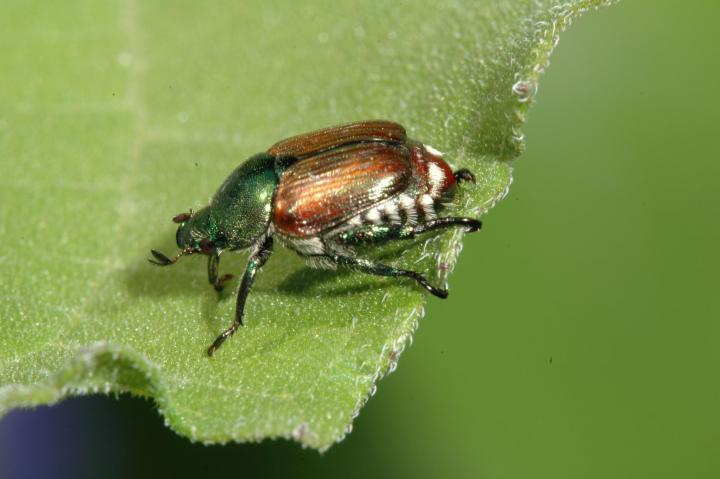
Again, with adults, START looking for beetles in mid- to late June or early July. In the early morning or evening, when beetles are more sluggish, knock beetles into a bucket of soapy water. Yes, it’s time-consuming, but it’s also the most effective way to kill these pests. Just be diligent.
When you pick off the beetles, drop them in a solution of 1 tablespoon of liquid dishwashing detergent and water, which will cause them to drown. Do this daily, as the chemical trail of beetles attracts more beetles.

Photo: Kylie P
Introduce Natural Enemies
You can also attract native species of parasitic wasps (Tiphia vernalis or T. popilliavora) and flies to your garden, as they are predators of the beetles and can be beneficial insects. They will probably attack the larvae, but they are not very effective in reducing the overall beetle population.
Spray Neem Oil
Deter feeding by adult beetles by spraying plants with neem oil, which contains potassium bicarbonate. Adult beetles ingest a chemical in the neem oil and pass it on to their eggs, and the resulting larvae die before they become adults. Neem oil is effective for several days, but repeat applications are needed, especially after rainfall. Neem oil is not effective once you have beetles in large numbers. Neem is low risk to bees and other beneficial insects but can be harmful to fish and aquatic life, so don’t use it near lakes, rivers, and water.
Consider Insecticides
Beware of insecticides. If you wish to use insecticides, speak to your local cooperative extension or garden center about approved insecticides in your area, and be aware of whether you’re killing the very pollinators that bring fruit and flowers!
For example, Chlorantraniliprole (Acelepryn®) provides 2 to 4 weeks of protection and is low risk to bees. But most dusts or sprays are highly toxic to honeybees, native bees, and other pollinators. If application of these materials to plants is necessary during the bloom period, do not apply during hours when bees are visiting the flowers (late morning through midday). Apply sprays in the morning, never in full sun or at temperatures above 90ºF. If your plants start to wilt, rinse the leaves immediately with clean water.
Nip Rose Buds and Spray Rose Bushes
When beetles are most abundant on roses, nip the buds and spray the bushes to protect the leaves. When the beetles become scarce, let the bushes bloom again. Timeliness and thoroughness of application are very important. Begin treatment as soon as beetles appear, before damage is done. For rose growers, see our Growing Guide for Roses for more tips on caring for roses!

Photo: Mike Hill Photography
More on Japanese Beetle Prevention
Choose the Right Plants
There are some plants that Japanese beetles seldom damage, such as boxwood, chrysanthemum, clematis, conifers, daylily, forsythia, geranium, ginkgo, common lilac, Japanese tree lilac, magnolia, red and silver maple, oak, white poplar, redbud, rhododendron, and yew. See our list of the Best and Worst Plants for Japanese Beetles.
Dispersing the beetle’s favorite plants throughout the landscape, rather than grouping them together, can also help.
| What Plants Attract Japanese Beetles | What Plants Repel Japanese Beetles |
|---|---|
| Roses | Catnip |
| Grapes | Garlic |
| Linden Trees (Basswood) | Chives |
| Apple Trees | Onion |
| Plums | Leeks |
| Birches | Tansy |
| Hibiscus | Larkspur |
| Raspberries | Begonias |
| Beans | Marigolds (especially French marigolds) |
| Blackberries | Boxwood |
Protect Your Crops With Row Covers
Use row covers during the 6- to 8-week feeding period that begins by mid- to late June in the North and mid- to late May in the South. Row covers will keep the pests out, but they will keep pollinators out, too; be sure to remove netting or covers if your crops need to be pollinated. Do not cover plants in bloom that require pollination (i.e., fruits). After the plant sets fruit, then cover it with netting.
Use Companion Plants
Avoid attracting beetles with companion planting. Try planting garlic, rue, or tansy near your affected plants to deter Japanese beetles. (Roses love garlic is a popular expression.) All herbs and other aromatic plants make wonderful companions. Scented geraniums (Pelargonium), rue (Ruta), feverfew (Tanacetum), parsley (Petroselinum), and thyme (Thymus) all may help ward off Japanese beetles as well as aphids.
Try ornamental and culinary sage (Salvia), anise-hyssop (Agastache), calamint (Calamintha), catmint (Nepeta), lavender (Lavandula), oregano (Origanum), Russian sage (Perovskia), and yarrow (Achillea). Four-o’clocks (Mirabilis) and larkspur (Delphinium) are said to act as decoys by attracting rose-loving Japanese beetles to eat their poisonous leaves, but they do not kill the beetles.

Photo: crystaldream
Methods That Don’t Work
Japanese Beetle Traps
Do NOT use Japanese beetle traps. They attract beetles, but research has proven that more beetles fly toward the traps than are caught. You’ll be in pulling beetles from all over town and end up with a worse problem.

Photo: mikeledray
Neem Oil
While we mentioned Neem oil above as a solution, it is essential to note that it has a time and place. Once you have a large population of beetles, or once they have grown to full-size adults, Neem oil will no longer be effective.
FAQ
What spray kills Japanese beetles?
Insecticidal sprays containing carbaryl, pyrethrin, or neem oil are commonly used. Neem oil works best when applied early, as it disrupts the beetles’ feeding and reproduction. Always follow label instructions and reapply as needed.
When do Japanese beetles go away?
Adult beetles typically appear in late June and remain active for 4–6 weeks, usually disappearing by mid-to-late August.
Do Japanese beetles bite humans?
No. Japanese beetles do not bite or sting. They only feed on plants and are harmless to people and pets.
Do grubs turn into Japanese beetles?
Yes. The white C-shaped grubs found in soil are the larval stage of Japanese beetles. They feed on grass roots, overwinter in the soil, and then emerge as adult beetles the following summer.
What birds eat Japanese beetles?
Many backyard birds (including starlings, robins, cardinals, and crows) feed on Japanese beetles. Encouraging birds in your garden with feeders, water, or nesting spots can help reduce beetle numbers. Learn more about creating a bird-friendly garden.

More Like This

- « Previous
- 1
- 2
- …
- 10
- Next »

Comments