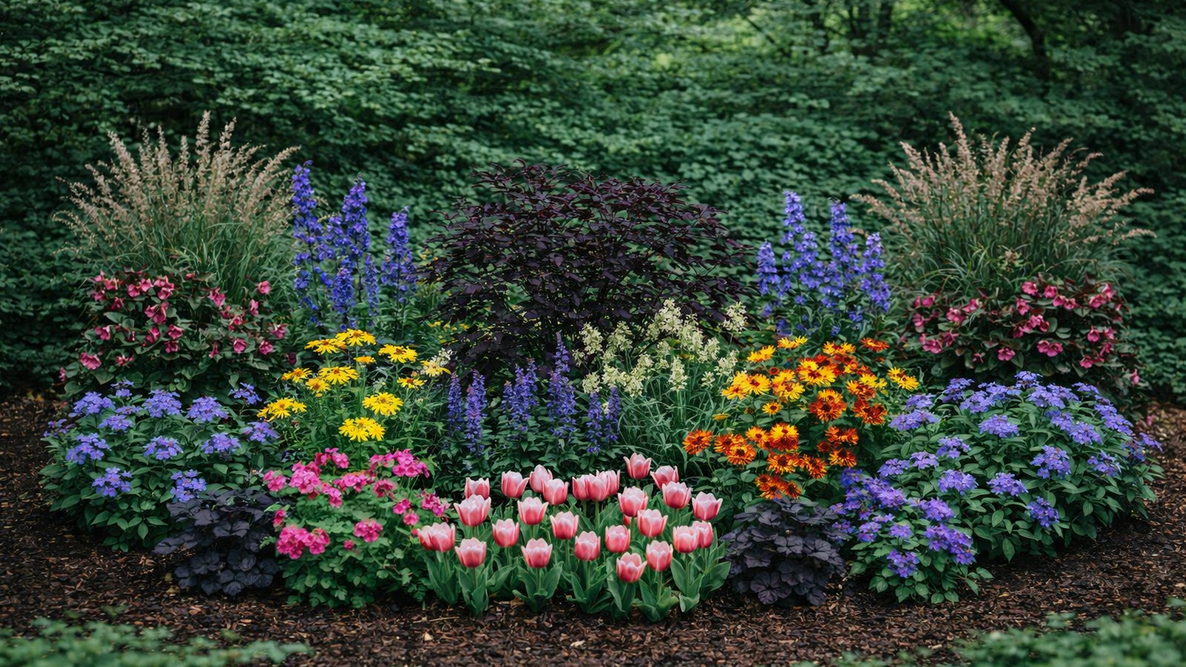
Caption
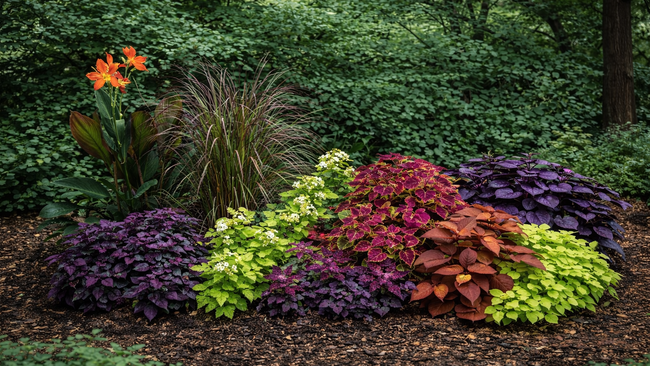
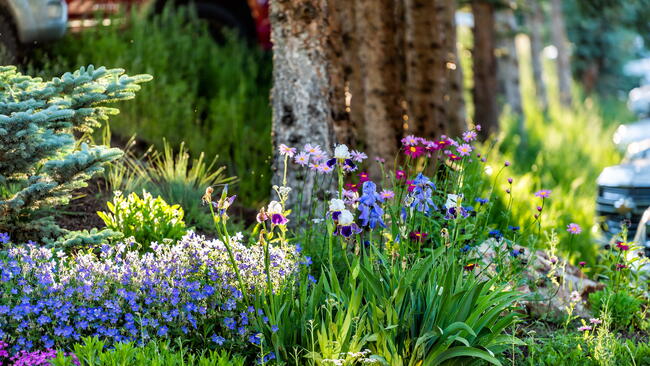
An illustration showing how this perennial garden provides color from spring through fall.

We are in love with this garden design! Imagine a flower garden so colorful it practically hums with life from early spring to the first frost of autumn. Our Three-Season Perennial Garden Design Plan focuses on dependable plants, rich foliage, and overlapping bloom times to deliver continuous color from spring through fall. Once established, the garden requires surprisingly little maintenance while offering a strong visual impact year after year.
In This Article
When using the right mix of perennials, small shrubs, and thoughtful plant placement, it’s entirely possible to enjoy a vibrant garden that blooms for months—without constant upkeep.
Part of Our Garden Plan Collection
This plan is part of our Garden Plan Collection, a free library of tested garden layouts designed to help gardeners grow confidently. Each plan emphasizes wise plant choices, realistic maintenance, and long-term success—especially for beginner and intermediate gardeners.
What’s Included in This Garden Plan
A three-season perennial garden layout with continuous color
- Spring-, summer-, and fall-blooming perennials and shrubs
- A complete plant list with quantities
- Flexible design options for borders or island beds
- Low-maintenance growing and care guidance
Quick Facts
| Feature | Details |
|---|---|
| Garden Type: | Perennial Flower Garden |
| Difficulty Level | Beginner |
| Hardiness Zones: | 4–8 |
| Sun Exposure: | Full Sun (at least 6 hours of sunlight per day) |
| Seasonality: | Spring through Fall |
| Soil Type: | Rich, well-draining garden soil amended with compost |
| Watering Needs: | Moderate; water regularly during the first season, then weekly during dry spells once established |
| Three-season color, low-maintenance, shrub + perennial structure, non-aggressive plants, pollinator-friendly blooms | |
| Garden Size: | 16 long × 6 feet wide (customizable as a border or island bed; can be shortened to 8 feet) |
| Fun Fact | This design relies on foliage color and overlapping bloom times—so it stays showy even when one group of flowers takes a break. |
Three-Season Garden Plot Plan Layout
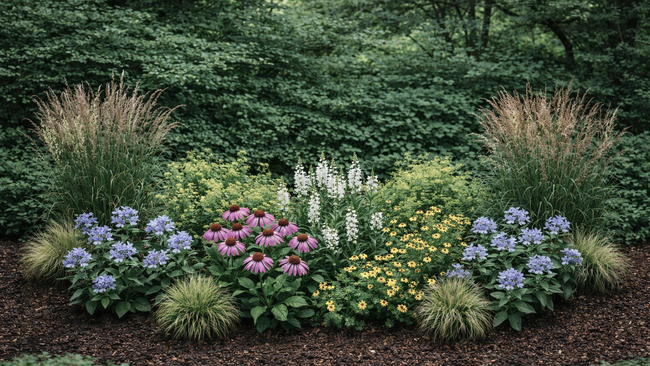
This perennial flower garden is designed as a 16-foot-long by 6-foot-wide bed that can be used as a border along a fence or wall, or adapted into an island bed. Plants are massed in generous groupings for strong visual impact and layered by height to ensure color from spring through fall.
- The 13 plant varieties are massed in numbers of each for maximum color and instant curb appeal.
- To create larger beds, double or triple the number of plants
- To reduce the size, shorten the bed to 8 feet and omit the large ‘Black Lace’ elderberry
- For a centerpiece in the middle of a lawn, place the elderberry and taller perennials in the middle and surround them with plants of shorter stature, ending with Rozanne geranium and ‘Obsidian’ heuchera at the edge of the bed.

The Three-Season Plant List
We’ve selected common plants for each season to suit most U.S. geographies (because most of these perennials need winter chill, this garden is inappropriate for subtropical climates such as southern Florida and southern California).
A three-season garden requires three essential ingredients:
- Perennials that bloom copiously year after year
- Small shrubs with color-saturated foliage all season long
- Plants that do not spread aggressively
These characteristics are found in all of the following:
- Elderberry (Sambucus nigra ‘Black Lace’)
1 plant - Weigela (Weigela Wine & Roses)
2 plants - Bleeding heart (Dicentra ‘King of Hearts’)
4 plants - Heuchera (Heuchera ‘Obsidian’)
2 plants - Black-eyed Susan (Rudbeckia fulgida var. sullivantii ‘Goldsturm’)
2 plants - Ox eye (Heliopsis helianthoides var. scabra ‘Sommersonne’, aka ‘Summer Sun’)
2 plants - Sneezeweed (Helenium ‘Mardi Gras’)
2 plants - Salvia (Salvia x sylvestris ‘Mainacht’, aka ‘May Night’)
4 plants - Cranesbill (Geranium ‘Gerwat’, aka Rozanne)
8 plants - Aster (Aster x frikartii ‘Mönch’)
3 plants - Tulip (Tulipa ‘Foxtrot’)
40 bulbs - Monkshood (Aconitum carmichaelli ‘Arendsii’)
6 plants - Delphinium (Delphinium ‘Connecticut Yankee’ series)
6 plants

Why Choose a Three-Season Garden?
A three-season perennial garden provides long-lasting beauty without the need for constant replanting.
Key benefits include:
- Constant color: Spring flowers and foliage in burgundy, pink, and blue transition into yellow, orange, blue, and deep ebony for summer and fall.
- Effortless impact: For at least five years, this garden requires no staking, dividing, or heavy pruning—only basic feeding and occasional weeding.
- Easy adaptability: The design tolerates a wide range of climates, whether the first frost arrives in early September or mid-November.


How This Garden Delivers Continuous Color
Once planted, this perennial garden changes subtly through the year as different plants take turns in the spotlight. Some bloom briefly, others for months, and several provide color through foliage alone.
The sections below highlight how the plants already included in the plan perform by season.
Spring Color and Early-Season Interest
Spring establishes the garden’s structure and sets the tone for the year. Plants providing strong spring interest include:
- ‘Black Lace’ elderberry
- Rozanne geranium
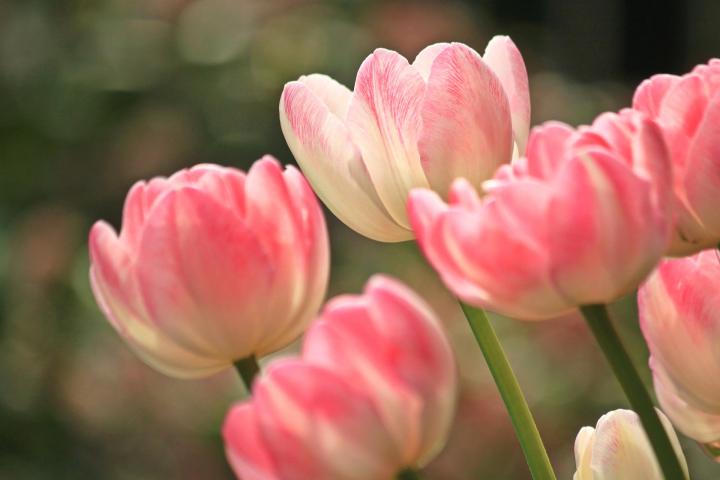
- ‘Foxtrot’ tulip
- ‘King of Hearts’ dicentra
- ‘Obsidian’ heuchera
- Wine & Roses weigela
Summer Blooms That Carry the Garden Forward
As spring flowers fade, summer perennials take over, filling the garden with height, movement, and saturated color. Summer performers include:
- ‘Connecticut Yankee’ delphinium
- ‘Goldsturm’ rudbeckia
- ‘Mardi Gras’ helenium
- ‘May Night’ salvia
- ‘Mönch’ aster
- ‘Summer Sun’ heliopsis
(‘Black Lace’ elderberry, Rozanne geranium, ‘Obsidian’ heuchera, and Wine & Roses weigela will still bloom.)

Fall Flowers and Late-Season Interest
Late-blooming perennials extend interest well into autumn, keeping the garden lively as temperatures cool. Fall highlights include:
- ‘Arendsii’ monkshood
- ‘Mönch’ hardy aster
Many summer perennials remain in bloom into fall, while foliage-rich plants maintain structure and color even as flowering slows. (‘Black Lace’ elderberry, Rozanne geranium, ‘Goldsturm’ rudbeckia, Mardi Gras helenium, ‘May Night’ salvia, ‘Obsidian’ heuchera, ‘Summer Sun’ heliopsis, and Wine & Roses weigela will still bloom.)
Tips for Success Every Season: Planting, Fertilizing, and Mulching
- Before you start digging, arrange the potted plants on the bed to get a general idea of what the garden will look like. Remember to leave space between the plants to allow them to grow wider.
- Plant from the back of the bed to the front. Set shrubs and perennials at the same depth as they are in containers.
- For a lush look, plant tulip bulbs thickly (about five per square foot of bed). After they bloom, remove the dead flowers so that the bulbs put their energy into storing nutrients for the next season rather than into setting seeds. Remove tulip leaves after they brown. Don’t worry about appearances; nearby perennials will cover up the aging leaves.
- Fertilize if you want these plants to thrive. Scrape away any mulch from the base of each plant in the early spring and spread an inch of compost around the plants. In July, lightly mix bonemeal or a slow-release fertilizer into the surface of the soil above the bulbs. (Note: Bonemeal may attract rodents that will dig for bones.) Learn more about organic soil amendments.
- Spread 3 inches of mulch over the bed. It will help to retain moisture and suppress weeds. Use an organic material (such as shredded bark or leaf mold), which adds nutrients to the soil as it decays. Cedar bark mulch is an excellent choice as well, because the resins in it repel many insects and prevent fungal diseases. Learn more about mulch.
- Remove fading flowers to increase perennials’ bloom production. Shrubs drop their old flowers and will bloom again if conditions are right.
- Do not remove brown foliage on perennials until early spring when new green growth appears. The dead material insulates plant roots from the extreme temperatures of winter.
- If you must prune your shrubs, do so after the shrubs flower, not in early spring.
Why This Garden Design Works
This plan succeeds by combining dependable perennials with shrubs that provide long-lasting foliage color. Bloom times overlap, plants are well-behaved, and the garden improves with age—delivering strong visual impact without demanding constant attention.
Once your three-season plot is planted, be patient. Perennials reach their full size and beauty by the second season. Shrubs grow more slowly, reaching their mature size 3 to 5 years after planting.
More Garden Plans
Want more inspiration for garden plots? Check out these plans below:
- Perennial Flower Garden Plan - this garden delivers reliable color, texture, and structure throughout the growing season.
- Pollinator Garden Plan - an open garden with native flowers that are easy for pollinators to access.
- Front Yard Flower Garden Plan - instant charm—and long-term curb appeal—for smaller landscapes.
- Cut Flower Garden Plan - a steady supply of fresh flowers for bouquets and vases from spring through fall.
Do you have a perennial garden? What’s your favorite perennial flower? Let us know in the comments below!

Vegetable Garden Plans
Flower Garden Plans
More Like This

Yes, this garden design is for temperature regions such as zone 7a. You should still doublecheck with a local nursery or your cooperative extension for more local knowledge! They're "on the ground," no pun intended!
Hi, Julie, Part of the challenge in locating Delphinum Connecticut Yankee may be your location. Seeds for it appear (on a Google search) to be available in the States. (It was selected as an "All-American Selection" in 1963, which means it's high-quality and AAS plants are usually almost eternally available; FWIW https://all-americaselections.org/product/delphinium-connecticut-yankee/ and here's a seed company description [there are others] https://www.redemptionseeds.com/delphinium-belladonna-connecticut-yankee-mix-seeds.html#:~:text=Delphinium%20belladonna%20Connecticut%20Yankee%20Mix%20is%20a%20celebrated%20All%20American,lavender%2C%20light%20rose%20and%20white.).
Coming up with a replacement is not easy—thinking color, height, double flower, and any other desirable features. But I Delphinium Double Stars https://gracefulgardens.com/delphinium-double-stars (this vendor appears to be in New York state). Another is Delphinium NEW MILLENNIUM but the page was only a plant description and the text reads "Selected in New Zealand . . . " so it's not clear where it's available.
With that, I would only say try larkspur, which is a close relative. We hope this helps!
- « Previous
- 1
- 2
- …
- 10
- Next »

Comments