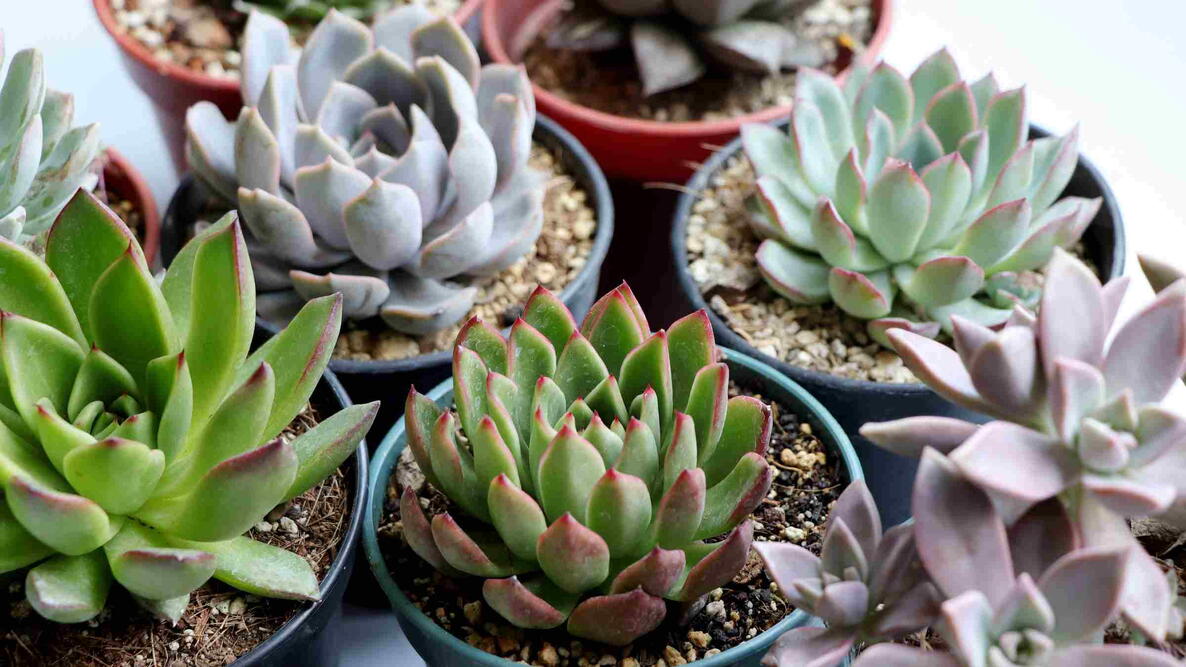
If you need proof that tough plants can be total softies, look no further than echeveria. These hardy succulents are undaunted by heat, drought, and even cool weather, but they’re so easy to keep that beginners can master them—and they come in lots of fun colors too. I’ve kept a number of echeveria indoors and outdoors over the years, and here are all the tips I’ve used for succulent growing succ-ess!
About Echeveria Plants
Echeveria are sometimes called “hen and chicks,” but they should not be confused with true hen and chicks or Sempervivum—an entirely different, but related, plant. Like Sempervivum, echeveria belongs to the Crassulaceae family and features plump, colorful leaves that grow in tight rosettes and often reproduce via offsets. However, echeveria aren’t quite as cold-tolerant as Sempervivum, and they’re native to Central and South America, while Sempervivum hail from Europe and Africa.
Currently, there are about 150 recognized species of echeveria, as well as thousands of unique cultivars with different leaf and flower colors, bloom times, and more. But despite all that diversity, most echeveria are relatively slow-growing plants that only reach 2 to 12 inches tall and spread just about as wide. Most types of echeveria share similar care needs and thrive in well-draining locations with ample sunlight and minimal watering.
If you live in an area with mild winters, you may be able to keep echeveria outdoors year-round in pots, rock gardens, or xeriscapes. But as I live in New England, I only grow echeveria inside as a houseplant and find it to be a very easy one to keep! These plants excel exceptionally well in terracotta pots, but I also enjoy mixing them into dish gardens with other succulents that have similar care needs, such as kalanchoe and sedum.

Types

Echeveria come in an astounding array of colors, which usually get more vivid when the plants receive more light. You can find these plants in blues, greens, yellows, reds, pinks, purples, grays, and near black. Some have wooly leaves for even more excitement!
‘Brown Rose’: This colorful echeveria has a pale green center surrounded by lightly fuzzed leaves that get increasingly red towards the plant’s exterior.
‘Dark Moon’: A darkly beautiful echeveria, ‘Dark Moon’ has deep purplish leaves that look nearly black in most light.
‘Doris Taylor’: A wooly echeveria option, ‘Doris Taylor’ has light green leaves with dark splotches on the leaf tips.

Wit and Wisdom
- Unlike Sempervivum, echeveria are monocarpic plants that can bloom more than once and live for decades!
- Outdoors, echeveria serve as pollinator plants for butterflies, bees, and hummingbirds.
- Interestingly, echeveria got its name from the 18th-century Mexican botanical artist Atanasio Echeverría y Godoy.

Propagation
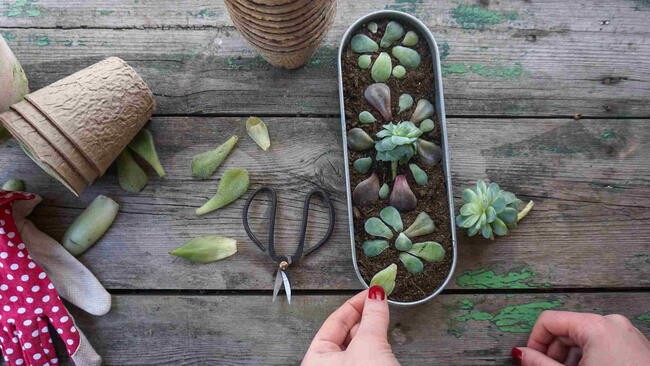
Non-hybridized echeveria can be propagated from seed, but it’s much easier to propagate these succulents from offsets, stem cuttings, or leaves. Stem-cutting propagation is particularly helpful for fixing echeveria that have become leggy or overgrown!
- Use a sharp, sterilized knife to cut an echeveria offset off the parent plant or to cut off a leggy plant stem. Trim the lower leggy section off the cutting with a sharp cut.
- If you’re propagating leaf cuttings, gently wiggle a healthy leaf until it pops off the plant whole. Damaged, cut, or broken leaves won’t propagate well.
- Place the offset, stem cutting, or leaf to the side in a warm, dry spot for a few days to callus over.
- Plant the offset or stem cutting in damp succulent growing medium, or scatter echeveria leaves across the medium’s surface.
- Keep the potting mix evenly moist, but not damp, while your plants are rooting, and locate the cuttings in an area that receives bright, indirect sun.
- Once the plants root, reduce watering and treat them just like the parent plant.
- Leaf cuttings will eventually produce new, rooted plants, which should be potted up on their own with the original leaf still attached!


More Like This

Comments