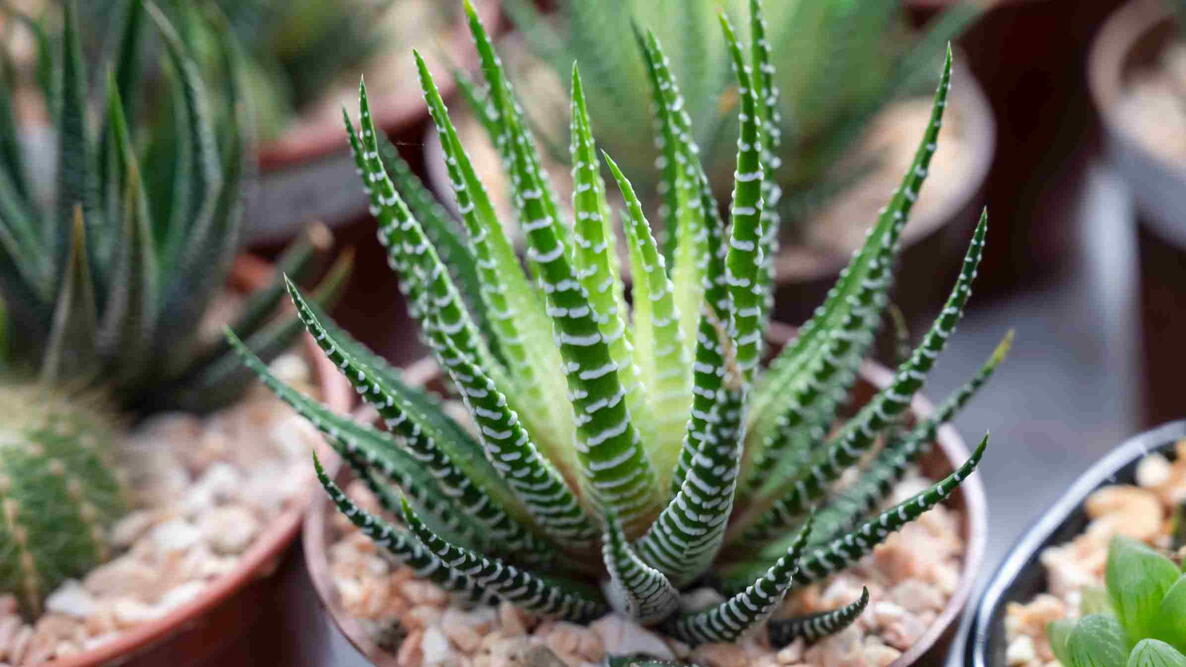
Caption
Mini striped succulent bringing life to your home décor.

Zebras can’t change their stripes, but who’d want to change the flashy patterns on zebra plants anyway? Haworthia succulents are easy-care plants that look like mini aloes, but they’re pet-safe and come in fun shapes and leaf patterns. Whether in pots, dish gardens, or outdoor xeriscapes, the right haworthia care—watering, light, and soil tips—will keep them healthy and thriving. Here are the basics, plus insider tips I’ve learned from years of growing these plants at home!
About Haworthia Plants
Also known as the zebra cactus, star window plant, pearl plant, or cushion aloe, haworthia belongs to the Asphodelaceae family, which includes other popular succulents like gasteria and aloes. There are currently over 100 recognized haworthia varieties, which vary mostly in the size and shape of their fleshy leaves. Some types display white dots or banding, while others have translucent “window” leaves that catch the light beautifully.
In the wild, haworthia grow in dry regions of southern Africa, often under the shade of bushes and rocky outcrops. As houseplants and garden plants, they tolerate sun and dry soil but generally grow best in light afternoon shade. Too much direct sun can damage their delicate leaves!
Although related to aloes, haworthia succulents are nontoxic to pets and usually stay smaller. Some varieties grow up to 20 inches tall, but most stay under 6 inches. I like to grow haworthia singly in small, unglazed terracotta pots indoors. Outdoors, in frost-free areas, haworthia can thrive year-round in rock gardens and xeriscapes.

Types
Haworthia range in shape, size, and color, but they all have the same basic care needs. Here are just a few of the more common haworthia varieties you may spot at your local nursery!
- ‘Striata’ is one of the easiest to find types of haworthia and is easily recognized by its spiky, zebra-striped leaves.
- ‘Cathedral Window’ features semi-translucent leaves, making this plant doubly efficient at photosynthesis.

- ‘Horse’s Teeth’ is a funky-looking haworthia with broad, flat leaves arranged in a fan-like form.

Potting and Repotting

How Often to Repot
Slow-growing haworthia rarely need repotting and should only be repotted every 3 to 5 years if the plants appear to need it. Signs include offsets crowding the container, the plant being rootbound, or the soil breaking down. Always use a well-draining succulent or cactus mix and a slightly larger pot.
When to Repot
You’ll know it’s time to repot haworthia if the plant’s roots are showing through the pot’s drainage holes or the plant has produced so many offsets that it looks crowded. Although you can repot indoor haworthia at any time, repotting in spring and summer usually yields the best results.
How to Repot
- Select a quality pot: Use a well-draining container that’s only slightly larger than your plant’s existing pot. If your plant hasn’t outgrown its old pot, you can reuse it!
- Repot when dry: Remove your haworthia from its old pot when the plant’s soil is good and dry.
- Plant at the proper depth: Using a succulent potting mix, repot the plant at the same depth it was growing in its old container and water deeply.
Propagation
Haworthia can technically be propagated from seeds, the easiest and most reliable method is by separating offsets, or “pups,” from the parent plant. Offsets are also faster.
- Separate the pups: Baby haworthia or “pups” can be separated from the parent plant at any size. Just use a sharp, sterilized knife to cut the base of the pup free from the parent plant.
- Let dry: Place the pup in a warm, dry spot for 1 to 2 days (to allow the cut stem to callus over).
- Repot: Plant the pup in a new container filled with succulent potting mix, locate the plant in bright, indirect light, and water often enough to keep the soil evenly moist. Once roots form, reduce watering and treat the pup just like the parent plant.


More Like This

Comments