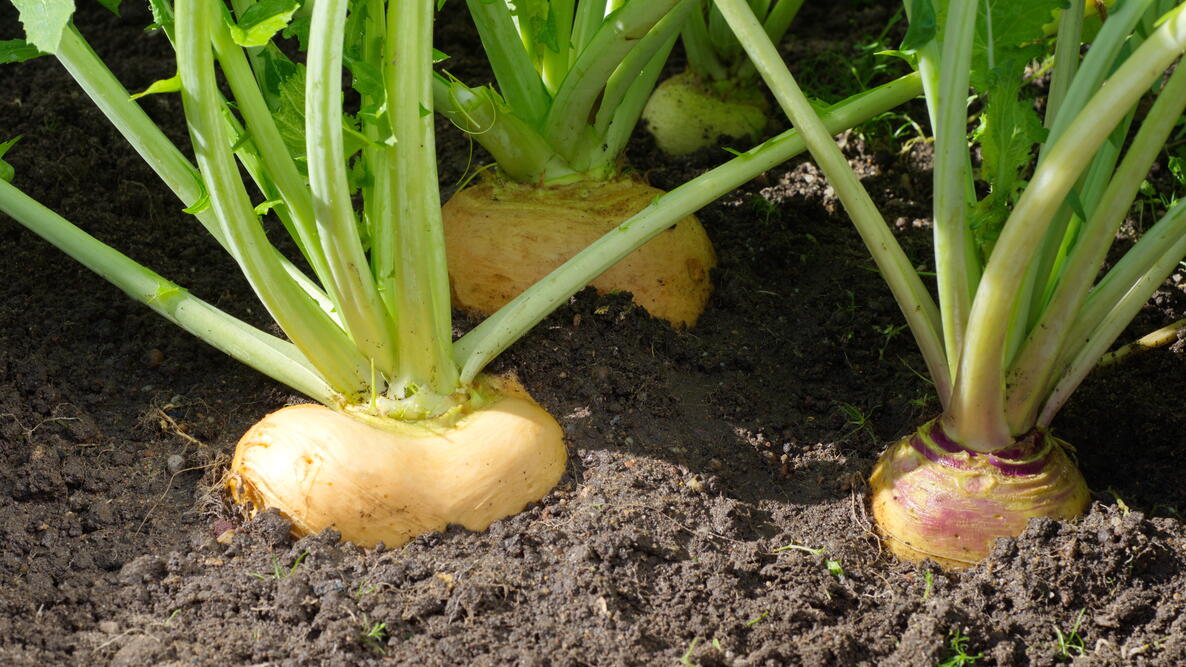
Caption
Turnips are a cool-weather root vegetable that germinate in only a few days.

Types
Many turnips are grown not for the root itself but for the turnip greens, which can be cooked or used raw in salads. Younger turnip greens will not be as bitter as mature leaves. If you are growing turnips primarily for their greens, almost any turnip variety will do.
For roots, try these …
- ‘Gold Ball’: yellow skin, soft, yellow flesh; harvest at 3 inches in diameter for maximum sweetness (will grow to 4 to 5 inches)
- ‘Just Right’: pure white roots, delicious greens; extremely cold-tolerant; stores well; not recommended for a spring crop, as it tends to bolt early
- ‘Purple Top White Globe’: delectable leaves; great for an extended production of greens; roots have purple shoulders; heirloom
- ‘Golden Globe’: roots with amber skin; firm, crisp, sweet flesh; tasty tops.

More Like This

That's a bit complicated. According to some traditions, if you will be harvesting turnip roots, a belowground crop, you would want to plant when the Moon is waning (between full and new), especially between full and last quarter Moons. But, if you are interested in harvesting turnip greens, which are an aboveground crop, you would want to plant when the Moon is waxing (between new and full), especially between new and first quarter Moons. Hope this helps!
Thanks, Peggy. Yes, if you plan to freeze turnips: Wash, peel and cut into 1/2-inch cubes. Water blanch for 2 minutes. Cool promptly in cold water and drain. Pack into containers, leaving 1/2-inch headspace. Seal and freeze.
Hi Dave, We're sorry to hear this. Turnips have problems in excessive heat and compact osil but sounds like neither were an issue. We wonder if your compost-heavy soil had too much nitrogen. Lots of nitrogen will result in plenty of leafy growth but poor root growth. We would add some more phosphorus, like bone meal, to the soil if you try again.
Turnips do taste better when they're an autumn crop. They're also sweeter when young and tender. They taste more like a potato when older.
For sweeter turnips, plant in late summer or early fall and leave them in the ground beyond a light frost and they'll taste even sweeter.
Also, raw turnips can have a bitter taste if consumed raw (for some folks) but they'll smell and taste sweet upon cooking them properly, much like beets (but less earthy).
- « Previous
- 1
- 2
- …
- 10
- Next »

Comments