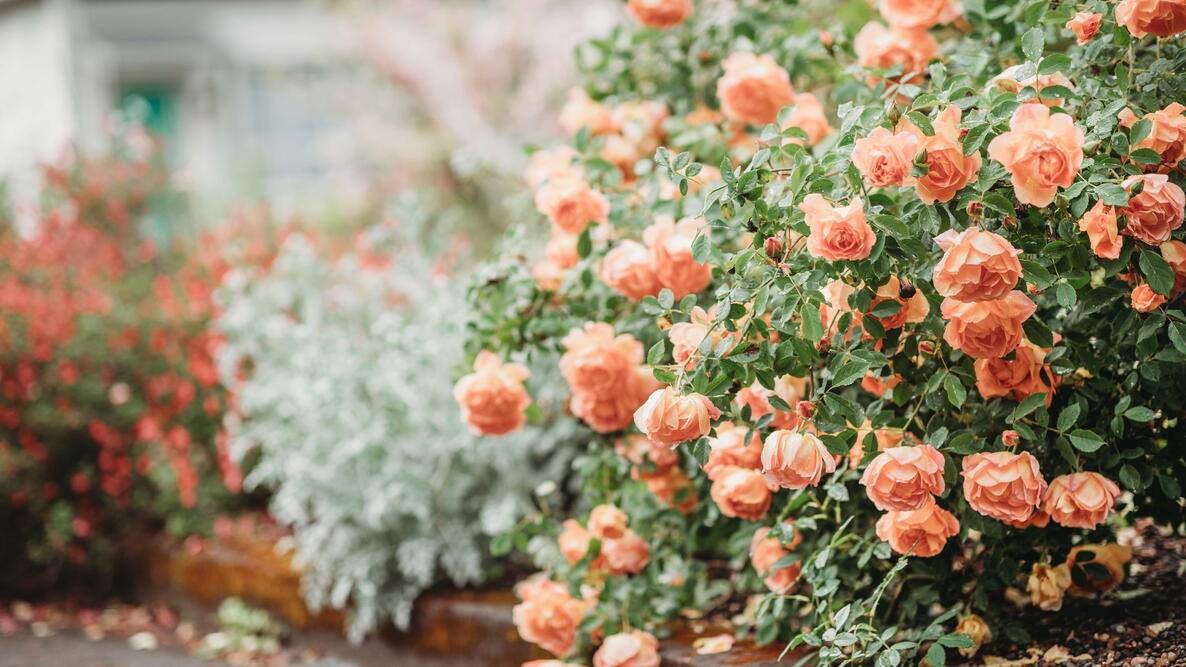

Roses (Rosa spp.) are popular garden shrubs, and with the right conditions, they are easier to grow than many gardeners expect. Understanding a few basic growing needs—such as space, sunlight, and blooming habits—can make a big difference in how well your roses perform.
What Roses Need to Grow Well
Space and Mature Size
Roses vary in size, so it’s important to know how large a plant will be at maturity. Some roses stay compact at under 3 feet tall, while others grow much larger and need more room.
Giving roses enough space improves air circulation, reduces disease problems, and helps plants bloom more reliably.
Sunlight
Most roses grow best with at least 6 hours of direct sunlight each day. More sun generally means stronger growth and better flowering.
Some roses tolerate partial shade, but flowering may be lighter in less sun.
Blooming Habits
Roses differ in how often they bloom. Some flower once per season, while others bloom repeatedly from spring through fall.
For continuous color, look for roses labeled repeat-blooming or continuous bloom.

While roses vary in size and bloom habits, most garden roses share the same basic growing needs, making them easier to care for than many gardeners expect.
Types
Roses can feel overwhelming when you’re new to them. No need to learn the whole rose universe right away—or start with the fussy types. Let’s begin with sturdy, low‑maintenance roses that give you the best chance of success.
Botanically, roses fall into three broad groups (species, old garden, and modern), but beginners will find it most helpful to choose by growth habit: shrubs, climbers, hybrid teas, or miniatures.
Choosing Your First Rose
If you’re new to roses, start with a shrub rose. They’re the toughest, most low‑maintenance roses you can grow.
Shrub Roses (Rose Bushes)
Shrub roses form rounded, bushy plants and are the most reliable, low‑maintenance roses for new gardeners. They bloom generously, resist disease, and need very little pruning.
Examples:
- Knock Out Roses — continuous bloom, excellent disease resistance; hardy in Zones 5–10
- Flower Carpet Roses — groundcover style, nonstop flowers; hardy in Zones 4–10
- Rugosa Roses — incredibly hardy, fragrant, and tough; many varieties (like ‘Jens Munk’) hardy to Zone 2
If you’re just starting out, shrub roses are your safest, easiest choice. See 3 easy roses for beginners!

Climbing Roses
Climbers send out long canes that need support from a trellis, fence, or arbor. They’re stunning but require training and a bit more attention, so many beginners add them after they’ve grown a shrub rose or two.
Examples:
- ‘Gertrude Jekyll’ (David Austin) — repeat‑blooming, fragrant; hardy in Zones 4–11
- ‘New Dawn’ — hardy, forgiving, blush‑pink; Zones 5–9
- ‘Don Juan’ — deep red, sweet fragrance; Zones 6–9
- ‘Iceberg’ — white, heat‑tolerant, disease‑resistant; Zones 4–9
Hybrid Tea Roses
These are the classic long‑stemmed roses you see in bouquets. They produce beautiful, elegant blooms — and they’re also the fussiest. Hybrid teas often need more pruning, feeding, and disease prevention, so they’re usually not a beginner’s first rose.
Examples:
- ‘Pink Peace’ — large, fragrant blooms; hardy in Zones 5–10
- ‘Sunsprite’ (‘KORresia’) — compact yellow floribunda; fragrant and disease‑resistant; Zones 5–9
Miniature Roses
Small, compact roses that stay tidy in containers or small gardens. They bloom repeatedly and are surprisingly tough, but need extra care if grown in pots. Most varieties fall within Zones 5–9.
See also our list of disease-resistant rose varieties.

More Like This



Hi, Peggy,
Rose Rosette Disease (RRD) is caused by the rose rosette virus (RRV), which attacks only roses. It is transmitted by grafting (not via sap) or by microscopic eriophyid mites, especially Phyllocoptes fructiphilus. The mites do not crawl far, but can be blown to other roses or carried on tools, clothing, or other materials. They tend to gather near buds, flowers, base of shoots or leaf stems, and leaf scars, including over winter.
All cultivated roses are considered susceptible. Studies are being done to determine if there are resistant rose cultivars/species. At this time, there is no known cure.
Symptoms include witches' brooms, thickened/elongated stems, many thorns, enlarged canes, distorted leaves or flowers, reddish leaves.
Symptoms may appear months after infection. The virus may survive in the roots (not the soil), and the mites may be on parts of the plant that do not currently show symptoms. Control ultimately is to remove a symptomatic rose, including the roots/rootball. Also keep up with deadheading spent blossoms, as mites tend to gather around there. Always be sure to clean up all plant debris and place in the trash (not compost pile). Avoid using leaf blowers around roses, as they can blow mites onto the plants. Prune symptomatic branches; if after pruning, new growth also shows signs of disease, it is best to remove the entire plant, including rootball. Also prune heavily in late winter/early spring, when the plant is dormant, and then apply dormant oil. Remove wild roses (such as Rosa multiflora) that are nearby, as they are a common host to the disease. A monthly treatment of horticultural oil (except in hot weather) can help. Avoid overcrowding planting sites; mixing roses with other plants can help minimize the spread of the disease. Make sure to keep plants healthy and unstressed, so that they can best fight the disease. If a rose is removed, wait at least 1 to 2 months before planting a new one in the same spot. Inspect plants often to check for symptoms.
Hope this helps!
The best time to move a rose bush is during the dormant season in early spring after the threat of frost is over. Cut the rose canes back to 10 to 12 inches and remove any foliage so the plant can focus on root development after transplanting. Choose a new place with good drainage. Dig your hole. Remove the rose by digging far enough away from the root ball so you don’t damage the roots. Take as many of the roots with you as possible and gently transfer to the new hole. If it is too large to carry, place it on a tarp and drag it to its new home. Amend the soil. In a bucket or wheelbarrow, mix equal parts mulch, potting soil, and peat moss. Add half of this mixture to the hole around the roots. Water the soil well when the planting hole is half-filled and let the water settle. Adjust the rose as needed if the soil has caused it to sink a bit. Add the remaining soil mixture and water again. Water the new rose every day for a week or two depending on your weather. Do not fertilize or use any insecticides until you see new growth on the rose.
Major pruning and shaping should be done in the spring before new growth appears. In the fall, do minor pruning tasks such as pruning extra-long or dead canes.
Hi Martha, Thanks for your question. We certainly understand why you want to keep that bouquet of yellow roses looking beautiful for as long as possible. One thing you will want to do is give your roses fresh water after 4 or 5 days. Wash out the vase, rinse off the stems of any slimy residue, and give them a fresh cut at the bottom to allow for better water intake. You can also add more flower food if you have it. Another way to preserve your arrangement is to keep it cool at night—the refrigerator works great. Roses love cool, humid temperatures, so keep them away from direct heat or drafts, which will dry out your flowers.
- « Previous
- 1
- 2
- …
- 10
- Next »

Comments