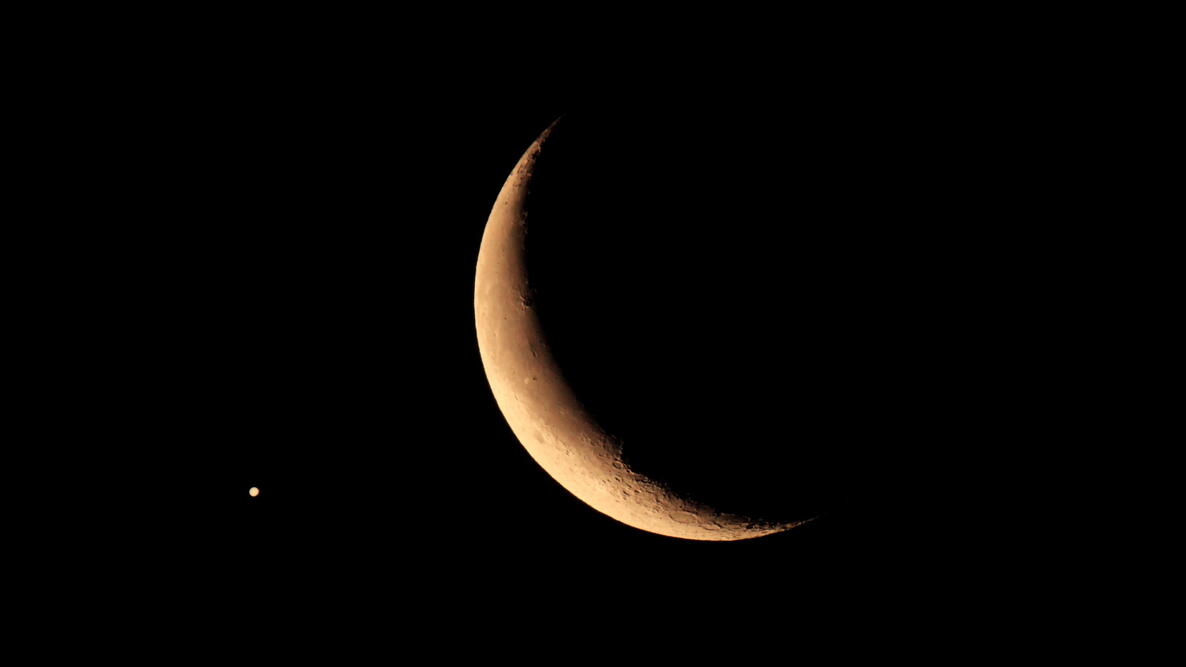
On October 6, mighty Jupiter will disappear behind the crescent Moon—and you can watch its dramatic return using nothing but your own two eyes.
Astronomers call this a lunar occultation of Jupiter—when the Moon passes in front of the giant planet and briefly hides it from view.
When and Where to Watch Jupiter Disappear
The Moon will rise in the east-northeast at around 2:30 A.M. local daylight time, with Jupiter shining near its sunlit side. As the “celestial dynamic duo” climbs higher, the Moon will appear to draw closer to the planet.
Skywatchers across the Eastern and Central U.S., parts of the Mountain West, and southern Canada can see at least part of the event.
How long Jupiter stays hidden depends on where you live. For some observers, the planet will remain hidden for about an hour; in other locations, the interval will be much shorter.
The exact timing varies by location. Find the city nearest you in the chart below to see when Jupiter will disappear and reappear. All times are in local daylight time.
| Location | When Jupiter disappears | When Jupiter reappears |
| Great Falls, MT | 2:50 A.M. | 2:57 A.M. |
| Rapid City, SD | 2:30 A.M. | 3:09 A.M. |
| Denver, CO | Not visible | 3:11 A.M. |
| Winnipeg, MB | 3:45 A.M. | 4:03 A.M. |
| Omaha, NE | 3:22 A.M. | 4:13 A.M. |
| Austin, TX | Not visible | 4:09 A.M. |
| Kansas City, MO | 3:19 A.M. | 4:14 A.M. |
| Chicago, IL | 3:22 A.M. | 4:17 A.M. |
| New Orleans, LA | 3:14 A.M. | 4:11 A.M. |
| Atlanta, GA | 4:15 A.M. | 5:16 A.M. |
| Miami, FL | 4:20 A.M. | 5:09 A.M. |
| Washington, DC | 4:20 A.M. | 5:24 A.M. |
| New York, NY | 4:23 A.M. | 5:27 A.M. |
| Boston, MA | 4:26 A.M. | 5:29 A.M. |
| Montreal, QC | 4:30 A.M. | 5:25 A.M. |
- If you’re in a location such as Denver or Austin, Jupiter will disappear before the Moon rises, but you can still watch the planet reappear.
- If you’re in Washington, Oregon, California, Idaho, Nevada, most of Arizona, and parts of western Montana and Utah, the occultation will happen before the Moon and Jupiter rise. Instead, look for lustrous Jupiter hovering just above the narrow crescent Moon as the pair comes into view above the east-northeast horizon—a memorable sight in its own right.
Want to know exactly when the Moon rises where you live? Check our Moonrise and Moonset Calculator.
Where to Look for Jupiter and the Moon
The farther west you are, the lower the Moon and Jupiter will appear in the sky. Make sure you have a clear view toward the east-northeast horizon.
You don’t need any fancy tools to figure this out. All you need is your own two hands. A clenched fist held at arm’s length measures about 10 degrees, and that’ll be your measuring device.
- Eastern U.S.: Look about 2 to 3 fists above the east-northeast horizon.
- Central U.S.: Look about 1 to 2 fists above the horizon.
- Rocky Mountain states where the event is visible: Look about 1 fist or less above the horizon.
Especially in the Mountain region, find a viewing spot ahead of time with no trees, buildings, or other obstructions blocking your view.
What You’ll See in the Night Sky
First, watch Jupiter draw closer to the edge of the bright crescent Moon and slowly slip behind it. Unlike a star, which would vanish almost instantly, Jupiter appears as a small disk in the sky and can take up to a minute to disappear completely.

Then comes the most dramatic moment: Jupiter begins to emerge from behind the Moon’s dark edge. The planet will emerge like a brightening jewel—a sight you can easily see with your own eyes.
Jupiter is bright enough to see easily without a telescope. If you do have one, though, it can make the experience even more immersive, letting you watch the precise moments Jupiter disappears behind the Moon and reappears on the other side.
The crescent Moon will also be especially eye-catching. Look up to see a thin arc of yellowish-white light surrounding a ghostly bluish-gray disk. That faint glow, known as Earthshine, helps create a beautiful sight called “the new moon in the old moon’s arms.”
And consider what you’re really watching: Our nearby Moon will completely hide giant Jupiter, an enormous planet far beyond it. For a few remarkable moments, the immense scale and depth of our solar system become something you can actually see.
Bonus: Jupiter’s Moons Join the Show
For folks who do have a small telescope, look for some of Jupiter’s bright moons nearby. You may be able to follow all four—Europa, Callisto, Io, and Ganymede—as they disappear behind our Moon and emerge again one by one.
The sequence begins several minutes before Jupiter itself disappears: Europa goes first, followed by Callisto and Io. Ganymede hangs on a little longer, disappearing shortly after Jupiter. Their return from behind the Moon’s dark edge should be especially striking.
It’s an extra layer to the show: Jupiter disappears, and its moons disappear and return one by one around the main event.
How Often Does This Happen?
A visible occultation of Jupiter happens at any one location only about once every 13 years on average—although the wait can be much shorter or much longer.
- New York City is a striking example: Before its favorable Jupiter occultation in 2004, the previous one occurred way back in 1889!
- The next good dark-sky Jupiter occultation will be visible from the western half of North America on September 28, 2034. Another will cross much of the continent on November 27, 2037, the morning after Thanksgiving.
So if this year’s event is visible where you live, it’s worth stepping outside to see it for yourself. Enjoy the show—and clear skies!
FAQ
What is a lunar occultation?
In astronomy, a lunar occultation is the term for when the Moon passes in front of a star or planet, temporarily hiding it. The word occultation comes from the Latin word “occultare,” which means “to conceal.”
How long will it take for Jupiter to disappear behind the Moon?
Unlike a star, which can vanish almost instantly, Jupiter appears as a small disk in the sky. It can take up to about a minute for the Moon to cover the planet completely.
Can I see this where I live?
If you live in much of the U.S. or southern Canada, yes—you can see at least part of the event this year. The best views of Jupiter disappearing and reappearing are across the eastern and central regions. Farther west, the occultation happens before moonrise, but you can still see Jupiter and the crescent Moon together in the early-morning sky.
Do I need a telescope to see Jupiter disappear?
No. Jupiter is bright enough to see the event without binoculars or a telescope. A telescope can make the experience even more immersive by making the precise moments Jupiter disappears and reappears easier to follow.
Sources
- Astronomy Club of Asheville — Pre-Dawn Lunar Occultation of Jupiter

More Like This



Comments