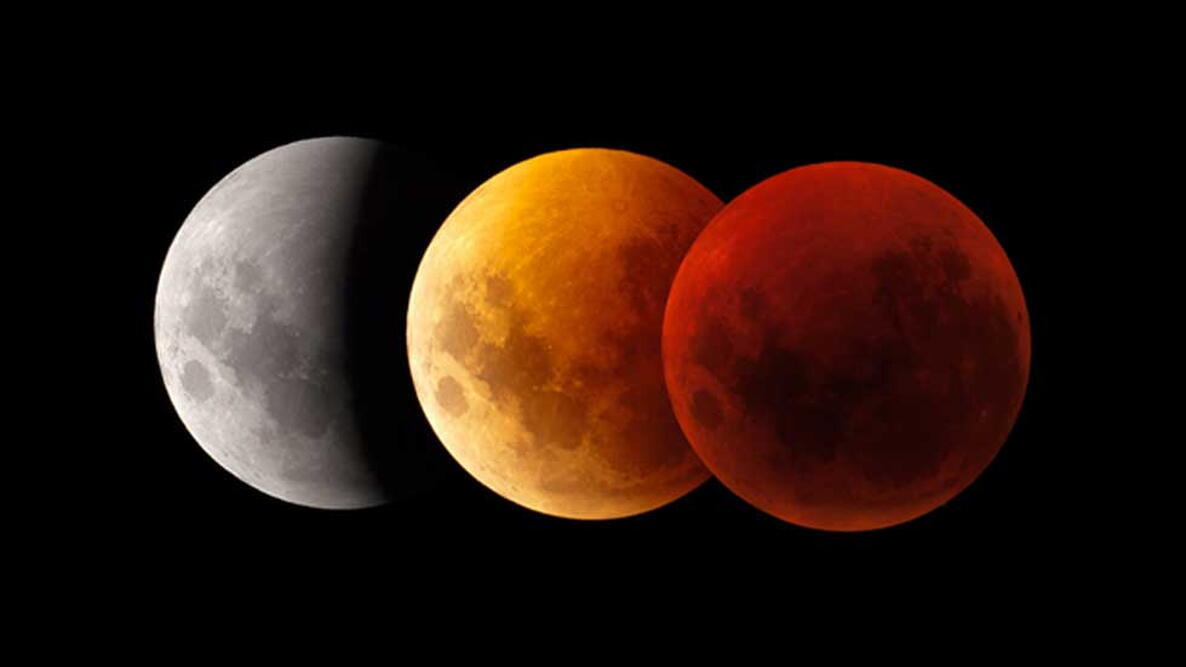
Caption
A sequence showing how the Moon changes color as it passes through Earth’s shadow during a total lunar eclipse.
A major total lunar eclipse will take place on March 3, 2026, and will be visible across much of North America. During this event, the Full Moon will slowly darken and change color, creating one of the most beautiful—and easiest to watch—sky shows of the year.
A total lunar eclipse unfolds gradually over several hours. The most noticeable changes happen near the middle of the event, when the Moon passes fully into Earth’s shadow and takes on its deepest coppery-red hues. No special equipment is needed to enjoy it.
What You’ll See During a Total Lunar Eclipse
A total lunar eclipse happens when Earth moves directly between the Sun and the Moon, causing Earth’s shadow to completely cover the Moon. When this occurs, the Moon often takes on a reddish or coppery glow that can be seen for hours.
Unlike a solar eclipse, which requires eye protection and careful viewing, a total lunar eclipse is safe to watch with the naked eye. If the Moon is above the horizon where you live, you can see it.
For exact times and visibility where you live, see our complete eclipse calendar.
Why the Moon Turns Red During a Total Lunar Eclipse
Even though Earth blocks direct sunlight during a total lunar eclipse, some light still reaches the Moon. That’s because sunlight bends as it passes through Earth’s atmosphere.

Earth’s air scatters blue light and allows red light to pass through more easily. This filtered red light is what gives the eclipsed Moon its familiar rusty or brick-red color. Because of this effect, a total lunar eclipse is sometimes called a blood moon.
The Moon’s color can vary from one eclipse to another, depending on conditions in Earth’s atmosphere, such as dust, smoke, or volcanic ash.
Types of Lunar Eclipses
There are three kinds of lunar eclipses, depending on how much of the Moon enters Earth’s shadow:
Total Lunar Eclipse
The Moon passes entirely into Earth’s umbra and often appears red.
Partial Lunar Eclipse
Only part of the Moon enters the umbra, creating a noticeable dark shadow.
Penumbral Lunar Eclipse
The Moon passes through the lighter penumbral shadow, causing a subtle dimming that can be easy to miss.

How Often Do Total Lunar Eclipses Occur?
Total lunar eclipses usually happen about once every year or two, though some years may have none at all. They are more common—and easier to see—than total solar eclipses.
Can Everyone See a Total Lunar Eclipse?
A total lunar eclipse can be seen from anywhere on Earth where the Moon is above the horizon during the event. Because the eclipse lasts for several hours, many regions have a chance to see at least part of it.
No special eye protection is needed to enjoy a lunar eclipse.
When Is the Next Total Lunar Eclipse?
Total lunar eclipses occur at different times of year and are visible from different parts of the world. For example, a major total lunar eclipse will occur in March 2026 and will be visible across much of North America.
For the latest dates, times, and visibility information, visit our complete eclipse calendar.
Total Lunar Eclipse FAQs
Is a total lunar eclipse the same as a blood moon?
A blood moon is a popular name for the reddish Moon that appears during a total lunar eclipse.
Is it safe to look at a lunar eclipse?
Yes. Lunar eclipses are completely safe to watch with the naked eye.
How long does a total lunar eclipse last?
The total phase can last up to about an hour, while the entire eclipse may last several hours from start to finish.
Why don’t all lunar eclipses look the same?
The Moon’s brightness and color depend on Earth’s atmospheric conditions at the time of the eclipse.
What’s the difference between a lunar eclipse and a solar eclipse?
A lunar eclipse happens when Earth’s shadow falls on the Moon. A solar eclipse occurs when the Moon passes in front of the Sun.

More Like This



Comments