
Learn how to grow onions from seed or sets with our complete guide

Read Next
Planting
Onions need to grow in full sun and in a spot where they won’t be shaded by other vegetables. The more energy they can get from sunlight, the larger their bulbs can grow. Soil must be well-draining and loose—sandy-loam to silt-loam, not heavy clay or compact. Mix aged manure or compost into the soil in the fall or early spring to improve texture. Soil pH should be between 6.9 and 6.8. Have your soil tested. Onions don’t grow in high-acid soils.
When to Plant Onions
- Plant onion sets (dormant bulbs) that can be planted directly into the ground in early spring, as soon as the ground can be worked and the danger of hard freezes has passed. This is typically around 2 to 4 weeks before your last expected spring frost date.
- Start onion seeds indoors: 8 to 10 weeks before your area’s last spring frost date, which typically means planting them in late winter. Some gardeners will start even earlier to grow seeds to roughly the same bulb size. Check out our tips for growing onions from seed.
- Transplant seedlings or plant starters outside in early spring when the soil is workable, about 2 to 4 weeks before the last spring frost. Onions require soil at least 50°F to germinate, so they should be started indoors about 6 weeks before transplanting to the garden and no longer likely to dip below 28°F (-2°C). This means snow has melted, the days are warmer, and nights are still near freezing. For us in the northern zones, we’re talking April or early May.
- A fall-planted crop of onions needs at least 4 to 6 weeks of warm temperatures to become established in the ground. They will remain dormant during the cool season; as the temperatures and soil warm again in early spring, the onions return to life.
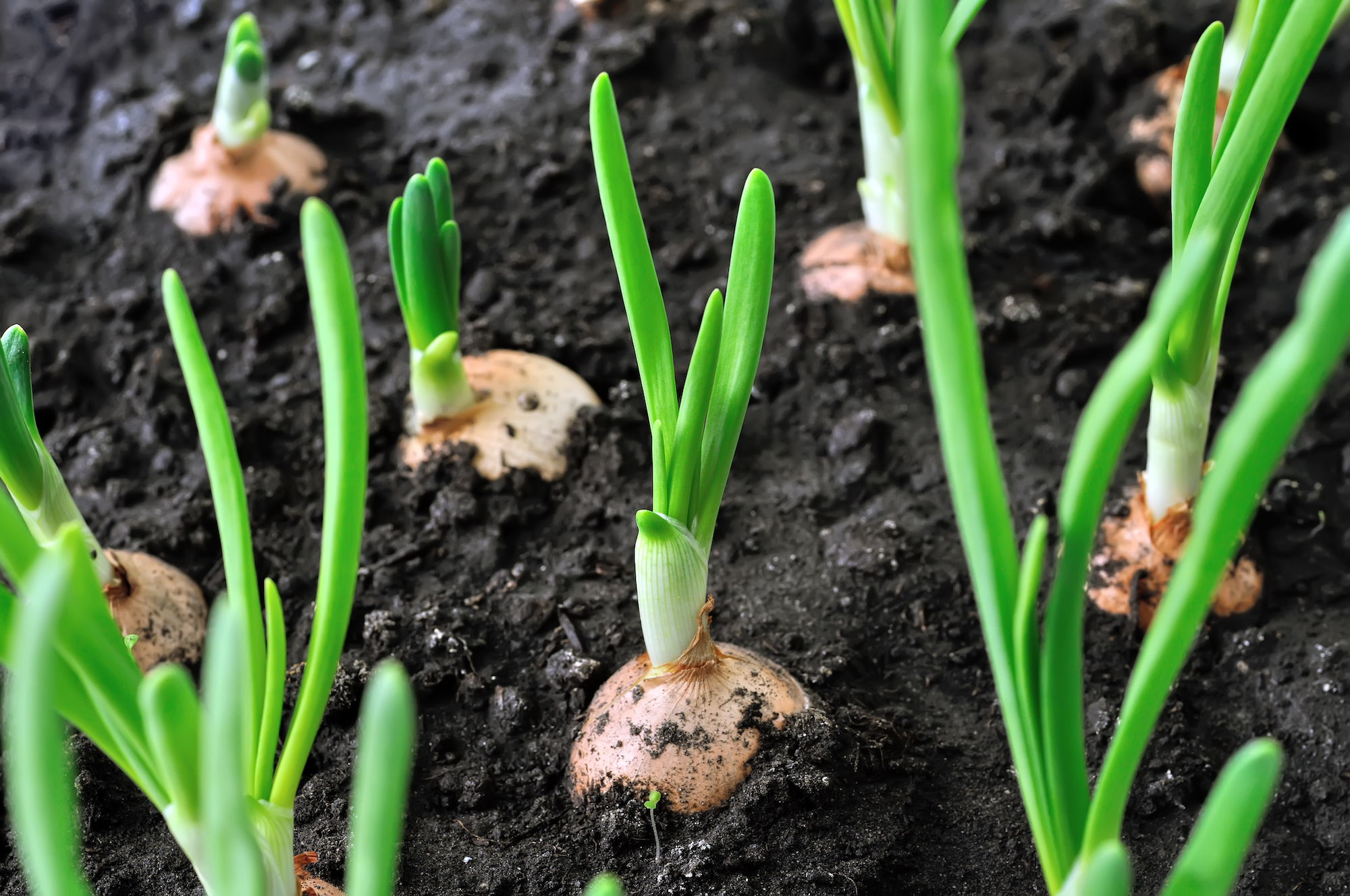
How to Plant Onions Indoors
Whether you’re planting seeds or sets, get a shallow tray and fill it with compost to the top. Modular trays with a small section for each bulb are ideal.
- Plant seeds 1/4 to 1/2 inch deep, or plant the onion bulbs so that the pointy end is just peeking over the top of the soil.
- Lightly water the tray and let it drain through.
- Set onions in a warm place, such as a well-lit windowsill.
- Thin to 3 to 4 inches.
How to Plant Onions Outdoors
Onion plants are heavy feeders and require constant nourishment to produce big bulbs. At planting time, add nitrogen fertilizer. Many organic gardeners will add an inch of compost to the bottom of each row before planting. Or, dig a trench in the soil about 2 inches deep and 3 inches wide, and then fill the trench back in with about an inch of compost.
- If planting onion sets outdoors, bury them 2 to 6 inches apart, gently pressing them 1 to 2 inches deep into loose soil. (Use the closer spacing if you want to pull immature onions as scallions.) Don’t bury them more than 2 inches under the soil. Onions mustn’t be planted too deep, as this can affect bulb development.
- If you are direct seeding outdoors, sow seeds 1/4 to 1/2 inch deep once the soil is workable.
- Once onions begin to grow, thin them to 3 to 4 inches apart. Plants thinned from the row to create room can be used as green onions. Space the seedlings in rows 12 to 18 inches apart.
- If you are transplanting from indoors, don’t forget to harden off the young plants for at least a week.
- Mulch with straw between rows to help retain moisture and stifle weeds.
Types
Onion varieties are categorized based on whether they’re “long-day,” “short-day,” or “day-neutral” varieties. This is because they are “photoperiodic,” meaning that they grow in response to day length—the number of daylight hours needed to trigger bulb formation.
Short-day onions grow best in the southern United States, between 25° and 35° north latitude. Start bulbs when day length reaches 10 to 12 hours. The earlier short-day onions are planted, the larger they get. In the South, onions can be planted in the fall and overwintered. Since they continue to grow throughout the winter, they will be ready for harvest in the spring.
Intermediate, or day-neutral, onions are best suited to the middle tier of U.S. states, approximately between the 32° and 42° latitudes. Start bulbs when day length reaches 12 to 14 hours.
Long-day onions grow best in the northern states, between latitudes 37° and 47°. Start bulbs when day length reaches 14 to 16 hours.
Do not try to fool Mother Nature: Short-day onions planted in a long-day zone will result in small bulbs—not an early harvest.
Long-day varieties:
- ‘Yellow Sweet Spanish’: large, round shape; yellow-white.
- ‘First Edition’: high-yielding, stores well, flavorful, creamy-yellow
- ‘Red Wethersfield’: flat bulbs that store well, white flesh, red-skinned
- ‘Aisa Craig’, ‘Walla Walla’: huge bulbs
- ‘Buffalo’, ‘Norstar’: produce early but keep only until late December
- ‘Copra’, ‘Southport Red Globe’, ‘Sweet Sandwich’, ‘Yellow Globe’: keep well
- ‘Red Florence’: heirloom; 4- to 6-inch-long, dark purple-red, torpedo shape; mild, sweet
- ‘Ailsa Craig’: heirloom; named for a Scottish island; large, up to 8 inches in diameter; average 2 pounds; pale yellow skin, globe shape; mild, sweet
- ‘Gold Coin’: cipollini; 1-1/2- to 3-inch yellow flattened bulb; pungent flavor sweetens when cooked
Short-day varieties:
- ‘Stuttgarter’: sold in sets, early maturity with a slightly flat shape, yellow
- ‘White Bermuda’: extremely mild, with thick, flat bulbs; white
- ‘Red Burgundy’: good table onion with mild, sweet white inside; short-term keeper
- ‘Crystal Wax White Bermuda’: a great onion for pickling when harvested at pearl size
- ‘Hybrid Yellow Granex’: sweet, Vidalia type
- ‘Red Creole’: heirloom; 3- to 4-inch, dark red globe shape; pungent
- ‘Southern Belle’: ruby color throughout
- ‘Texas 1015-Y Supersweet’: stores well
- ‘Yellow Granex’: Vidalia type; 3- to 4-inch, yellow, flattened globe shape; crisp; said to be the sweetest of the super sweet
Day-neutral or intermediate varieties:
- ‘Candy’: golden, thick-flesh, jumbo bulbs; stores well
- ‘Red Stockton’: large, red-ringed, white-flesh bulbs
- ‘Super Star’: large, sweet, white bulbs
- ‘Purplette’: mini onion, at 1-1/2 inches; glossy, burgundy red when raw; pastel pink when cooked or pickled; mild, sweet
- ‘Southport Yellow Globe’: early; 2-1/2- to 3-1/2-inch thick-skin yellow globe; mild, sweet
Harvesting
Pull any onions that send up flower stalks. This means that the bulbs have stopped growing. These onions will not store well, but can be used in recipes within a few days.
- Spring-planted onions tend to be ready for harvesting by mid-summer.
- When onions start to mature, the tops (foliage) become yellow and begin to fall over. At that point, bend the tops down or even stomp on the foliage to speed up the final ripening process.
- Loosen the soil around the bulbs to encourage drying.
- Harvest by late summer in dry weather. (Wet-harvested onions do not cure well and might rot in storage.)
- When the tops are brown, pull the onions. Handle them carefully, as the slightest bruise (now and in storage) will encourage rot.
- Cut the roots and trim the tops back to 1 or 2 inches (but leave the tops on if you are planning to braid the onions together).
Onion’s skin very thin,
Mild winter coming in;
Onion’s skin thick and tough,
Coming winter cold and rough.
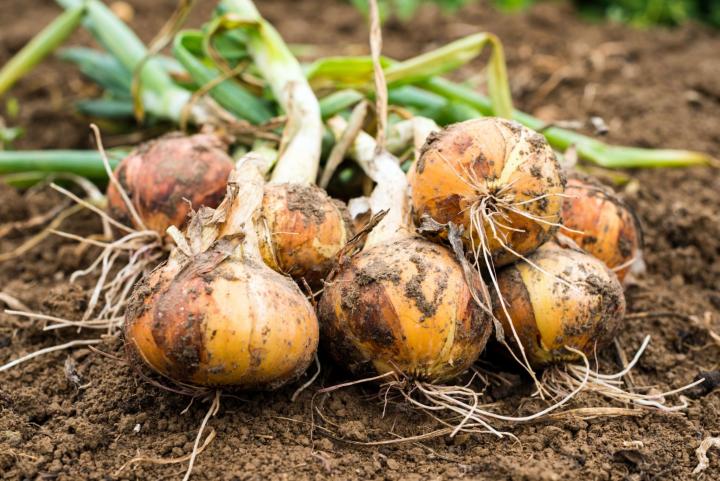
How to Store Onions
- Set onions on dry ground for a few days to cure, weather permitting, or in a protected place such as a garage or barn.
- Once cured, hang onions in a mesh bag or nylon stocking; spread up to two layers deep in a box; or braid and hang them in a cool, dry, well-ventilated area. The ideal temperature range for storage is 40 to 60°F (4 to 15°C). Do not store in a refrigerator, as conditions will be too damp.
- Check periodically for sprouting or rotting onions and remove them.
- Don’t store onions with apples or pears, as the ethylene gas produced by the fruits will interrupt the onions’ dormancy. Onions may also spoil the flavor of these fruits (as well as potatoes).
- A pungent onion will store longer than a sweet onion. Sweet onions have a high water content and do not keep well. Eat the sweet varieties first and save the more pungent onions for later.
- To avoid bruising, store them so that they do not touch each other—for example, in clean old pantyhose. Slip in the onions one at a time, tying a knot between each one. Hang them in a cool, dry place.
- You can also braid your onions for extended storage. Learn to braid onions!
Check out this video to learn how to harvest and store onions.
Gardening Products
Cooking Notes
To make onions taste milder, soak them in milk or pour boiling water over the slices and let them stand for 20 minutes. Rinse with cold water.
Chopping onions can sometimes look daunting: There’s the skin and the layers… Where to begin? Check out our tips for chopping onions in four easy steps. Onion skins actually have several health benefits, too, so don’t throw them out!
Check out more tips on using onions in the kitchen and cooking them correctly.
More Like This


Comments

The usual reason for split bulbs is moisture stress, such as dry soil or waterlogged soil, especially when bulbs begin to form and enlarge. Even moisture is very important; Keep onions evenly moist, but not waterlogged, throughout the growing season.
The Old Farmer's Almanac is a North American publication addressing needs of North American readers. We suggest you speak to gardening experts in India who understand your climate and conditions!
The bulbs are probably small. You can eat them now or let them keep growing as long as the tops are green. It will just take longer. You may be harvesting in August. Onions send out a leaf for each layer on the bulb. If some of the leaves fall over, it will send out more. No worries.
- « Previous
- 1
- 2
- …
- 10
- Next »

It depends on the variety and your climate, but the "days to maturity" are generally 100 to 120 days for mature bulbs.