No more logic supports seven days than, say, eight or five, yet the seven-day week has resisted any and all attempts at change.
Unlike the year and the month, which correspond to the movements of the Earth around the Sun and the Moon around the Earth, the week has no astronomical analog. Seven days is roughly the same length as a phase of the Moon (seven days, nine hours), but any system of timekeeping quickly falls apart due to the extra hours piling up.
Officially adopted by Emperor Constantine in A.D. 321, the seven-day week actually goes back thousands of years.
Ancient Origins of the Seven-Day Week
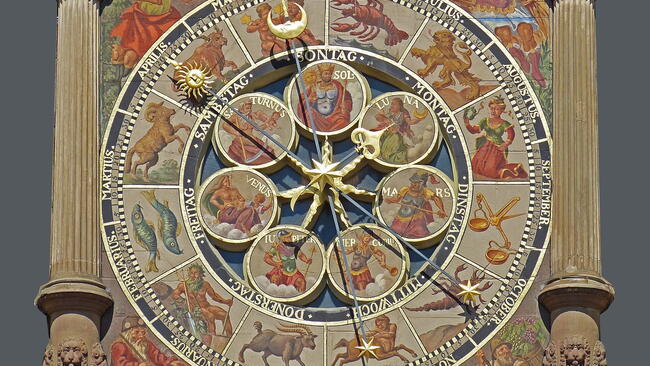
The seven-day week started with the first civilizations of the Middle East. Mesopotamian astrologers designated one day for each of the seven most prominent objects in the sky—the Sun, the Moon, and the five major planets visible to the naked eye.
The Jews also adopted a seven-day cycle, based on the time it took the Lord to create the universe as reported in Genesis. A new wrinkle in their week was the Sabbath, a day set aside for rest. This was the first time a culture had invented a holiday that occurred on a regular basis, unrelated to natural phenomena.
Other Week Lengths Throughout History
Not everyone embraced seven days.
The Romans adopted different weeks for business reasons; they thought of a week as the eight days between market days.
West African societies preferred a four-day market cycle.
In Assyria, six days was the rule; in Egypt, ten; in China, fifteen.
The ancient Germans used a five-day cycle named for their primary gods, which is how our week ended up honoring Norse deities like Tiw (Tuesday), Odin (Wednesday), Thor (Thursday), and Frigga (Friday). Our word “week” may come from the Old Norse word vikja, meaning to turn. Sunday and Monday, of course, honor the Sun and the Moon.
Learn more about how the days of the week were named.
Attempts to Change the Week
Atheistic revolutionaries tried, unsuccessfully, to get rid of the seven-day week.
In 1793, the leaders of the French Revolution produced a new calendar divided into three ten-day “decades.” It never caught on, and Napoleon abandoned it in 1805.
In 1929, the Soviet Union tried a five-day work week with one day of rest. Instead of the traditional day names, the days were given colors: yellow, orange, red, purple, and green.
In order to keep mass production going, each Soviet citizen was assigned a different day of rest, so that a husband might have a yellow day off while his wife took her leisure on green.
Due to mass confusion, the plan was revised in 1932 to a six-day week, with numbers replacing the colors.
By 1940, the Russians were back on the familiar seven-day cycle.
Calendar Reform Proposals
Somebody was always trying to come up with something better.
In 1936, the League of Nations solicited proposals for world calendar reform and considered almost 200 different schemes, many of which rearranged the week.
Edward Skille of Drummond, Wisconsin, suggested a year consisting of seventy-three five-day weeks called “metos.” The days of the week would be called Ano, Beno, Ceno, Deno, and Eno.
Why Has the Seven-Day Week Survived?
Why the seven-day week?
It doesn’t divide evenly into 365- or 366-day years, so holidays fall on different days of the week from year to year. But human beings are not logical creatures.
Who can imagine saying, “What are you doing next purple?” or “Yeah, it’s Eno!”
As one member of the British Parliament remarked during a 1944 debate on calendar reform:
“It is bad enough to be born on April 1, but to have one’s birthday always on a Monday would be perfectly intolerable.”









Comments