

Spring brings dramatic changes to the garden—but the sky is transforming just as quickly. From fading winter constellations and disappearing planets to deep blue daytime skies and galaxy viewing season, the spring sky offers a completely different celestial experience. Here’s how and why the sky changes in spring.
Why the Night Sky Changes in Spring
The brilliant winter constellations—the hunter Orion and his friends—now balance for a final week low in the west at nightfall. After 9 or 10 P.M., they’re gone, replaced by the much darker patterns of spring, caused by our now looking through the thinnest portion of the Milky Way.
Spring lets us gaze into the yawning intergalactic emptiness. On top of that, we’re confronting a strange, sudden absence of planets. Autumn’s brilliant cornucopia is a thing of the past. This is why spring is galaxy time! See how to view the galaxies of spring.
If you look closely, it may seem as if the stars drift westward every night. In actuality, we on Earth are the ones moving eastward as we orbit along the Sun, leaving those westward stars in our wake. We’re always in motion and never standing (or spinning) in place. One evening, try lining up a star with a landmark (such as the corner of your roof); look the next evening around the same time and you’ll see how the star shifts to the right (or west).
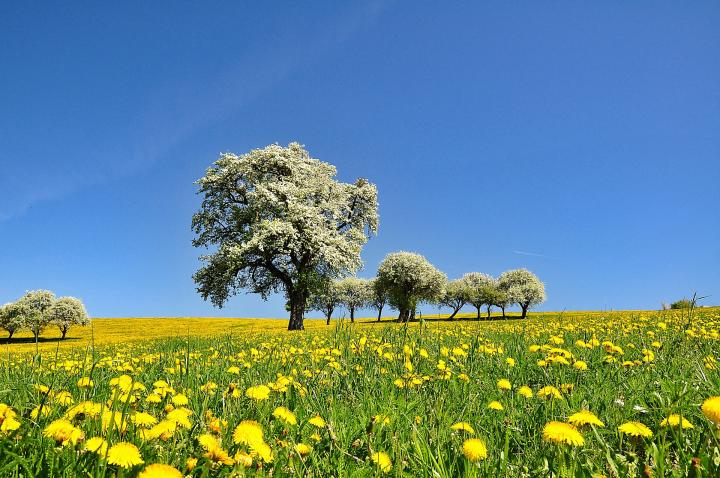
Changing the Color of the Daytime Sky
Even the daytime sky is changing. Notice the gorgeous deep blues of the spring sky? Soon, that deep blue will yield to summer’s milky-white canopy. Why does this happen?
- The reason is humidity. Winter air is dry air, while summer’s moisture fills the sky with countless tiny water droplets, which diffuse the light from the Sun, Moon, and stars.
- The second factor is the loss of snow cover. Snow bounces streetlights into the sky. Its 90 percent reflectivity is radically different from the murky 15 percent reflectivity of grass. No wonder the spring and summer sky appears darker.
Your location matters a lot, too. In the Carolinas and the Gulf Coast, humidity sometimes gets so extreme that windows fog up on the outside. This only happens when the dew point is higher than the temperature of your air-conditioned room. Likewise, humid air chilled to its dew point makes toilet bowls and pipes “sweat”—a common phenomenon in humid regions. In such places, early-morning lawns are routinely wet with dew.
Humid air contains countless tiny droplets that reflect all the Sun’s colors equally, which whitens the atmosphere. Since we look through 14 times more air when gazing down just above the horizon, the low sky is white on humid days. Even the overhead sky is light and not richly cobalt. These are some of the celestial changes underway between April and June.
Stars and the Moon
Look at the stars on a humid night. The air loses its heat very slowly, never cooling below its dewpoint. The resulting temperature homogeneity lets starlight arrive without being bent one way and then another by air layers of varying density (colder air is thicker). Incoming starlight thus takes straighter paths during our warmer months.
Result: Stars don’t twinkle on humid nights!
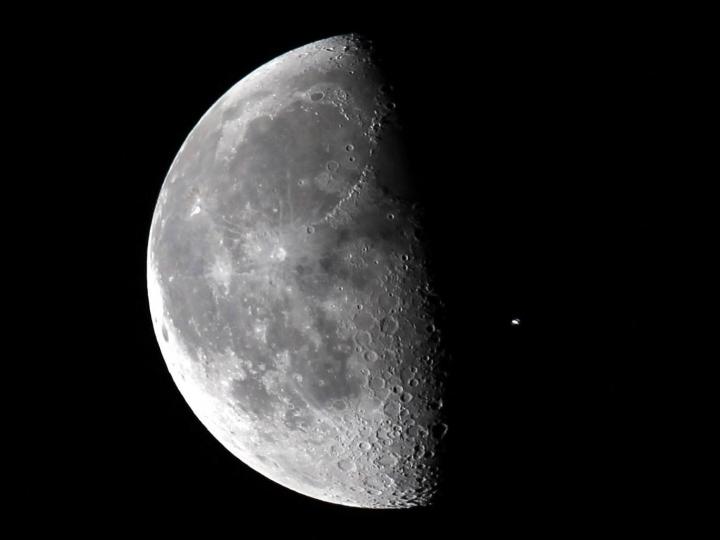
Telescopically, fine detail emerges with rock-steady images. Any night you feel a preview of the upcoming season’s warmth and humidity, point a telescope at the Moon and you’ll be treated to exquisite views of rare quality. The First Quarter Moon and Third Quarter Moons are the best Moon phases for seeing the detail of our only satellite without the moonshine produced by the Full Moon.
It’s Nature compensating for yanking away all those brilliant winter stars!

More Like This


Comments