The language of astronomy can seem complex—but it doesn’t have to be. Whether you’re tracking the Moon’s phases, watching an eclipse, or trying to understand terms like apogee, declination, or magnitude, this glossary explains the key words used to describe celestial events and the motions of the Sun, Moon, planets, and stars. These clear definitions make it easier to follow what’s happening in the sky above us.
APHELION (APH.): The point in a planet’s orbit that is farthest from the Sun.
APOGEE (APO.): The point in the Moon’s orbit that is farthest from Earth.
CELESTIAL EQUATOR (EQ.): The imaginary circle around the celestial sphere that can be thought of as the plane of the Earth’s equator projected onto the sphere.
CELESTIAL SPHERE: An imaginary sphere projected into space that represents the entire sky, with an observer on Earth at its center. All celestial bodies other than Earth are imagined as being on its inside surface.
CIRCUMPOLAR: Always visible above the horizon, such as a circumpolar star.
CONJUNCTION: The time at which two or more celestial bodies appear closest in the sky. Inferior (Inf.): Mercury or Venus is between the Sun and Earth. Superior (Sup.): The Sun is between a planet and Earth.
DECLINATION: The celestial latitude of an object in the sky, measured in degrees north or south of the celestial equator; comparable to latitude on Earth. This almanac gives the Sun’s declination at noon.
ECLIPSE, LUNAR: The full Moon enters the shadow of Earth, which cuts off all or part of the sunlight reflected off the Moon. Total Eclipse: The Moon passes completely through the umbra (central dark part) of Earth’s shadow. Partial: Only part of the Moon passes through the umbra. Penumbral: The Moon passes through only the penumbra (area of partial darkness surrounding the umbra).
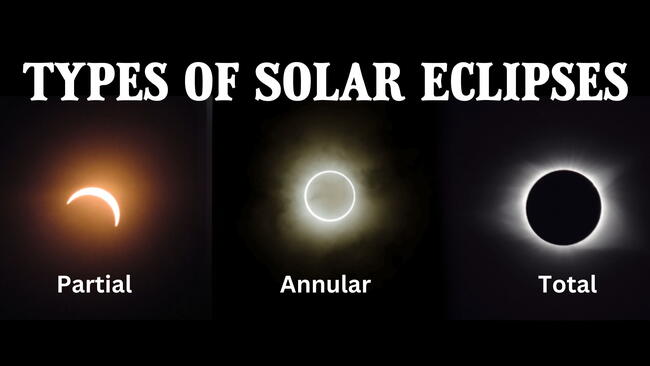
ECLIPSE, SOLAR: Earth enters the shadow of the new Moon, which cuts off all or part of the Sun’s light. Total: Earth passes through the umbra (central dark part) of the Moon’s shadow, resulting in totality for observers within a narrow band on Earth. Annular: The Moon appears silhouetted against the Sun, with a ring of sunlight showing around it. Partial: The Moon blocks only part of the Sun.
ECLIPTIC: The apparent annual path of the Sun around the celestial sphere. The plane of the ecliptic is tipped 23½° from the celestial equator.
ELONGATION: The difference in degrees between the celestial longitudes of a planet and the Sun. Greatest Elongation (Gr. Elong.): The greatest apparent distance of a planet from the Sun, as seen from Earth.
EPACT: A number from 1 to 30 that indicates the Moon’s age on January 1 at Greenwich, England; used in determining the date of Easter.
EQUINOX: When the Sun crosses the celestial equator. This event occurs two times each year: Vernal is around March 20 and Autumnal is around September 22.
EVENING STAR: A planet that is above the western horizon at sunset and less than 180° east of the Sun in right ascension.
GOLDEN NUMBER: A number in the 19-year Metonic cycle of the Moon, used in determining the date of Easter.
MAGNITUDE: A measure of a celestial object’s brightness. Apparent magnitude measures the brightness of an object as seen from Earth. Objects with an apparent magnitude of 6 or less are observable to the naked eye. The lower the magnitude, the greater the brightness; an object with a magnitude of –1, e.g., is brighter than one with a magnitude of +1.
MIDNIGHT: Astronomically, the time when the Sun is opposite its highest point in the sky. In 12 hours before and after noon (so, technically, both A.M. and P.M.), midnight in civil time is usually treated as the beginning of the day. It is displayed as 12:00 A.M. on 12-hour digital clocks. On a 24-hour cycle, 00:00, not 24:00, usually indicates midnight.
MOON ON EQUATOR: The Moon is on the celestial equator.
MOON RIDES HIGH/RUNS LOW: The Moon is highest above or farthest below the celestial equator.
MOONRISE/MOONSET: When the Moon rises above or sets below the horizon.
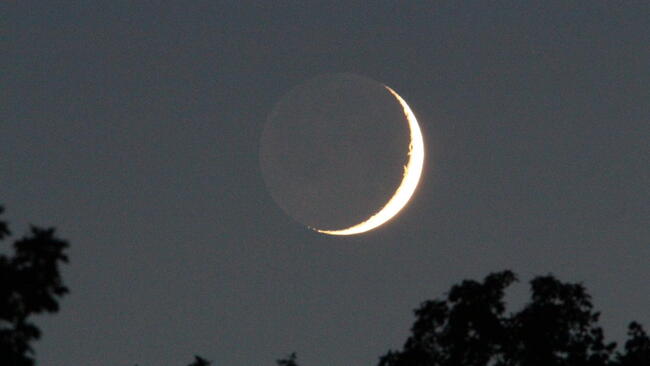
MOON’S PHASES: The changing appearance of the Moon, caused by the different angles at which it is illuminated by the Sun. First Quarter: Right half of the Moon is illuminated. Full: The Sun and the Moon are in opposition; the entire disk of the Moon is illuminated. Last Quarter: Left half of the Moon is illuminated. New: The Sun and the Moon are in conjunction; the Moon is darkened because it lines up between Earth and the Sun.
MOON’S PLACE, ASTRONOMICAL: The position of the Moon within the constellations on the celestial sphere at midnight.
ASTROLOGICAL: The position of the Moon within the tropical zodiac, whose twelve 30° segments (signs) along the ecliptic were named more than 2,000 years ago after constellations within each area. Because of precession and other factors, the zodiac signs no longer match actual constellation positions.
MORNING STAR: A planet that is above the eastern horizon at sunrise and less than 180° west of the Sun in right ascension.
NODE: Either of the two points where a celestial body’s orbit intersects the ecliptic.
OCCULTATION (OCCN.): When the Moon or a planet eclipses a star or planet.
OPPOSITION: The Moon or a planet appears on the opposite side of the sky from the Sun (elongation 180°).
PERIGEE (PERIG.): The point in the Moon’s orbit that is closest to Earth.
PERIHELION (PERIH.): The point in a planet’s orbit that is closest to the Sun.
PRECESSION: The slowly changing position of the stars and equinoxes in the sky caused by a slight wobble as Earth rotates around its axis.
RIGHT ASCENSION (R.A.): The celestial longitude of an object in the sky, measured eastward along the celestial equator in hours of time from the vernal equinox; comparable to longitude on Earth.
SOLSTICE, SUMMER: When the Sun reaches its greatest declination (23½°) north of the celestial equator, around June 21.
SOLSTICE, WINTER: When the Sun reaches its greatest declination (23½°) south of the celestial equator, around December 21.
STATIONARY (STAT.): The brief period of apparent halted movement of a planet against the background of the stars shortly before it appears to move backward/westward (retrograde motion) or forward/eastward (direct motion).
SUN FAST/SLOW: When a sundial is ahead of (fast) or behind (slow) clock time.
SUNRISE/SUNSET: The visible rising/setting of the upper edge of the Sun’s disk across the unobstructed horizon of an observer whose eyes are 15 feet above ground level. Check our sunrise/set tool to find out your local times.
TWILIGHT: The time when the sky is partially illuminated preceding sunrise and again following sunset. Learn about the three stages of twilight.
Originally published in The Old Farmer’s Almanac. See the latest edition here.







Comments