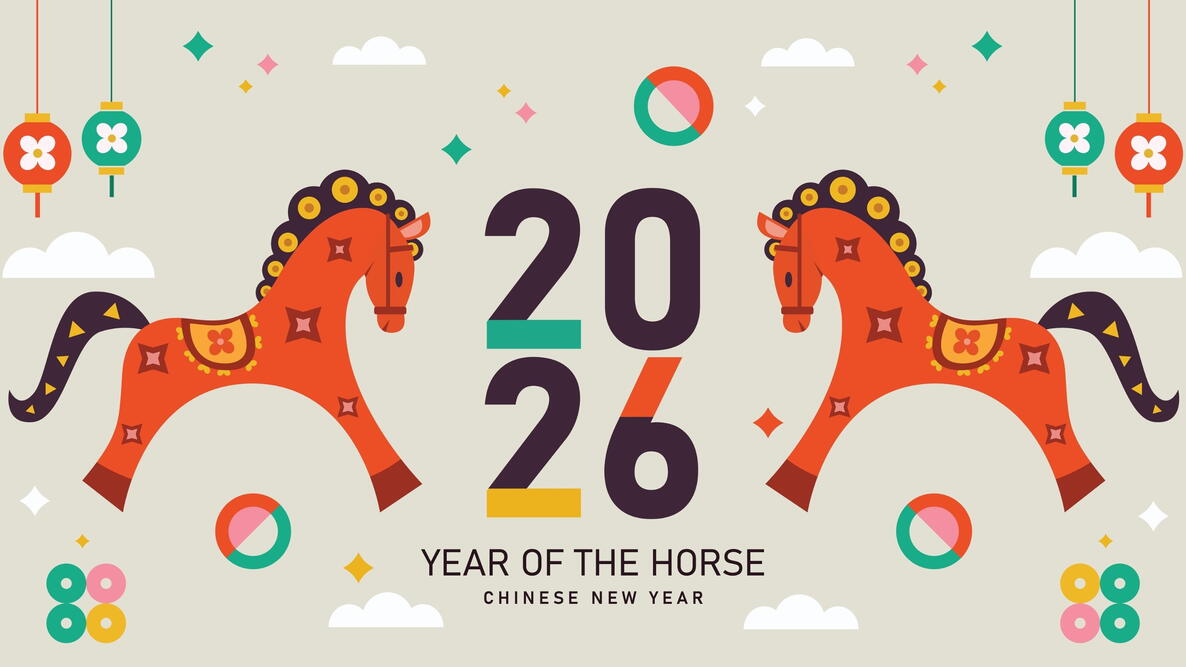

The Lunar New Year starts on February 17, 2026, and ushers in the Year of the Horse! More specifically, it’s the year of the Fire Horse, which only happens every 60 years. Learn more about the Lunar New Year—what it is, who celebrates it, and what the Year of the Fire Horse means for 2026!
The Chinese calendar, which underpins the Lunar New Year, is a lunisolar calendar based on astronomical observations of the Sun’s position in the sky and the Moon’s phases.
When Is the Lunar New Year?
The year begins on the date (in East Asia) of the second new Moon after the winter solstice, which always occurs in late December. This means that the first day of the Lunar New Year can occur anytime between January 21 and February 20.
In 2026, the second new Moon will occur in China on Tuesday, February 17, marking the start of a new lunar year.
| Year | Lunar New Year | Chinese Zodiac Sign |
|---|---|---|
| 2026 | Tuesday, February 17 | Horse |
| 2027 | Sunday, February 7 | Goat |
| 2028 | Wednesday, January 26 | Monkey |
| 2029 | Tuesday, February 13 | Rooster |
(Note: Due to the difference in time zones, the new Moon may technically occur one calendar day earlier or later in the United States. See our Moon Phase Calendar for local times.)
Why Are There Different New Years?
This ancient calendar dates back to the 14th century BCE (whereas the Gregorian calendar was introduced in 1582). The Chinese lunisolar calendar shares some similarities with the Hebrew calendar, which is also lunisolar, and has influenced other East Asian calendars, such as those of Korea and Vietnam.
Because the Chinese calendar defines the lunar month containing the winter solstice as the 11th month, the Lunar New Year usually falls on the second new moon after the winter solstice.
Just like New Year according to the Gregorian calendar (January 1), Lunar New Year celebrations start on the night before the first day of the new year.
(Note: China follows the Gregorian calendar for daily business but still follows the Chinese calendar for important festivals, auspicious dates for events such as weddings, and the Moon phases.)
Who Celebrates Lunar New Year?
This event is celebrated by billions of people worldwide! Although this holiday is sometimes called Chinese New Year in the West, China is not the only country that observes it. Lunar New Year, also known as the Spring Festival, is the most celebrated and longest of all Asian festivals and is observed by millions worldwide.
Many other East Asian countries, including Vietnam, Korea, Japan, and the Philippines, hold their own New Year celebrations at this time. (Occasionally, the date celebrated may differ by one day or even one moon cycle due to time zones and other factors.)
How Is the Lunar New Year Celebrated?
As with many winter solstice celebrations, the symbolic darkness of night is banished by the light of fireworks, lanterns, and candles. Man-made paper lanterns are hung by the hundreds in public areas, bringing good luck to the new year.
There are dragon dances, performances, and festival parades with music and acrobatics. The festivities continue for 2 weeks, finishing with a special lantern festival, which signals the end of the New Year celebration period.
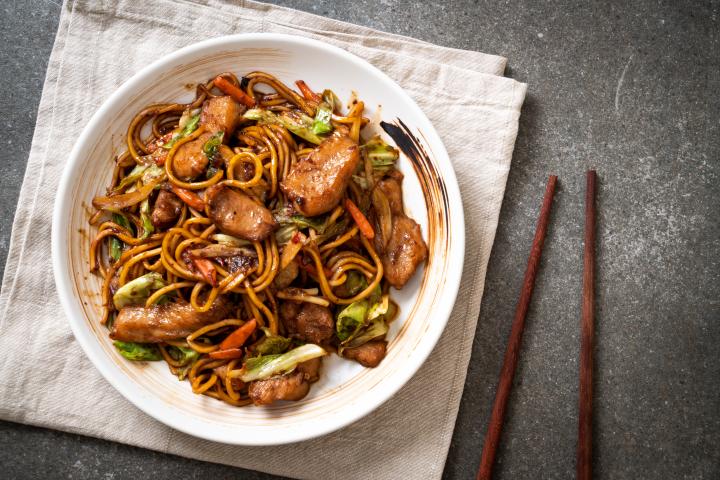
Of course, much delicious food is made and served! For the New Year, it’s traditional to serve long noodles, symbolizing a long life. See our recipe for Longevity Noodles.
Another popular food for New Year is Chinese Dumplings, symbolizing good luck and wealth. Families wrap them up and eat them as the clock strikes midnight.
“Good Luck” is also a common theme of the New Year. Many children receive “lucky money” in red envelopes. Sometimes, offerings are made to temples.
People clean their homes and open their doors to let good luck enter. According to tradition, no one should pick up a broom in case they sweep the good luck for the New Year out of the door!

2026 Zodiac: The Year of the Horse!
In 2026, we welcome the Year of the Horse, the seventh animal in the Chinese zodiac. The zodiac operates on a 12-year cycle, with each year corresponding to one of 12 animal signs in a fixed sequence. (Which Zodiac animal are you? Find out.)
People born in the Year of the Horse are energetic, confident, free-spirited, and naturally charismatic. They’re quick thinkers with a love for adventure and independence. However, they can also be impulsive, stubborn, and easily restless. Horses are especially known for their strong drive, optimism, and unstoppable enthusiasm.
The 2026 Element: Fire
Each year in the 60-year Chinese zodiac cycle is associated with one of five elements, which blend with one of the 12 animal signs. These elements repeat every 12 years, while the animals repeat every 10 years.
2026 marks the Year of the Fire Horse. This is a rare and special combination that occurs once every 60 years. If you were born 60 years ago, you, too, are a Fire Horse! The element for the year adds a unique “flavor” to each zodiac sign. Here are the five elements and their associated traits:
Wood: Imagination and creativity
Fire: Passion and dynamic energy
Earth: Pragmatism and lack of pretense
Metal: Solidity and willpower
Water: Responsiveness and persuasion
Lucky and Unlucky Signs in 2026
The Chinese zodiac includes 12 animals: Rat, Ox, Tiger, Rabbit, Dragon, Snake, Horse, Goat, Monkey, Rooster, Dog, and Pig. The energy of the Horse sign affects each animal differently:
| Zodiac Sign | 2026 Overview | Lucky Numbers | Lucky Colors |
|---|---|---|---|
| Rat | A dynamic year with fresh opportunities; stay organized to keep pace. | 2, 3, 9 | Blue, Gold |
| Ox | A steady yet slightly demanding year; persistence pays off. | 1, 4, 6 | White, Green |
| Tiger | A highly favorable year full of momentum and personal victories. | 1, 3, 4 | Gray, White |
| Rabbit | A year of adjustment; focus on balance and self-care. | 3, 4, 6 | Red, Pink |
| Dragon | A productive year with room for creative progress. | 1, 7, 9 | Gold, Silver |
| Snake | A mixed year; rely on intuition and avoid impulsive decisions. | 2, 8, 9 | Black, Red |
| Horse | A powerful and transformative year with major breakthroughs. | 2, 3, 7 | Yellow, Green |
| Goat | A smooth year overall; creativity and relationships flourish. | 2, 7, 8 | Brown, Pink |
| Monkey | A lucky year with rapid advancements—perfect for bold moves. | 4, 5, 7 | White, Blue |
| Rooster | A rewarding year as long as you stay flexible and open to change. | 5, 7, 8 | Gold, Brown |
| Dog | A challenging but empowering year; focus on patience and communication. | 3, 4, 9 | Green, Red |
| Pig | A positive, uplifting year with strong support in career and home life. | 2, 5, 8 | Yellow, Gray |
More About How The Chinese Zodiac Works
The traditional Chinese lunisolar year has 12 months and 353 to 355 days (or during a leap year, 13 months and 383 to 385 days).
Therefore, the Chinese year usually begins several weeks into the Western 365-day year (usually between January 21 and February 20), not on January 1 of the Gregorian calendar.
As is ancient tradition, the Chinese zodiac attaches animal signs to each lunar year in a cycle of 12 years. The animal designation changes at the start of the New Year.
A Deeper Look
On a broader scale, the Chinese lunisolar calendar counts its years according to the stem-branch system, a 60-year rotating name system known as the Chinese sexagenary cycle. By this, a year’s name contains two parts: the celestial stem and the terrestrial branch.
- The celestial, or heavenly stem, is taken from a rotating list of 10 terms concerning the yin/yang forms of five elements.
- The stem (wood, fire, earth, metal, and water): jia, yi, bing, ding, wu, ji, geng, xin, ren, and gui.
Stem/Element
jia = yang wood
yi = yin wood
bing = yang fire
ding = yin fire
wu = yang earth
ji = yin earth
geng = yang metal
xin = yin metal
ren = yang water
gui = yin water
- The terrestrial, or earthly, branch is taken from a rotating list of the 12 animal names of the Chinese zodiac.
Branch/Animal
zi = rat
chou = ox
yin = tiger
mao = rabbit
chen = dragon
si = snake
wu = horse
wei = sheep/goat
shen = monkey
you = rooster
xu = dog
hai - boar/pig
So, putting the stem and branch terms together, the first year in a 60-year cycle is called jia-zi (Year of the Rat) as jia is the celestial stem and zi (rat) is the terrestrial branch. The next year is yi-chou (Year of the Ox), and so on. The 11th year is jia-xu, etc., until a new cycle starts over with jia-zi.

More Like This




Technically, they would be considered the prior animal (in this case, the rabbit).
- « Previous
- 1
- 2
- …
- 10
- Next »

Comments