
Planting
When to Plant Sunflowers
- It’s best to sow sunflower seeds directly into the garden (or outdoor containers) after the danger of spring frost has passed, anytime after soils have warmed to at least 50°F (10°C).
- In the northern half of the U.S. and in Canada, this will fall between April and mid-June. In the South, this will probably occur in mid-March or early April.
- Sunflowers dislike having their roots disturbed, so we recommend direct sowing instead of transplanting.

Where to Plant Sunflowers
First and foremost, find a sunny spot! Sunflowers grow best in locations with direct sunlight (6 to 8 hours per day); they require long, warm summers to flower well. Shelter from strong winds—for example, along a fence or near a building—helps as they mature. Larger varieties may become top-heavy, and a strong wind can topple them.
Choose a location with well-draining soil. The planting spot shouldn’t pool with water after it rains. Otherwise, sunflowers aren’t too picky about soil, but the soil shouldn’t be too compacted for the best results. They have long taproots that need to stretch out; in preparing a bed, dig down or till 2 feet in depth and about 3 feet across. They’re not too fussy when it comes to soil pH, either. Sunflowers thrive in slightly acidic to somewhat alkaline soil (pH 6.0 to 7.5).
Sunflowers are heavy feeders, so the soil needs to be nutrient-rich with organic matter or composted (aged) manure. Or work in a slow-release granular fertilizer 8 inches deep into your soil.
Plant sunflowers in a spot sheltered from strong winds, perhaps along a fence or building. Larger varieties may become top-heavy, and a strong wind can be devastating.
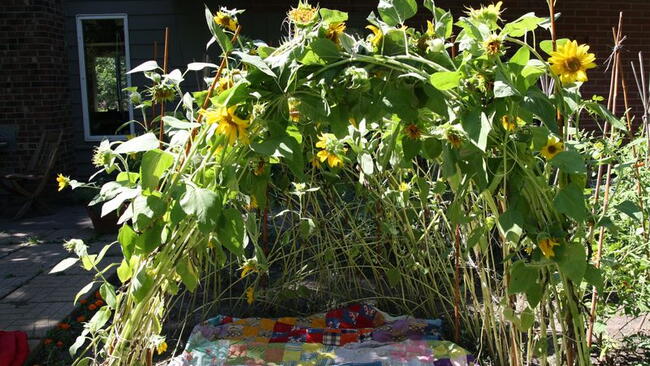
Before choosing a planting site, decide whether or not you want to grow a sunflower tower—a fun project for kids!
Planting Sunflower Seeds
- Sunflowers should be planted 1 to 1½ inches deep and about 6 inches apart after the soil has thoroughly warmed. If you wish, you can plant multiple seeds and thin them to the strongest contenders when the plants are 6 inches tall.
- Give plants plenty of room, especially for low-growing varieties that will branch out. Make rows about 30 inches apart. (For very small varieties, plant closer together.)
- A light application of fertilizer mixed in at planting time will encourage strong root growth to protect them from blowing over in the wind.
- Experiment with plantings staggered over 5 to 6 weeks to keep enjoying continuous blooms.
- If you see birds scratching around for the seeds, spread netting over the planted area until the seeds germinate. See more ways to keep birds away from your garden.
Check out this video to learn how to plant sunflowers:
Growing
Watering
While the plant is small, water around the roots, about 3 to 4 inches from the plant. To protect the plant, it may help to put snail or slug bait around the stem.
Once the plant is established, water deeply, though infrequently, to encourage deep rooting. Unless the weather is exceptionally wet or dry, water once a week with several gallons of water.
Fertilizing
Feed plants only sparingly; overfertilization can cause stems to break in the fall. You can add diluted fertilizer into the water, though avoid getting the fertilizer near the plant’s base; it may help to build a moat in a circle around the plant about 18 inches out.
Staking
Tall species and cultivars require support. Bamboo stakes are a good choice for any plant that has a strong, single stem and needs support for a short period of time.

Harvesting
Cutting Sunflowers for Bouquets
- For indoor bouquets, cut the main stem just before its flower bud has a chance to open to encourage side blooms.
- Cut stems early in the morning. Harvesting flowers during the middle of the day may lead to flower wilting.
- Strip stems of all leaves except for those closest to the flower head. Recut bottoms of stems at a 45-degree angle.
- Handle sunflowers gently. The flowers should last at least a week in water at room temperature.
- Arrange sunflowers in tall containers that provide good support for their heavy heads, and change the water every day to keep them fresh.

Harvesting Sunflower Seeds
At the end of the season, harvest sunflower seeds for a tasty snack and/or to replant or to feed the birds in the winter!
- Let the flower dry on or off the stem until the back of the head turns brown, the foliage turns yellow, the petals die down, and the seeds look plump and somewhat loose.
- With sharp scissors or pruners, cut the head off the plant (about 6 inches below the flower head). Place in a container to catch loose seeds.
- Lay the sunflower head on a flat, clean surface and grab a bowl to hold the seeds.
- To remove the seeds, rub your hand over the seeded area and pull them off the plant, or you can use a fork. Another way to remove them is to rub the head of the sunflower across an old washboard or something similar. Just grip the head and rub it across the board as if you were washing clothes.
- If you are going to harvest the seeds for roasting, you can cover the flowers with a light fabric (such as cheesecloth) and a rubber band to protect the heads from the birds.
- Alternatively, you can cut the flower head early and hang the heads upside down until the seeds are dry; hang indoors or in a place that’s safe from birds and mice.
- Rinse sunflower seeds before laying out to dry for several hours or overnight.
- If you’re saving seeds to replant, store them in an airtight container in a cool, dry place until you are ready to plant.
Read our complete article on harvesting sunflower seeds here.
Types
There are tons of varieties of sunflowers available today, so there’s bound to be one that fits your garden. Choose between those with branching stems or single stems, those that produce ample pollen for pollinators or are pollen-free (best for bouquets), those that stay small or tower above the rest of the garden, or those that produce edible seeds!
Everyone is familiar with those huge sunflowers that grow on towering 8-foot-tall stalks. But did you know some varieties top off at a modest 15 inches? Sunflowers are a diverse bunch!
- The towering ‘Mammoth’ variety is the traditional giant sunflower, sometimes growing to over 12 feet tall. Its seeds are excellent for snacks and for feeding the birds, too.
- ’Autumn Beauty’: One of the most spectacular cultivars, the ‘Autumn Beauty’ has many 6-inch flowers in shades of yellow, bronze, and mahogany on branching stems up to 7 feet tall.
- ’Sunrich Gold’: An excellent flower for bouquets and arrangements, this sunflower grows to be about 5 feet tall and produces a single 4- to 6-inch flower. The big, no-mess, pollenless flowers have rich, golden-yellow rays and green-yellow centers. This variety is wonderful for arrangements.
- ’Teddy Bear’: Just 2 to 3 feet tall, this small sunflower is perfect for small gardens and containers. The fluffy, deep-gold, 5-inch blossoms on branching stems last for days in a vase.

More Like This

The ants are there because of pests called aphids. The ants are attracted to the aphids’ sweet nectar and “farming” them. If you spray water to dislodge aphids, the ants will also go away.
- « Previous
- 1
- 2
- …
- 10
- Next »

Comments