Planting, Growing, and Caring For Jasmine Flowers

Read Next
Types
Common Jasmine
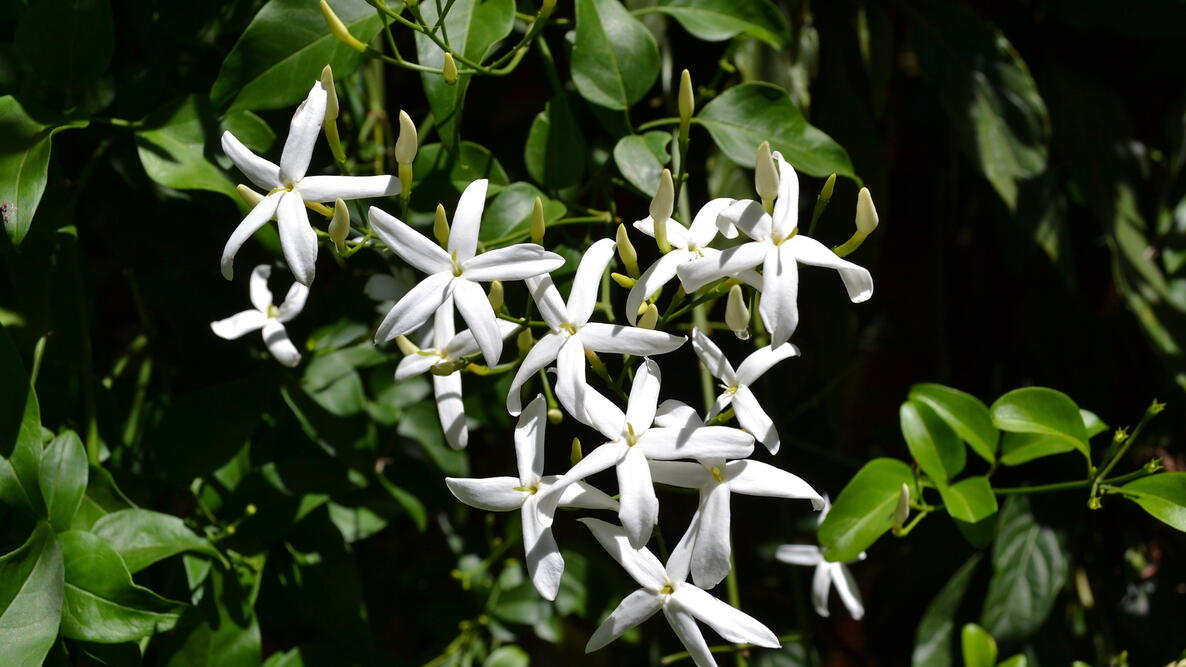
Common jasmine or poet’s jasmine (Jasminum officinale), also called true jasmine, is a deciduous vine with clusters of starry, pure-white flowers that bloom all summer. It’s a twining climber with deep-green leaves that have five to nine leaflets, each up to 2-1/2 inches long. The very fragrant flowers are up to 1 inch in diameter.
Hardy to Zone 7, the vine grows vigorously (1 to 2 feet per year, up to 20 feet) and looks stunning climbing a large pergola, fence, or very large trellis. In the landscape, jasmine can also be pruned as a shrub near the house or near a walk so its intense fragrance can be enjoyed and so you can watch hummingbirds and butterflies come to the flowers. Common jasmine is native to Asia.

Winter Jasmine
Winter jasmine (Jasminum nudiflorum) is an “old-timey” shrub often found around Victorian homes. The beautiful yellow flowers are unscented, 1 inch wide, and they appear in winter or early spring before the leaves unfold. Winter jasmine is a good bank cover that will spread by rooting where the stems touch the soil. It is also very attractive when planted above retaining walls, with the branches cascading over the side. Hummingbirds love this vigorous vine!
Most other Jasminum species are semitropical vines, which are best planted in the spring after the danger of frost has passed.
Not a True Jasmine
Star jasmine, aka Confederate jasmine (Trachelospermum jasminoides), looks similar but is not a true jasmine. Hardy in USDA Zones 7B through 10, this native to China has phlox-like flowers that bloom on twining stems in spring and summer and are highly scented.

Gardening Products

More Like This

Hi Sue,
Sorry to hear about your jasmine plant. There are a number of reasons why your jasmine has yellow leaves that are dropping. Too much or too little water can be an issue, as can soil that does not drain well. It is best to create a schedule for watering and make sure not to water too often.
Your plant also may lack key nutrients in the soil. You might want to test the pH of your soil to see what your plant needs. A lack of nitrogen can cause yellowing leaves. If you have not done so recently, you could also repot it to give the roots fresh soil. The best time to repot is in the spring.
Exposing your jasmine to too much sun can also cause leaves to yellow. You want it to be in a location that gets partial sun.
As with most plants, jasmine has a certain lifespan and yellowing of leaves can be part of the natural aging process. But don't be too alarmed because jasmine can lose its leaves in the fall.
Hi Emily, To chip in here . . . Note that only jasmine officinale is edible. If you live in the South do not mistake “Carolina Jasmine” for real Jasmine. It is "false Jasmine" aka Gelsemium Sempervirens and considered too poisonous for human consumption.
We like making sachets of dried flowers. Here's how to make sachets.
The edible flowers of jasmine officinale are intensely fragrant and are traditionally used for scenting tea, as you know. In North America, jasmine is rarely used in foods however, you'll see it in Thai cuisine and especially in seafood dishes. Jasmine flower is also use to make sweet syrups for desserts. See recipes from yummly, a popular recipe site.
- « Previous
- 1
- 2
- …
- 10
- Next »

Comments