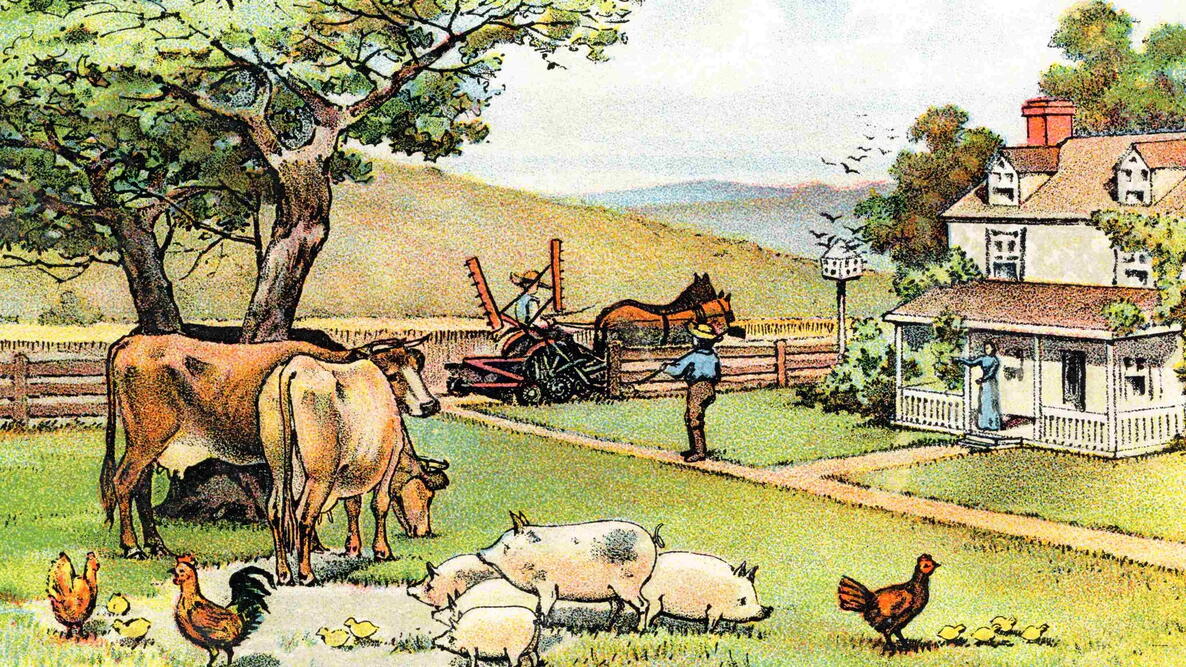
Caption
Everyday farm life in the 19th century—much like the scenes recorded in The Old Farmer’s Almanac.
How did Americans garden, farm, and live in years past—and what threads still connect us today? As the nation marks its 250th anniversary, these four Almanac moments offer a window into everyday life across time.
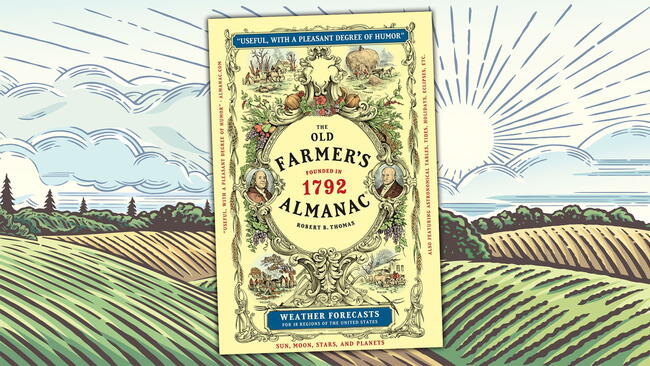
Published continuously since 1792, when George Washington was president, The Old Farmer’s Almanac has long recorded everyday American life. These brief excerpts—from 1826, 1876, 1926, and 1976—offer a glimpse of how Americans worked, learned, and adapted across two centuries.

200 Years Ago
Early Almanac entries focused on practical survival—how to grow food and make the most of the land.
April 1826
To raise asparagus, the soil should be the best in your garden, moderately light and yielding. Open a trench 3 feet wide and 12 inches deep. The warmer the place the better. Fill the trench half full of good dung; sprinkle over the rich earth making it level, and then place roots upon it 8 or 9 inches apart. If you have not roots, then take seed and place them half that distance, and cover with rich earth. Roots will produce shoots fit to cut the second year, but seeds will require another year.
150 Years Ago
By the nation’s centennial, the Almanac reflected not only daily life but also civic values and personal improvement.
To Patrons, 1876
’Tis a hundred years this year since our fathers founded the Nation. Long live the Republic! And that she may live long, let her sons cherish public and private virtue. Put good men in office, and keep them there during good behavior.
January 1876
When the chores are all done, and the day’s work is through, there will still be time to read and study some, and we might as well make up the mind to learn more, to do more, and to be more this year than we ever did or ever were before.
100 Years Ago
In the early 20th century, advice became more analytical, blending observation with practical experience. Figures like pioneer seedswoman Carrie H. Lippincott also helped spread new plant varieties and gardening knowledge through widely distributed catalogs.
April 1926
A ton of manure is actually worth just the value of the increased crop which it produces, minus the cost of handling. But as this value must vary with different crops, seasons, and soils there can be no set value for all conditions. Yet an approximate value can be reached which will serve all practical purposes.
August 1926
Take the auto and part of the family (send the others later) to see what other farmers have done… . Some fields will look good and other fields will not appeal to you. Make the acquaintance of some of the owners. They will tell you what they did, perhaps what they ought to have done, and what they hope to do. The actual first-hand experience of others, added to your own, produces education—the ability to solve both your problems and the problems of others.
50 Years Ago
By the bicentennial, the tone had shifted toward reflection—on land use, changing rural life, and modern habits.
May 1976
In this changing country world we may well find a profit from our forests.
But this again depends on the knowledge and energy of the forest owner. For those of us who live in the country it must seem that with scrubby fields and scrubby half-grown forests, we have the worst of two worlds. Wildlife—particularly woodcock, grouse, and rabbits are increasingly scarce. Our problems and nature’s are compounded.
November 1976
The old farmer may have confined his reading to the Bible, his State History, farm journals, and his Almanac. Today we have the compulsion to read everything. With so much to read, we have forgotten how to read selectively. We buy, or subscribe to, more magazines, more newsprint, more books than we can read—let alone enjoy. But of course, we don’t have to read everything… . I wonder if the speed reader can ever again enjoy the quiet page.
A Window Into Everyday American Life
From planting asparagus to reflecting on how we read and learn, these entries from The Old Farmer’s Almanac offer quick glimpses of everyday American life. Across 200 years, the details may change—but the rhythms of work, curiosity, and adaptation remain much the same.




Comments