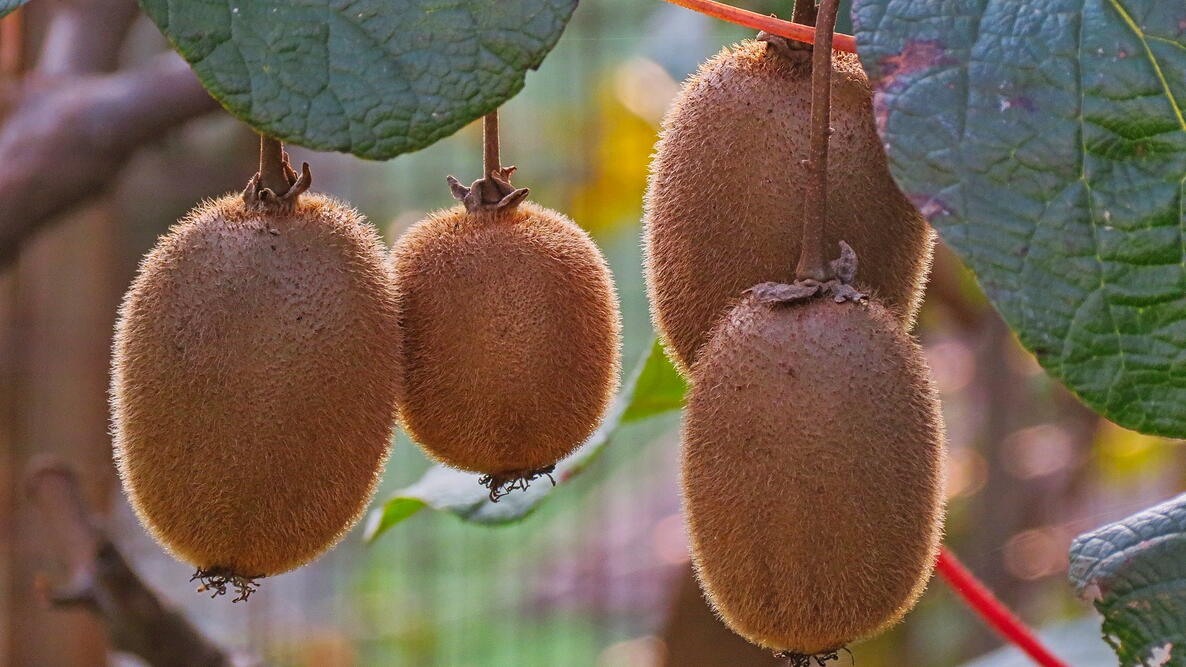
Caption
Fruit of the kiwifruit plant, Actinidia deliciosa.

Did you know that kiwis aren’t native to New Zealand? Kiwi plants can be grown on a vine in both colder and warmer regions. These tasty and nutrient-rich fruits are an excellent choice to grow in your own home. Learn more.
Note: If you are considering growing kiwifruit in your garden, know that both a male and a female plant are required to produce fruit. The male plant produces flowers, while the female plant produces both flowers and fruit. (However, if you only have space for one plant, one reportedly self-fertile variety of hardy kiwi is called ‘Issai’.)
Growing
How to Grow Kiwi Vines
- Unless it has been rainy, give the plants supplemental watering at the height of summer or during other dry periods.
- Do not fertilize in the first year. After that, fertilize with a well-balanced fertilizer or soybean meal in the spring.
- Start training the flexible vines up a support during the first year of planting.
- Prune the lateral growth (if not flowering) two to three times during the growing season.
- Kiwi plants flower and fruit from old wood.
- Regularly remove water sprouts (vigorous shoots originating from older wood) and shoots from the trunk.
- Prune female vines during the winter months, when the plant is dormant. Prune male vines in early summer after bloom.
- In cold areas, the vines of hardy kiwi may die back to the ground each year. Remove the dead stems and mulch with leaves or straw.
How to Propagate Kiwi Vines
- Kiwi plants can be propagated from seeds. Here’s how:
- Remove the seeds from a mature kiwi’s fruit and let the seeds dry for two days.
- Place the seeds in a container with moist perlite and refrigerate at 40°F (4°C) for 2 months.
- Plant the seeds 1/8 inch deep in moist sterile potting mix and cover the container with plastic wrap.
- Place the container in a warm, bright spot and moisten the soil.
- When seedlings start growing, uncover the container.
- When the plants have four true leaves, transplant them into individual pots.
- When the plants are several inches tall, transplant them outdoors.
- Kiwis can also be propagated from softwood cuttings (cuttings taken from new growth during the summer):
- Cut a kiwi stem into six-inch lengths and cut off any growing tip.
- Put the cuttings into a glass with an inch of water.
- In about three weeks, the cuttings will have tiny roots at the ends of the cuttings.
- Plant the cuttings in pots or plant outdoors.
Types
There are two main types of kiwi plants grown in home gardens: kiwifruit and kiwiberry. Both types of kiwi are frost-susceptible, so this plant is best grown in areas with a frost-free growing season of at least 200 days.
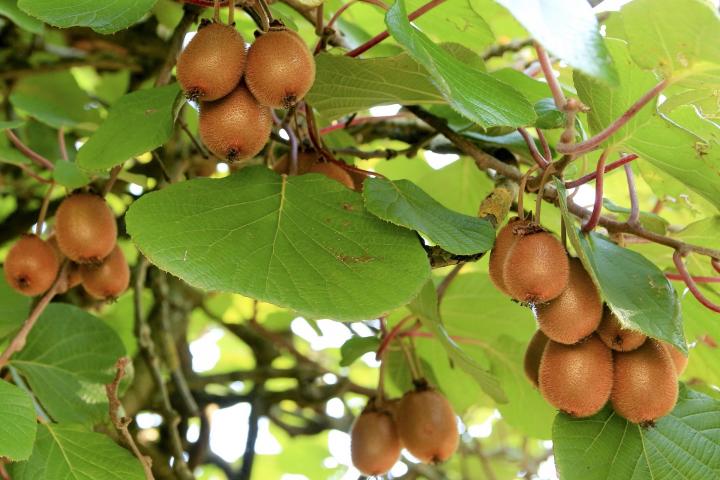
- Kiwifruit (Actinidia deliciosa) is the plant with the fuzzy brown fruit variety you’ve likely seen in stores. The fruits are typically about the size of an extra-large chicken egg. In the early 20th century, the plant was exported from southern China to Europe, the United States, and New Zealand. Today, most kiwifruit is grown in New Zealand. Kiwifruit grows in Zones 8 to 9.
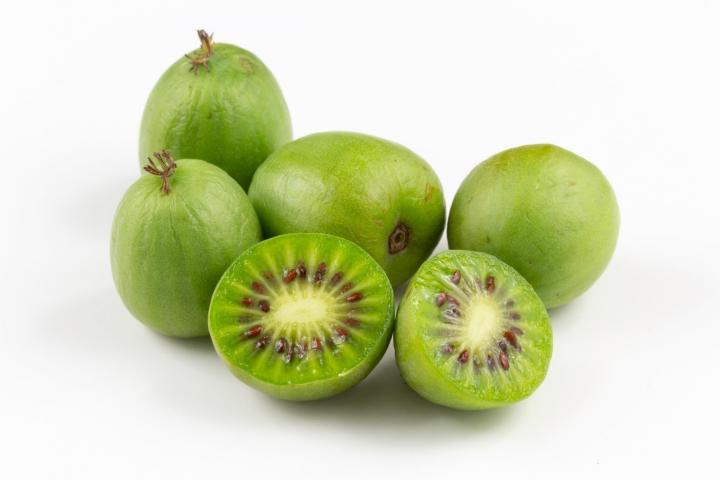
- Kiwiberry (A. arguta) produces a smooth, green, grape-sized fruit. They are grown often for their attractive, pink-variegated foliage and fragrant flowers. Native to northern China, Japan, and Korea, this exported plant is sometimes called “hardy kiwi” or “Northern kiwi.”
As the name suggests, the hardy kiwi (Actinidia arguta) does best in colder areas (USDA zones 4 to 7) and can even survive subzero temperatures.

More Like This

Kiwi plants are dioecious, which means that plants only have female or male parts. So in order to produce fruit both must be present.
The way to tell if your vine is male or female is at bloom time. Female kiwis have multi-branched stigmas in the center of the flowers with a row of white ovules at the base of the flower, which will develop into a seed when fertilized. The male vines have lots of stamens with anthers that are covered in pollen.
It is recommended that one male plant be present for every six females.

Comments