
Dig into the basics of planting, growing, and storing potatoes

Read Next
Planting
When to Plant Potatoes
Garden potatoes can be planted 2 to 4 weeks before the average last frost date. The soil temperature should be at least 55°F during the day and 45°F at night. However, pay more attention to the soil than the calendar to determine planting time. The soil should not be so wet that it sticks together and is hard to work. Let it dry out a bit first. If you have a late and wet spring, you can plant later, through April (depending on location) or even June, especially in containers.
In cooler regions, the early-maturing potatoes are usually planted early to mid-April. In warmer regions, planting times range from September to February; in central Florida, gardeners plant potatoes in January; in Georgia, they plant in February.
See our Planting Guide for the best dates to plant by zip code or postal code.
How to Plant Potatoes
Potatoes for planting are called seed potatoes and are usually sold in bags or netting. Use certified (disease-resistant) seed potatoes from which eyes (buds) protrude. Do not confuse seed potatoes with potato seeds or grocery produce.
When you get them, break them free, lay them out in a tray (such as an old egg carton), and pop them somewhere bright and frost-free to sprout, such as an indoor windowsill. This is a process called chitting. It’s not essential, but chitting helps speed things along so that by the time the potatoes are planted, they’ll be primed and itching to send out roots.
As the video below shows, after a month of chitting, the potatoes produced stout, stocky, green sprouts, which is exactly what we’re after; we don’t want the long, pale sprouts you get when potatoes are left in the dark. But if you haven’t had a chance to chit your potatoes and it’s already time to plant, don’t worry—get them in the ground.
A great way to get more seed potatoes for free is to cut them in half. But only do this if they’ve got plenty of eyes, which appear as small dimples and are where the sprouts emerge from. For this reason, you want to place the end with the most eyes facing upwards.
At least 2 days before planting, use a clean, sharp paring knife to cut large potatoes into golf ball-size pieces, with one to two eyes each. This time allows the pieces to heal or form a protective layer over the cut surface, improving both moisture retention and rot resistance. Do not cut up seed potatoes that are smaller than a hen’s egg; plant them whole.
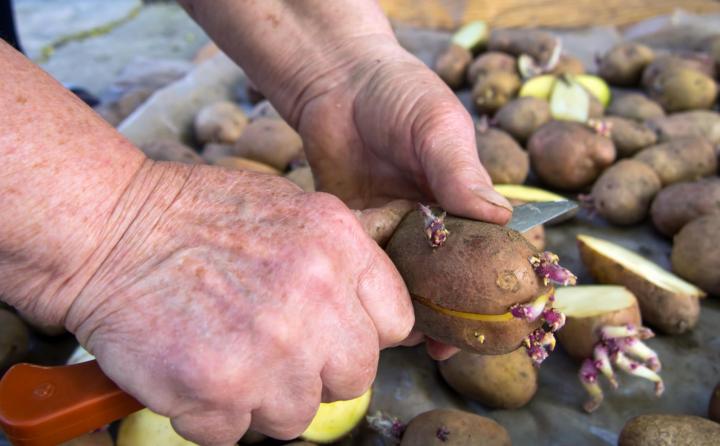
Photo by tanyss/Getty Images.
- You’ll need a location with at least 6 hours of direct sunlight and fertile, loose, well-draining soil; hard or compacted soil leads to misshapen tubers. Ideally, the soil is slightly acidic (pH 5.8 to 6.5), and the soil temperature is at least 45º to 55ºF (7° to 13°C). In the fall, mix compost or organic matter into the soil. Learn more about compost, soil amendments, and preparing the soil for planting.)
- Outside, prepare the planting area by simply spreading compost across the surface to a depth of around an inch or 3 cm. Potatoes are fairly hungry plants, so this extra nourishment will help to support good soil fertility and a strong harvest.
4 Methods of Planting Potatoes
There are different approaches to planting potatoes:
- Dig Holes: For each seed potato, dig a hole about 6 inches deep (16 cm). Add in a little slow-release organic fertilizer (e.g., chicken manure pellets) and then pop in the potato with sprouts pointing up and cover with soil. Space potatoes about 16 inches (40 cm) apart in both directions for early types. Main crop potatoes need a bit more space to stretch their legs, so space them at 18 inches (45 cm) apart.
- Dig V-Shaped Trenches: Dig 2- to 2.5-foot-deep (15- to 190-cm) trenches. Lay a nourishing cushion of garden compost along the bottom and a few of those chicken manure pellets, then set your tubers into position about 1 foot (30 cm) apart. Then, just fill back in. I don’t think it makes a huge difference which way you plant, so do whatever’s easiest in the space you have.
- Plant in Straw: Nestle seed potatoes down into the soil surface, then cover them with straw. See our article on planting potatoes in straw.
- Plant Potatoes in Pots: If you don’t have the garden space, plant in large containers, old compost sacks, trash cans, or purpose-made potato sacks. Fill the bottom of your pot or sack with about 4 inches (10 cm) of potting mix, then lay one or two potatoes on top and cover. Once the foliage is growing, add in more potting mix, a bit at a time, to hill or earth them up until the soil level reaches the top, at which point the foliage almost seems to explode in size. See our article about container gardening with potatoes.
Growing
How to Grow Potatoes
Firstly, water! This is really important because potatoes are lush and leafy plants, and those tubers take a lot of effort to swell. So if it’s dry, water thoroughly. Maintain even moisture, especially from the time after the flowers bloom. Potatoes need 1 to 2 inches of water a week. Too much water right after planting and not enough as the potatoes begin to form can cause them to become misshapen. Stop watering when the foliage begins to turn yellow and die off.
If you’re growing potatoes in containers, take extra care to keep your plants really well watered, especially in warmer weather, as this really will make all the difference in achieving a good crop.
Hilling Potatoes
The potato flavor is improved by depth and darkness. As the potato plants grow above the soil surface, you’ll need to periodically “hill up” or mound up soil and compost around the plant so that only the top leaves stick out of the ground. When growing potatoes, it’s vital not to allow potato spuds to be exposed to sunlight, as this also causes them to turn green and produce solanine, a chemical that gives off a bitter taste and is toxic. Do the hilling in the morning, when plants are at their tallest. (During the heat of the day, plants start drooping.) Just draw up the soil with a hoe every time the stems get to around 6 to 8 inches (15 to 20 cm) tall so that just the very tops are left poking out. Continue doing this in stages until you can no longer draw up any more soil, or the foliage closes over in between the rows.
If you’re growing your potatoes in a smaller raised bed, it may be easier to simply top up with organic matter around the whole area.
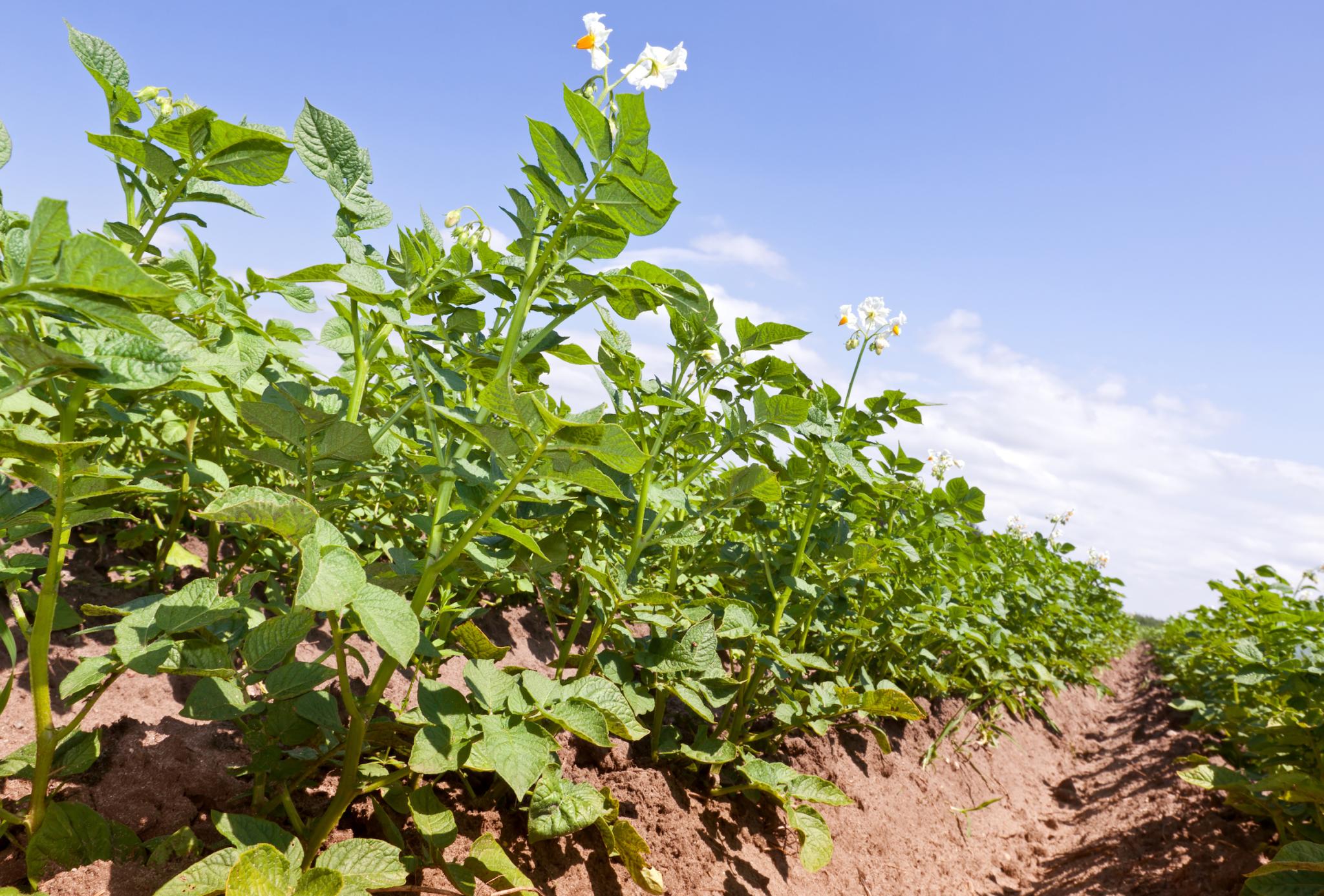
Credit: Avalon Studio/Getty.
Protect Your Potatoes From Frost
Potatoes aren’t fussy vegetables, which makes them a fabulous choice for first-time growers. They do well in most soils and almost always produce plenty to hunt for at harvest time. That said, you can do a few things to elevate your crop.
Late frosts can damage the young foliage—something to watch out for with early starts. Frost-bitten plants usually have enough energy to shake off any damage, but it can set plants back nonetheless. So if a frost is forecast and potatoes stand to get clobbered, do whatever you can to protect them. Cover the area in a few layers of warming fleece or row cover fabric, cover clusters of shoots with pots, or draw up the soil to bury the young shoots.
Note: In cool growing seasons, potato vines may sport berries. The berries are the fruit. Cut one open and see how it resembles its cousin, the tomato. Potato berries are poisonous and inedible. Plus, their seeds will not produce potato plants that resemble the parent. Discard them.
Practice yearly crop rotation with potatoes in order to avoid pests and diseases.
Types
Despite the limited options in the grocery store, gardeners know there’s much more to potatoes than the traditional Idaho white potato. There are over 100 types of potatoes, varying in skin color, flesh color, and size from large to fingerling! Floury types are perfect for roasting or mashing, while firm, waxy potatoes are superb boiled or as salad potatoes. You can learn all about potato varieties in the section below.
There are three classifications for potatoes based on when you harvest (vs. when you plant). If you harvest for storage, be sure to choose the right type:
- Early-season potatoes: first to be planted in early spring. Grow quickly (60 to 80 days), ready to harvest by early summer, tender flesh, thinner skin, store up to a few weeks.
- Mid-season potatoes (aka second early potatoes or “earlies”): mature in 80 to 100 days, typically lifted up from the second half of summer, store up to a month.
- Late crops: mature in 100 to 130 days, best for storing, lasting 2 to 3 months in the right conditions; planted in August and harvested in fall.
Also, decide on the texture and flavor of your potatoes, and how you’d like to eat them:
- Dry-fleshed, mealy potatoes are fantastic for baking, frying, and mashing. Russets and long white potatoes are a favorite for mashed potatoes, easily absorbing the butter and sour cream while maintaining that light and fluffy texture.
- Moist, waxy, round potatoes are great in soups, curries, frittatas, and salads because they don’t fall apart when cooked. You can pan-fry leftover boiled potatoes. When you mash waxy potatoes, they can become sticky.
- Red-skinned potatoes are often used for boiling or for potato salads.
Some popular potato varieties, such as ‘Yukon Gold’, fall somewhere in between truly waxy and mealy.
There are over 100 potato plant varieties! Go beyond the Idaho potato to explore more exotic and delicious options. See our article on choosing the best potato varieties!
Early Varieties:
- ‘Irish Cobbler’: tan skin, irregular shape (great heirloom potato for delicious mashed potatoes!)
- ‘Red Norland’: deep red skin, sweet, delicate flavor, great in potato salads or boiled
- ‘Mountain Rose’: red skin and pink flesh, resistant to some viruses
Mid-Season Varieties
- ‘Yukon Gold’: popular, tan skin and buttery-yellow flesh, mid to large size
- ‘Red Pontiac’: red skin, deep eyes (easiest and most adaptable red potato there is to grow)
- ‘Viking’: red skin, very productive
- ‘Chieftan’: red skin, resistant to potato scab, stores well
Late Varieties
- ‘Katahdin’: tan skin, resistant to some viruses
- ‘Kennebec’: tan skin, resistant to some viruses and late blight
- ‘Elba’: tan skin, large round tubers, resistant to blight and potato scab
- All Blue Potatoes
- ‘Fingerling Salad’ potatoes
Harvesting
Harvesting potatoes is fun! It’s like unearthing nature’s treasures. Harvest potatoes on dry days. Dig up gently, being careful not to puncture the tubers. Avoid cutting or bruising potato skin. The soil should not be compacted, so digging should be easy. Potatoes can tolerate light frost, but when the first hard frost is expected, it’s time to get out the shovels and start digging potatoes.
Harvesting at the right stage keeps tubers from sitting too long—upping the chances of a slug or disease attack, particularly for main crop spuds.
Earlies are the first to be lifted, usually while the plants are still in flower. Your tubers should be about the size of a hen’s egg or a touch bigger, but it’s up to you how big you want them. Use a fork and work your way in from the edge of the plant, taking care to avoid stabbing into the potatoes themselves. Once you’ve loosened the plants, you can lift them to expose most of the spuds, but be sure to dig around in the soil for any you’ve missed!
Dig up main crop spuds once the foliage is dying back towards the end of the growing season. I find it easier to cut back the foliage before digging up the potatoes on a dry day. Leave the potatoes on the soil surface for a few hours so the skin can dry off a bit. Don’t leave them there any longer, or they may start to turn green.
Extra tips for knowing when and how to dig up potatoes:
- Toughen up potatoes for storage before harvest by not watering them much after mid-August.
- Dig up a test hill to see how mature the potatoes are. The skins of mature potatoes are thick and firmly attached to the flesh. If the skins are thin and rub off easily, your potatoes are still too new and should be left in the ground for a few more days.
- If the soil is very wet, let the potatoes air-dry as much as possible before putting them in bags or baskets.
- Small green spots can be trimmed off, but throw the potato out if there is significant greening.
- Only store potatoes that are free of bruises, disease, or damage, as you don’t want problems in storage, and check on stored potatoes every few weeks and remove any that are starting to spoil.
How to Cure Potatoes
- Once they’ve dried off, pack them up into breathable sacks or just sturdy cardboard boxes to store somewhere dark, cool but frost-free (45° to 60°F / 7° to 15°C) for up to 2 weeks. This allows the potato skin to cure and thus keep longer.
- Brush off any clinging soil; do not wash the potatoes until ready to eat; washing will shorten their life.
How to Store Potatoes
If you are harvesting potatoes to eat within a few days, storage is not an issue. You can store anywhere.
To store potatoes for keeping, however, you need a dark, cool (38° to 40°F) place; if it’s too warm, potatoes will sprout and be susceptible to disease. Also, it needs to be somewhat humid; potatoes are 80% water, so if it’s too dry, potatoes wither and dry out.
If you happen to have a damp cellar, you’re all set! Otherwise, consider an extra refrigerator set a few degrees higher than normal with tubers in dark-colored plastic bags that are perforated (with many holes cut in the side) for air movement. Avoid all light to prevent greening. Or, consider an unheated entrance, spare room, closet, attic, cabinet, or insulated garage. To elevate humidity, you could place large pans of water in front of the air source.
Even after harvest, potatoes still use oxygen and give off carbon dioxide, so they must have fresh air and ventilation. Never put potatoes in airtight containers. Use perforated bags, as mentioned above. Do not store potatoes with apples; the fruit’s ethylene gas causes spoilage.
Find more tips on getting potatoes ready for the root cellar.
Gardening Products
Pests/Diseases
The most common potato disease is scab, which causes rough, scabby patches on the skin. These can be peeled off along with the skin, so it’s not all bad. But scabby potatoes ain’t half ugly! So avoid scab in the first place by watering to keep the soil consistently moist at the critical time when tubers are developing—basically once the foliage has started to bush out. Adding compost or other organic matter to the soil before planting should help improve water retention, too. It’s also worth seeking out scab-resistant varieties.
Potato blight, or late blight, is a little trickier to dodge. It strikes after a period of warm, wet weather, seemingly out of the blue. Blight causes dark patches on the leaves as it takes hold—then it spreads with devastating speed, killing off your entire crop. There are a few blight-resistant varieties, but the choice is very limited. The good news is that early varieties are usually harvested before the blight arrives later in summer. Check regularly, and if you do spot the tell-tale signs of blight, act fast to cut back the foliage before it spreads to the potatoes belowground—then harvest them as soon as possible.
Potato Pests and Diseases
| Pest/Disease | Type | Symptoms | Control/Prevention |
|---|---|---|---|
| Aphids | Insect | Misshapen/yellow leaves; sticky “honeydew” (excrement); sooty, black mold | Grow companion plants; knock off with water spray; apply insecticidal soap; put banana or orange peels around plants; wipe leaves with a 1 to 2 percent solution of dish soap (no additives) and water every 2 to 3 days for 2 weeks; add native plants to invite beneficial insects |
| Blight (early) | Virus | Leaves, beginning with lower ones, develop dark, concentric spots, often with yellow outer ring, and eventually die; tubers/stems also may be affected | Destroy infected plants; choose resistant varieties; maintain proper soil fertility; ensure good air circulation; avoid overhead watering; water in morning; disinfect tools; rotate crops |
| Blight (late) | Virus | Small, greenish gray, water-soaked spots on leaves that enlarge and turn brown, sometimes with yellow halo; white, fuzzy growth on leaf undersides; stems also affected; tubers develop reddish brown dry rot | Destroy infected plants; choose resistant varieties and certified, disease-free seed potatoes; ensure good air circulation; avoid overhead watering; remove plant debris; rotate crops |
| Colorado potato beetles | Insect | Yellow-orange eggs laid in clusters on leaf undersides; larvae and adults chew holes in foliage | Handpick; use straw mulch; weed; use row covers; destroy crop residue; rotate crops. In the nymph state, they can be controlled with diatomaceous earth (food grade). If they continue to be a problem, a few sprays of spinosad, an organic pesticide, will get rid of the beetles. Always use products at dawn or dusk to avoid harming beneficial insects. |
| Flea beetles | Insect | Tiny black beetles that jump when spooked. Numerous tiny holes in leaves; clusters of holes, as if leaf was hit by shotgun | Use row covers; mulch heavily; add native plants to invite beneficial insects |
| Leafhoppers | Insect | White shed skins on leaf undersides (from nymph molting); stippling (many tiny spots) on leaves; “hopperburn” (leaves yellow/brown, curled, or stunted); reduced yield | Knock nymphs off leaf undersides with strong spray of water; use row covers; monitor adults with yellow sticky traps; weed; destroy crop residue |
| Potato scab | Bacteria | Brown, rough, corky spots that can be shallow/raised/sunken | Choose resistant varieties and certified disease-free potato seed; maintain soil pH between 5.0 and 5.2; dust seed potatoes with sulfur before planting; use pine needle mulch; keep soil moist after tubers start to form; do not use manure; rotate crops |
| Tomato hornworms | Insect | Chewed leaves (initially toward top of plant); rapid defoliation; black/green excrement | Handpick (leave larvae that have white, rice-like cocoons, which house braconid wasp parasites); till soil in fall and spring; weed; add native plants to invite beneficial insects; grow dill as a trap crop or basil/marigolds as repellents; spray Bacillus thuringiensis (Bt) |
| Whiteflies | Insect | Sticky “honeydew” (excrement); sooty, black mold; yellow/silver areas on leaves; wilted/stunted plants; distortion; adults fly if disturbed; some species transmit viruses | Remove infested leaves/plants; use handheld vacuum to remove pests; spray water on leaf undersides in morning/evening to knock off pests; monitor adults with yellow sticky traps; spray with insecticidal soap; invite beneficial insects and hummingbirds with native plants; weed; use reflective mulch |
| Wireworms | Insect | Seedlings severed; stunting/wilting; roots eaten; tubers/bulbs bored | Trap by digging 2- to 4-inch-deep holes every 3 to 10 feet, fill with mix of germinating beans/corn/peas or potato sections as bait, cover with soil or a board, in 1 week uncover and kill collected wireworms; provide good drainage; remove plant debris; rotate crops |
FAQ
How Long Do Potatoes Take to Grow?
The length of time that it takes potatoes to grow to maturity will largely depend on the variety of potato that you are growing. Generally speaking, it takes 90 to 120 days for potatoes to grow. Some varieties, however, like the ‘Yukon Gold’, can be ready to harvest in as little as 70 days.
What is a Potato Eye?
A potato’s “eyes” can’t see much! These protrusions on the potato are actually the sprouts or buds of new plants. Each potato eye is capable of growing into a new potato plant.

Photo: Paul Hein
How Can I Tell if My Potatoes are Growing?
It can be difficult to tell if your potato plant is growing potatoes because, frankly, all the fun is happening underground! When it comes to growing potatoes, patience is key. Within several weeks of planting your potatoes, you should see sprouts emerging from the ground. At this point, the potato plant will begin to form leaves rapidly, and eventually, potato flowers will appear. The flowers on a potato plant are the best indicator that your plant is indeed producing potatoes.
How Should I Cut Potatoes for Planting?
When planting, you can increase your crop by cutting your larger seed potatoes (make sure that they are at least the size of a golf ball). Use a clean, sharp knife to cut the seed potato, leaving at least two eyes on each section. Some of the bigger seed potatoes can even be cut into three pieces! Then, allow the pieces to “cure” by leaving them in a cool room for several days, forming a scab over the cut end. Curing the seed potatoes will help to prevent root rot.
Why Are My Potatoes Green?
A potato can turn green when exposed to light (such as under a grocery store’s lighting), especially at certain temperatures. The greening appears as the potato increases its production of harmless chlorophyll (which helps the plant to make food) but also, independently, a natural nerve toxin called solanine, a glycoalkaloid, which serves as the plant’s defense against insects, animals, etc. Usually in the potato, the solanine extends no deeper than about 1/8 inch from the surface. (It is present in all parts of a potato plant, including leaves and stems.)
Can I Eat Green Potatoes?
According to the Cooperative Extension, if the potato has only small areas of green, then you can use the potato with little risk. But if there is a lot of green, do not eat it. Also, toss it if there is a bitter taste. They also recommend not feeding green potatoes, even after they are trimmed, to children, as they may be more susceptible to solanine. (And do not feed to dogs or other pets.) Cooking will not eliminate the solanine.
Cooking Notes
Potatoes can be prepared in many ways: boiled, mashed, cut into pieces and roasted, french-fried, scalloped, made into dumplings or pancakes, grated into hash browns, and even brewed as alcoholic beverages.
Most potato dishes are served hot, but some are first cooked, then served cold, notably potato salad and potato chips.
More Like This


Comments

A dry potato can be due to variety (such as russets vs. more waxy types), or cultural/environmental disorders or disease problems. If your potatoes showed any discoloration inside, or sunken or hollow areas, you might look into a disease such as fusarium dry rot, or a cultural or environmental problem. For more information, see:
http://vegetablemdonline.ppath.cornell.edu/factsheets/Potato_Fusarium.htm
http://vegetablemdonline.ppath.cornell.edu/factsheets/Potato_Detection.htm
http://cropwatch.unl.edu/web/potato/physiological_disorders
Check your soil to make sure it has the nutrients that potatoes need (not too much/not too little), and be sure that the crop has the proper amount of water, consistently. Consider environmental factors that might be coming into play, such as chemical damage from nearby areas, heat or cold stress, etc.
Often, one can make the final harvest after the plant has died back, unless you desire a smaller sized potato, in which case the main harvest would be earlier, when most tubers have reached the desired size. If you do not have frost in your area, the plant still has plenty of green leaves (along with the new ones), and the plant is not starting to die back (turning brown), then you can certainly let the plant continue to grow and see if it survives to form more tubers.
Potatoes can be planted as soon as the ground is workable but not too wet. This is often 2 to 3 weeks before your average last frost date. The soil temperature should reach 45 degrees. If you're not sure of your frost dates, see our Frost Charts: http://www.almanac.com/frostdates
- « Previous
- 1
- 2
- …
- 10
- Next »

Although there seems to be no conclusive study that indicates a blight-infected potato is harmful to eat, there was an investigation a few decades back that raised the question of whether blighted potatoes were linked with certain birth defects and therefore expecting moms should avoid them; however, this theory is still inconclusive. Even if there were no risk from blight, however, there is a chance that a blighted potato may also contain other diseases that might indeed be harmful, so it might be best to just throw the entire potato away. (And, no one should eat a green potato.)
If you want to take a chance with the tubers from your blighted plants, then check to see if the potato itself looks healthy. If it does, it likely would be OK to eat. If there is any sign of corky dry areas, scabs, etc., on the tuber, then you can cut that part out and eat the rest, or just throw the whole potato out. If there is any slime or mold, throw the potato out. If it has an odd flavor, also throw it out.
If your potato tubers show any sign of disease, do not use them for canning--even the good parts.