
A Complete Guide to Growing Delicious Peaches at Home

Read Next
Planting
Where to Plant Peaches
For the best fruit production, peach trees should be planted in an area that receives full sun all day long. The morning sun is especially crucial because it helps to dry morning dew off the fruit and keeps it from rotting. Be sure to avoid planting in low areas, too, as cold air and frost can more easily settle there and affect the quality of your peaches.
Choose a site with well-draining, moderately fertile soil. Peach trees won’t do well in areas where the soil is compacted or remains constantly wet. Soil pH should be on the slightly-acidic side, between 6 and 6.5.
When to Plant Peach Trees
- Peach trees should be planted while they are dormant—typically in late winter or early spring (depending on climate).
- In regions where the ground freezes during winter, hold off on planting until the soil has thawed and the ground is no longer waterlogged from snowmelt or heavy spring rains.
- It’s best to plant the trees the same day that you get them (if possible) to reduce stress on the seedling or sapling. Potted trees can tolerate not being planted for a little while, but bare-root trees should be planted as soon as possible.
- Select a tree that is about 1 year old and has a healthy root system. Older trees tend not to be as productive or vigorous overall.
How to Plant Peach Trees
- Dig a hole that is a few inches deeper and wider than the spread of the roots. Set the tree on top of a small mound of soil in the middle of the hole. Be sure to spread the roots away from the trunk without excessively bending them.
- For container-grown trees, remove the plant from its pot and remove any circling roots by laying the root ball on its side and using clean shears to cut through the offending roots. (Keep root pruning to a minimum, overall.)
- For grafted trees, position the inside of the curve of the graft union away from the sun when planting.
- Tip: Especially for dwarf or semi-dwarf grafted trees, the graft union must be 2 to 3 inches above the soil surface. If it’s any lower, the grafted tree (called the scion) may start to put out its own roots and grow into a standard-size tree.
- Do not fertilize at the time of planting.
- If you are planting standard-size trees, space them 15 to 20 feet apart. Space dwarf trees 10 to 12 feet apart.
- Most types of peach trees are self-fertile, so planting one tree is all that’s needed for fruit production.
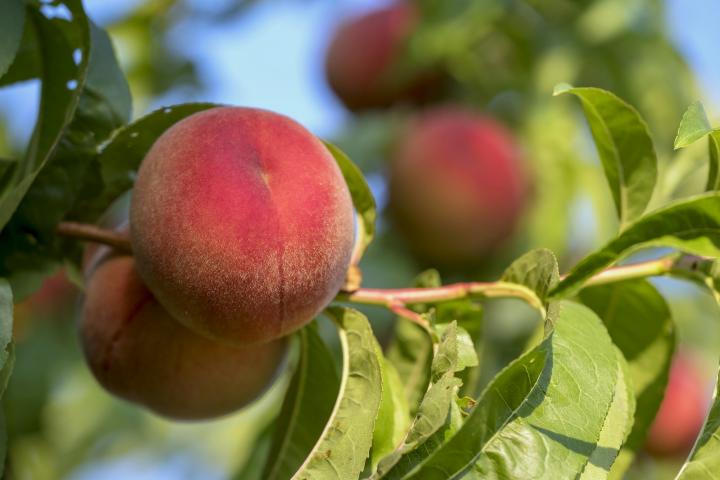
Check out our video to learn more about how to plant a bare–rooted fruit tree.
An Alternative Planting Method
If your circumstances are suitable, you might want to try a technique practiced in England. It involves planting a peach tree—ideally a dwarf variety—on the south side of the home (or other structure), directly under the eaves. Over time, the gardener prunes and trains the peach tree to espalier in a fan shape against or very near to the wall of the house.
Plastic sheeting is attached to the eaves and draped to cover but not touch the tree, similar to a lean-to tent. This keeps the tree dry in winter, and the tree enjoys the warmth of the sun—directly and reflected off the house—year-round. The plastic should be opened or lifted during bloom time to welcome pollinating insects and on hot, sunny days to ventilate the tree and prevent foliage burn.
Types
- ‘Redhaven’, which is the standard and most popular choice. These peaches are medium-size, but can be small if the tree is not properly thinned. Its skin is tough and firm and red in color.
- ‘Reliance’, which is a hardy variety. It produces small and soft fruits.
- ‘Harmony’ (‘Canadian Harmony’), which is winter hardy and moderately resistant to bacterial leaf spot. It produces medium to large fruit and freezes well.
- Some zone favorites are:
| Zone | 4 | 5 | 6 | 7 | 8 | 9 | 10 |
| Variety | Hale | Madison | Saturn | Contender | Frost | Topaz | Florida Beauty |
Harvesting
- Peaches are harvested when they are fully ripe from late June through July and August.
- With peaches, it’s especially important to harvest at the RIGHT time.
- Though this timing depends on what type of peach variety, you can generally go by the color of the fruit. When peaches are fully ripe, the ground color of the fruit changes from green to completely yellow. No green should be left on the fruit. They should come off the tree with only a slight twist. The fruits found on the top and outside of the tree usually ripen first.
- Be careful when picking your peaches because some varieties bruise very easily.
- Tip: Peaches ripen faster in a closed paper bag at room temperature.
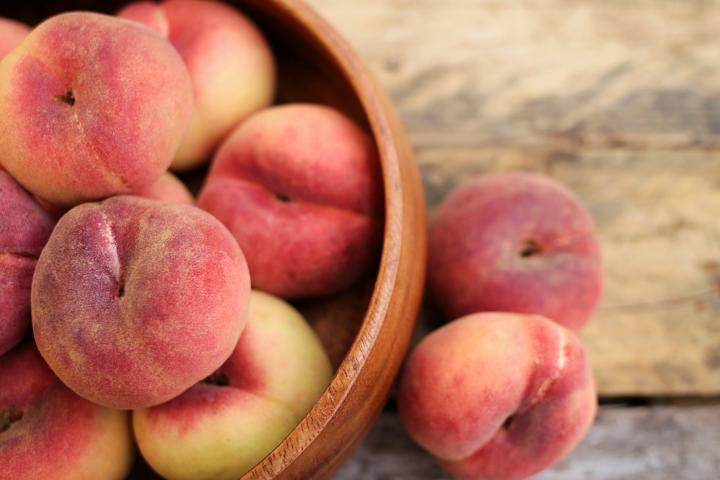
How to Store Peaches
- You can store peaches in the refrigerator in a plastic bag. They should keep for about 5 days.
- You can also make use of fresh peaches by making peach jam or peach butter.
- Peaches can also be canned or frozen for storage.
Gardening Products

More Like This





- « Previous
- 1
- 2
- …
- 10
- Next »

Comments