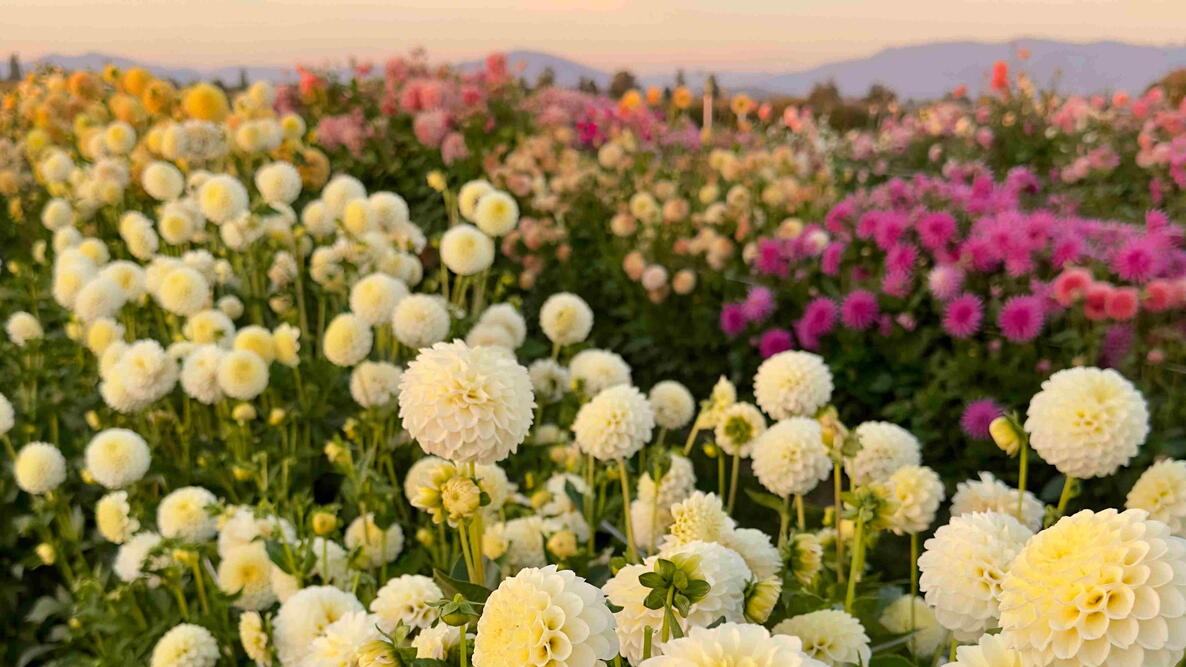
Caption
A field of dahlias in full bloom, showcasing the incredible range of colors and forms.
As a small-scale flower farmer who grows thousands of dahlias each year, I’ve learned what actually matters when you’re choosing varieties for a real garden—your space, your purpose, your budget, and how each plant behaves once it’s in the ground. That’s where I come in!

Spring is the perfect time to plan a dahlia garden, but with over 57,000 cultivars recognized by the American Dahlia Society, it can be daunting to know where to begin. Dahlias are stunningly beautiful, relatively easy to grow, and generous with both blooms and tubers—but choosing the right ones is the real challenge.
This guide will help you sort through the noise and choose dahlias that will truly thrive in your garden.
How to Pick the Right Dahlia Variety for Your Garden
If you ask a dozen growers how they chose their first dahlias, you’ll likely get a dozen different answers. Becoming a flower farmer was not on my BINGO card when I planted my first tubers, and I’ll admit I focused on all the wrong things.
Instead of considering form, size, or vigor, I was smitten with the names—the more unique, the better. Cue ‘Connecticut Dancer’, ‘Diva’, ‘Fuzzy Wuzzy’, ‘Lemon Meringue’, ‘Rejman’s Polish Kid’, and ‘Valley Rust Bucket’. Let’s just say my first dahlia garden was eclectic at best.
If I were to do it all over again, my goals would be practical: choosing cultivars that fit my space, purpose, and budget, and paying attention to how each plant actually grows.

Consider your space first
Dahlias can be grown successfully in every state. They’re often hardiest in growing Zones 8 to 10, where they may overwinter as perennials if conditions are right, but they also grow beautifully as annuals in Zones 3 to 7.
I have a friend in Alaska with an exceptionally short growing season who starts her dahlias indoors to give them a jump start before it’s warm enough to plant them in her community garden.
Not everyone has acreage to plant hundreds (or thousands!) of dahlias, so think about how you envision planting them: as border plants, in container gardens, in a flower bed, or in a school or community garden.
And finally, consider how much space you have within your location. Dahlias need at least 12 inches between plants. Taking a few minutes to measure your growing space to determine how many dahlias will fit is a great first step (and can prevent overspending when you’re tempted to buy “just one more!”).
Choose dahlias based on your purpose
Thinking about why you want to grow dahlias will help you narrow down the types that are right for you. If your purpose is nothing more than the pleasure of growing something beautiful, then the sky’s the limit!
If you are interested in adding dahlias to your pollinator garden, you will want to focus on open-centered dahlias, such as anemones, collarettes, and singles.
You might opt for shorter, more compact dahlias for borders or containers, whereas dahlias with long, strong stems and prolific blooms are ideal for cutting gardens.
Or maybe you’re interested in the dahlia exhibition world—whether showing at the county fair or an ADS show, brush up on form requirements and past winners, then select your dahlias accordingly.
Workhorses vs. unicorns
The prices range from $5 to $50 per tuber, but buyer beware: expensive does not necessarily mean better quality. It’s common in dahlia circles to hear growers refer to dahlias as “workhorses” or “unicorns,” and the unicorns are typically what capture people’s attention when bloomscrolling on social media.
The unicorns are usually newer cultivars, meaning supply is nowhere near meeting demand, or their tubers are finicky in a way that limits their availability (for example, the variety is a poor tuber producer or the tubers overwinter poorly).
Unicorns often sell out within seconds of farms opening tuber sales, making them hard to acquire. I have chased my fair share of unicorns, and unfortunately, they don’t always live up to the hype.
There have been plenty of times I’ve waited in anticipation for a coveted dahlia to start blooming, and when it finally does, it’s nothing like the curated social media picture that convinced me I needed it. It’s the ultimate sad trombone melody: whomp-whooommmmp.
Workhorses, on the other hand, are the best bet for beginning and even intermediate growers. As an experienced grower, I continue to fill my field with hundreds of workhorses every year because they are dependable and fulfill my needs.

They are easy to source because they produce many tubers, and there are always flower farms growing them, as their stems are essential for filling bulk harvest orders. They also create a strong base in flower arrangements to let those fancy unicorns “pop.”
Some of my all-time favorite dahlias fall in the workhorse category: ‘Coralie’, ‘Cornel’, ‘Hy Suntan’, ‘Isabel’, ‘Ivanetti’, ‘Sonic Bloom’, and ‘Terracotta’. Since they are readily available, they are an inexpensive way to build a beautiful—and bountiful—dahlia garden!
Where to buy healthy dahlia tubers
And speaking of readily available tubers, a word of caution before grabbing a bag of Dutch-imported tubers from the big box store: it is common for imported tubers to be mislabeled, shriveled, have broken necks, or be infected with disease such as crown or leafy gall.
While this is not always the case, there is an increased risk of these factors due to machine-harvesting practices at large-scale operations. Unfortunately, crown gall and leafy gall cannot be cured and will also infect the soil.
If you choose to grow Dutch-imported tubers, consider growing them in planters or grow bags while monitoring their health.
Your best bet for sourcing healthy dahlia tubers is to buy from small-scale, U.S. growers. Many dahlia societies have sales each spring, and you can find a dahlia society near you by visiting the American Dahlia Society website: www.dahlia.org.
An incredible resource is the online database, Dahlia Addict (www.dahliaaddict.com). Type in the dahlia you want to find, and it will pull up all the farms that sell it, complete with prices, links to sellers’ websites, and seller reviews.
Not looking for a specific variety? You can also search by form, color, and size.
Once you start exploring sellers’ websites, pay attention to statements about how farms mitigate plant disease and viruses through responsible harvesting and dividing practices. Things many sellers note are Department of Agriculture nursery stock inspections, culling sick dahlias, and disinfecting clippers when harvesting stems and dividing tubers.
How Dahlias Are Classified (In Plain English)
Dahlias are most often described by their form, or shape. The American Dahlia Society has a very technical system that assigns a 4-digit classification number to ADS-registered dahlias, with each digit representing size (first digit), form (second digit), and color (third and fourth digits).
There are six different sizes, six main forms, and fifteen color classes.
Notice I said six “main” forms? That’s right, there are actually 14 more, often called “other types,” and instead of being classified by size, their first two digits represent their form.
Scratching your head yet? Don’t worry, you don’t need to know how to classify dahlias to grow them.
We’re going to focus on a few common dahlia forms and how they perform in gardens.
Common Dahlia Shapes (and How They Grow)
Anemone Dahlias

Anemone dahlias feature a dense mound of tubular florets in the middle, surrounded by a ring of flat petals. Some people compare them to pincushions or daisies.
When selecting anemones, pay attention to plant height. Some, such as ‘Totally Tangerine’, grow on the shorter side and may be preferred as border plants, whereas others grow up to 4 feet and will do just fine in a field or large garden setting.
Anemones tend to drop their petals quickly, so they aren’t ideal for long-lasting arrangements, but they add a visual pop to the garden and are loved by pollinators.
Ball, Mini-Ball, and Pompon Dahlias

Ball, Mini-Ball, and Pompon dahlias all share the same petal form attributes. Blooms are sphere/ball-shaped, with petals completely covering the flower head and reaching back toward the stem.
Each of these comes in a variety of colors, and most grow 2.5 to 4 feet tall. Pompons are less than 2 inches in diameter, mini-balls are between 2 and 3.5 inches, and balls are over 3.5 inches.
Ball dahlias are known workhorses, providing abundant blooms and tubers, and are among the easiest dahlias to grow. They are a staple in every dahlia garden!
Collarette Dahlias

A favorite with pollinators, collarette dahlias feature open centers with a single row of petals and petaloids that create a collar around the center.
Collarettes are quick to go to seed, so harvest or deadhead often to keep them churning out blooms. While collarettes are not known for a long vase life, they are a whimsical addition that attracts pollinators.
Decorative Dahlias
If you’re picturing full, lush dahlias with layers of petals, you’re probably thinking of decorative types. These are among the most popular dahlias for home gardens, thanks to their abundant, eye-catching blooms.
Decorative dahlias are separated into two distinct classifications: Formal Decorative and Informal Decorative. Both are fully double and come in a range of heights and bloom sizes.
Formal Decorative petals are broad and flat. Their uniform, symmetrical blooms have a neat, structured look.

Informal Decorative petals are less uniform, typically curly or wavy. This gives them a more romantic, visually engaging appearance in the garden and in bouquets.

Both types are popular for displays and cutting gardens because they are prolific bloomers, and work well in flower arrangements.
Laciniated Dahlias

Laciniated dahlias have petals with split tips. The adjectives used to describe laciniated dahlias are almost as fun as the dahlias themselves: shaggy, frilled, wild, fluffy, lacy, feathery, and twisty.
I will always remember my first laciniated dahlia, ‘Myrtle’s Folly’, and gleefully saying, “THAT is a dahlia?!” Its blooms reminded me of my favorite muppet’s pigtails!
Laciniated dahlias are easy to grow, come in all colors, and add an unexpected zing to arrangements.
Cactus Dahlias

There are three types of cactus dahlias (Semi-Cactus, Straight Cactus, and Incurved Cactus), but we will touch on Semi-Cactus because it’s my personal favorite of the three.
Semi-Cactus dahlias have uniform petals with broad bases that narrow toward the tips. They appear less “pokey” than their Straight Cactus and Incurved Cactus counterparts.
I find them a bit easier to use in arrangements. Cactus dahlias also add texture and interest to gardens.
Stellar Dahlias

Stellar dahlias have narrow petals, pointed tips, and create a star-like shape. Stellar dahlias are beautiful in the garden and as cut flowers.
There aren’t as many stellar cultivars readily available compared to more common dahlia forms, such as decoratives or ball. With growing interest in dahlia hybridizing and the stellar form becoming more popular, we may see more of these in the future.
Waterlily Dahlias

The current “it” form is the Waterlily. Waterlily dahlias are defined by their fully double saucer-shaped bloom with a closed center.
They may look romantic and delicate, but often grow on tall, strong stems and can hold their own in bouquets.
Perhaps the loveliest characteristic of some waterlilies is that they tuck themselves in at night, cupping their petals closed when the sun goes down!
Although newer waterlily cultivars come with steep price tags, there are many classic waterlilies to be found at reasonable prices.
Classification Summary
| Dahlia Form | Average Size | Best For | Recommended Cultivars | Difficulty |
|---|---|---|---|---|
| Anemone | Height: 30–48” Bloom: 3–5” | Garden impact Container beds Pollinator gardens | Polka Take Off | Easy |
| Ball | Height: 36–48” Bloom: 3.5–4” | Bouquets Cut flowers Landscape | Cornel Cornel Bronze | Easy |
| Mini Ball | Height: 24–48” Bloom: 2–3.5” | Bouquets Cut flowers Landscape and borders | Creamy Fifi | Easy |
| Pompon | Height: 24–36” Bloom: <2” | Bouquets Cut flowers Borders | Burlesca Chick-a-Dee | Easy |
| Collarette | Height: 24–48” Bloom: 3–6” | Borders and containers Pollinator gardens Collecting seed | Apple Blossom Pipsqueak | Easy |
| Formal Decorative | Height: 24–48” Bloom: 4–6” | Bouquets Cut flowers Landscape and borders | Foxy Lady Last Dance | *Easy |
| Informal Decorative | Height: 24–60” Bloom: 4–8” | Bouquets Cut flowers Statement plants | Gay Princess Sonic Bloom | *Easy |
| Laciniated | Height: 42–60” Bloom: 6–8” | Bouquets Cut flowers Statement plants Exhibitions | Hapet Perfekt Hollyhill Pinkie | Easy |
| Semi-Cactus | Height: 36–60” Bloom: 4–8” | Cut flowers Garden borders Statement plants | Miss Rose Fletcher Terracotta | Easy |
| Stellar | Height: 24–48” Bloom: 4–6” | Bouquets Cut flowers Containers | Alloway Candy Fidalgo Julie | Easy |
| Waterlily | Height: 24–48” Bloom: 3–6” | Bouquets Cut flowers Garden borders | Karma Prospero Keith H | Easy |
*Formal Decorative and Informal Decorative dahlias that are dinnerplate dahlias are moderate in difficulty level due to the extra work required to provide them support.
Dinnerplate Dahlias

I would be remiss not to mention dinnerplate dahlias. While “dinnerplate” is not an actual classification term, it’s a common nickname for what the ADS recognizes as Giant (Size AA), which are blooms 10 inches or greater. Many also consider dahlia blooms 8 to10 inches (Large/Size A) dinnerplate-sized. I am forever awestruck by flowers that are larger than my face, and I grow several dinnerplate dahlias for personal pleasure.
Be prepared to provide extra support to hold those heavy blooms upright. The large blooms can get waterlogged in the rain; with proper staking and regular deadheading, though, dinnerplate dahlias will thrive.

Examples of Dinnerplate Dahlias
| Cultivar/Variety | Size | Form | Color |
|---|---|---|---|
| Clearview Jonas | A / Large (8–10”) | Semi-Cactus | Pink & Yellow |
| Hercules | A / Large (8–10”) | Formal Decorative | Golden Orange |
| Spartacus | A / Large (8–10”) | Informal Decorative | Dark Red |
| Vancouver | A / Large (8–10”) | Novelty Fully Double | Purple & White |
| Penhill Dark Monarch | AA / Giant (10” or greater) | Informal Decorative | Dark Pink |
| Penhill Watermelon | AA / Giant (10” or greater) | Informal Decorative | Pink & Yellow |
| Sherwood’s Peach | AA / Giant (10” or greater) | Informal Decorative | Peach |
Do All Dahlias Grow the Same Way?
Aside from dinnerplate dahlias, which may need extra support, the growing needs of all dahlias are remarkably similar. What you do for one dahlia, you can do for all dahlias, regardless of their classification.
I plant all of mine in rows by color, with little regard for their form. They are all given the same support system (corralling with t-posts and twine), the same irrigation, the same fertilizer, the same love.
This is great news because it means you don’t have to overthink it!
Start with a few reliable varieties, see what thrives in your space, and go from there. Before long, you’ll have your own favorites—and maybe a few that surprise you.
About the Author
Melissa Brown is an educator by day, and a flower farmer by night, weekends, and all free moments in between. Melissa, along with her husband Jeff and their two sons, owns a small-scale flower farm in Skagit Valley, Wash., called Bee Merry Farm. You can follow along with their journey on Instagram at @beemerryfarm.

More Like This

Comments