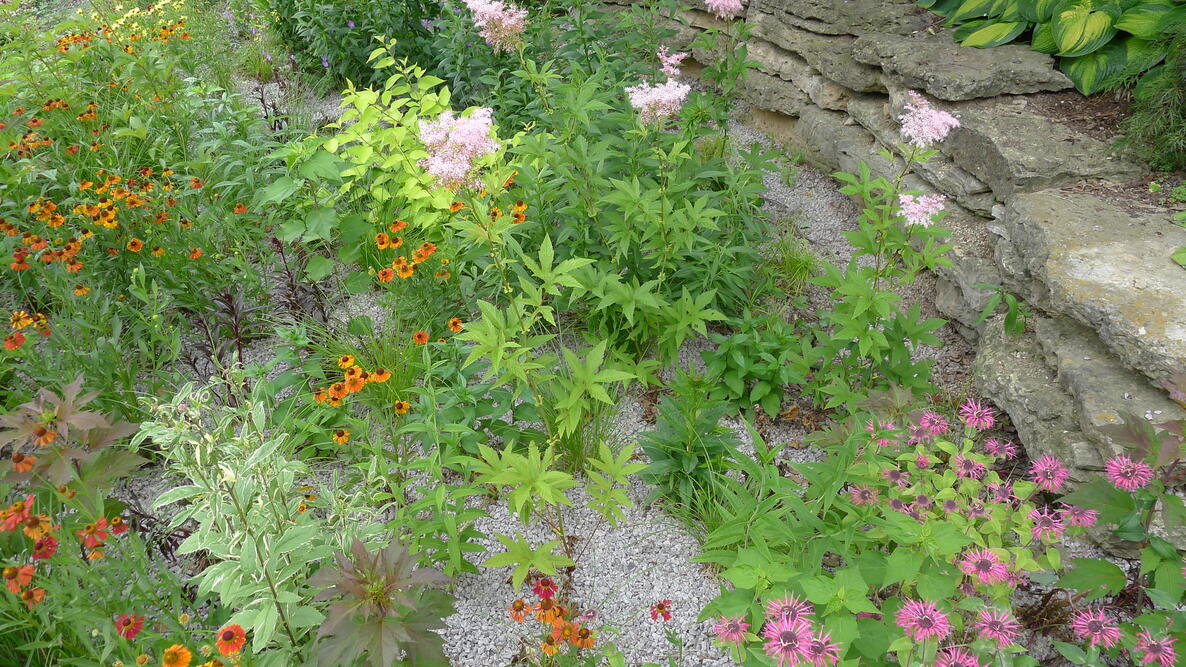
Caption
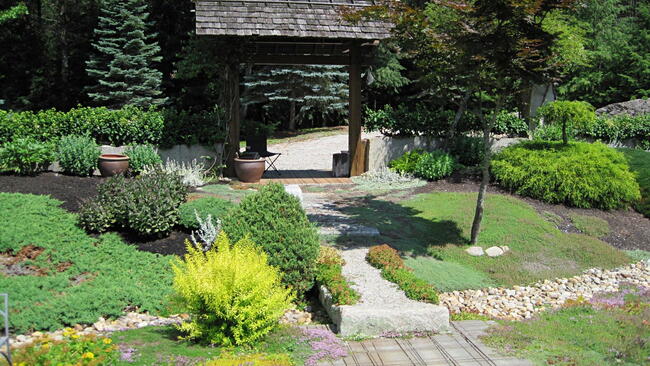
Rain garden in the Allen Centennial Gardens on the campus of the University of Wisconsin-Madison

Rain garden plans help turn extra rain and soggy spots into workable garden layouts. With clear layouts and plant combinations, they show how water is managed within the garden and how different plants work together in sun and shade.
If you’re looking for background on rain gardens and whether one is right for your yard, see Rain Gardens: 8 Things to Know Before You Build One.
Planning a Rain Garden: How Water Moves Through the Space
Since rain gardens are designed to catch runoff from roofs, driveways, walkways, and other hard surfaces, planning starts with understanding how water enters and moves through the garden. A rain garden is shaped to slow water down and spread it out, allowing it to soak into the ground rather than rushing away.
In a well-planned rain garden, the wettest conditions occur near the center, where water collects first. Areas toward the edges dry out more quickly. The garden plans in this article show how plants are arranged to match these changing moisture levels, with water-tolerant plants placed where water lingers and drier-soil plants positioned farther out.

Why Planning Matters
Rain gardens work best when water flow and plant needs are considered together. A clear plan helps determine where runoff enters the garden, how long different areas stay wet after rain, which plants should be grouped together, and how much space is needed to manage excess water. The example plans and plant lists that follow illustrate these relationships and can be adapted to different yard sizes and conditions.
Planning a Rain Garden: Location and Size
Rain garden plans assume the garden is located downhill from a source of runoff and at least ten feet away from a home’s foundation. Avoid directing water toward septic systems or areas where water already stands for long periods.
Before choosing a location, test how quickly the soil drains. Dig a hole about ten inches deep and fill it with water. If the water drains within 48 hours, the site is suitable for a rain garden.
As a general guideline, a rain garden should be about 20 to 30 percent the size of the area draining into it. For example, runoff from a 1000-square-foot roof can typically be handled by a rain garden about three hundred square feet in size.
Garden Shape and Soil Preparation
Most rain garden plans use a shallow, bowl-shaped form with gently sloping sides. Soil removed during digging is often used to create a low berm along the downhill edge to help hold water briefly during heavy rain. In areas with heavy or compacted soil, improving drainage is important. A commonly recommended mix includes one-half sand, one-quarter compost, and one-quarter topsoil to create a fast-draining but moisture-holding base for plants.
Planting Zones in a Rain Garden
Rain gardens are planted in zones based on moisture levels. Plants that tolerate wetter soil are placed near the center of the garden, where water collects first. Plants that handle occasional saturation are planted in the middle areas, while plants that prefer drier conditions are placed along the outer edges. This approach keeps plants healthy and helps the garden look natural and balanced.
Rain Garden Plans and Plant Lists
Plants of all types and sizes help manage excess water, so rain garden plans typically include a mix of trees, shrubs, grasses, and perennials.
- Trees and large shrubs help slow rainfall before it reaches the ground, giving water more time to soak into the soil.
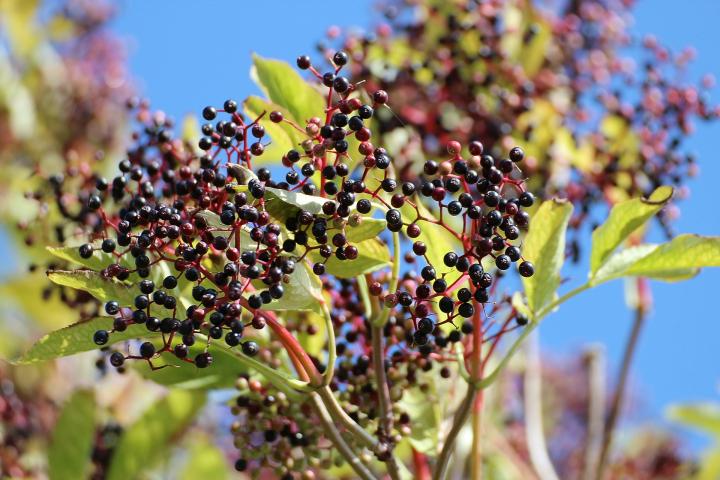
- Tall grasses act as filters, sucking up water, trapping pollutants, and preventing silt from being carried off into ponds or rivers.
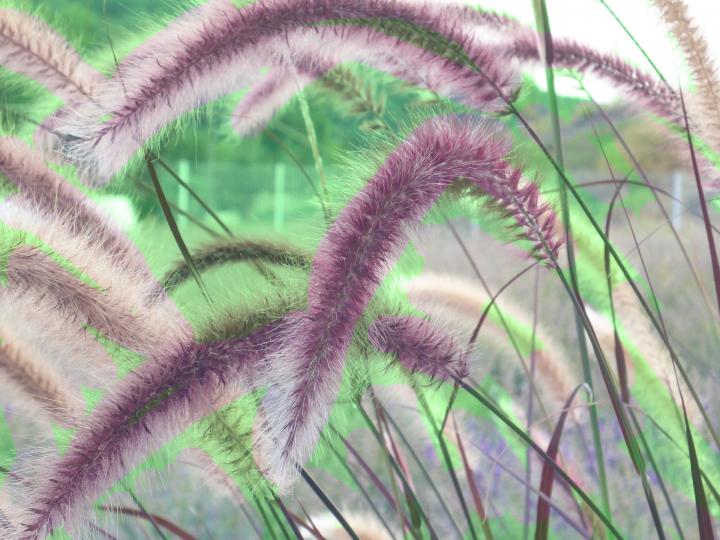
Shorter, well-established plants with deep roots help hold soil and direct water into the ground.
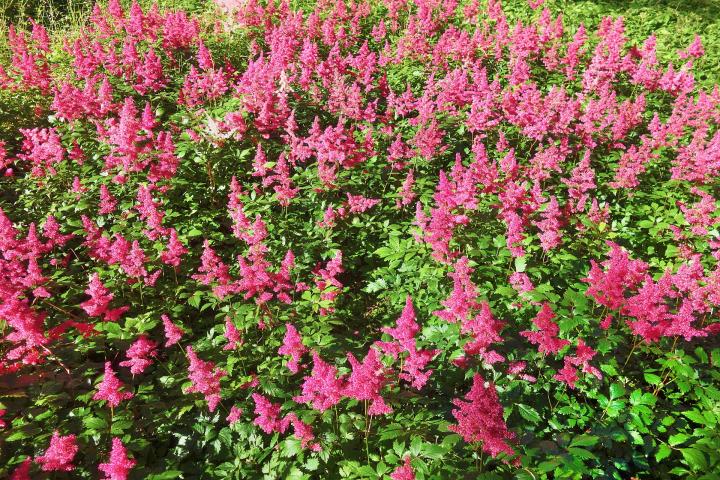
Deep-rooted perennials like astilbe help stabilize soil and guide water into the ground.
Planting a Rain Garden
We’ve provided sample plant lists below, but it helps to understand how plants are typically arranged in a rain garden. Contrary to common belief, rain gardens are not planted with true wetland plants. Instead, they use plants that can tolerate temporary saturation, followed by normal drying.
Plants in the center of the garden are usually woody and herbaceous perennials that can handle wetter soil for short periods. Surrounding areas are planted with species that tolerate occasional standing water, while the outer edges are reserved for plants that prefer drier conditions.
Many rain garden plants are native and well-adapted to these changing moisture levels. Favorites include purple coneflower, summersweet, and, in shadier areas, plants such as lady ferns.
Once planted, mulch the garden with compost or shredded hardwood to help retain moisture and protect the soil. Bark chips are less suitable, as they may float during heavy rain. If mulch shifts or washes away, breaking up the flow of water as it enters the garden—using a strategically placed rock, for example—can help slow it down.
Rain Garden for Sun
Rain gardens in full sun must tolerate both brief flooding and dry periods between storms. In this plan, moisture-tolerant plants are placed near the center of the garden, while plants that prefer drier soil are placed along the outer edges.
The rain garden plan below is designed for a 12x24-foot space but can be scaled up or down to fit different yards.
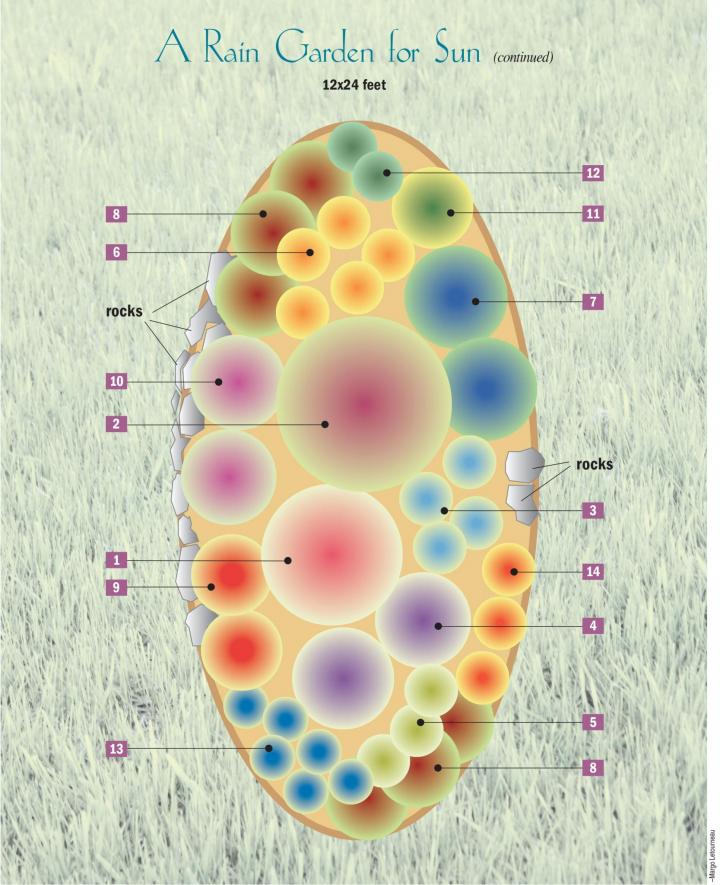
Sun Rain Garden Plant List
In the center, plant #1 to #6. For the drier, outer edge, plant #7 to #14.
- Summersweet (Clethra alnifolia ‘Ruby Spice’), a woody shrub that bears fragrant, pink, bottlebrush flowers in the summer. 5 to 6 feet tall; Zones 4 to 9. One plant.
- Red osier dogwood (Cornus sericea), which has white blossoms in spring and reddish-purple leaves in the fall—although its most attractive features are its red stems, which lend winter interest to the landscape. 6 to 10 feet tall; Zones 2 to 8. One plant.
- Blue flag iris (Iris versicolor), which brightens the rain garden with lavender-blue flowers in the spring. It looks very natural in a wet setting. Avoid the yellow flag iris (Iris pseudacorus), which is an invasive species that will take over. 2 to 4 feet tall; Zones 3 to 9. Four plants.
- Joe-pye weed (Eupatorium maculatum), which has purple flowers in late summer that butterflies can’t resist. 3 to 5 feet tall; Zones 3 to 7. Two plants.
- Astilbes (Astilbe), which are long-lived, moisture-loving perennials that will thrive in the sunny rain garden if planted where they get some afternoon shade from taller shrubs nearby. They bloom in summer and are available in pinks, reds, purple, and white. 1 to 3 feet tall; Zones 3 to 8. Three plants.
- Daylilies (Hemerocallis), which may not be natives but can keep your rain garden in bloom over a long season if you plant early, midseason, and late varieties. Assorted heights and a rainbow of colors are available. Zones 4 to 11. Five plants.
- Blueberries (Vaccinium), whether highbush (up to 5 feet tall) or lowbush (up to 2 feet tall) varieties, which add both a flowering shrub and an edible fruit to your landscape. Zones 3 to 8. Two plants.
- American cranberry (Vaccinium macrocarpon), which is a pretty, ground-covering shrub that also bears edible fruit. About 6 inches tall; Zones 2 to 7. Six plants.
- Bee balm (Monarda), which in summer features brilliant-red, pink, or white flowers that attract hummingbirds and butterflies. Look for a mildew-resistant variety. 3 feet tall and wide; Zones 3 to 9. Two plants.
- New England aster (Aster novae-angliae), which will carry the show into fall with its bright, violet-purple flowers. It gets quite tall but can be cut back to half its height in June to create a shorter and bushier plant, if desired. Up to 6 feet tall; Zones 4 to 8. Two plants.
- Sneezeweed (Helenium autumnale), which bears sunny yellow flowers in late summer. It is highly adaptable to wet or dry soil. 3 to 5 feet tall; Zones 4 to 8. One plant.
- Meadow anemone (Anemone canadensis), which is a deer-resistant and salt-tolerant plant. This tough little perennial bears pure-white blossoms in late spring. 2 feet tall; Zones 2 to 9. Two plants.
- Blue cardinal flower (Lobelia siphilitica), which has spikes of true blue flowers in late summer. 2 to 4 feet tall; Zones 5 to 9. Six plants.
- Butterfly weed (Asclepias tuberosa), which features orange blossoms that provide excellent nectar for butterflies. In addition, the plants are an important larval food for monarch butterflies. 2 to 3 feet tall; Zones 4 to 9. Three plants.
Rain Garden Plan for Shade
Rain gardens for shade work best in partial shade rather than full shade. As with sunny gardens, plants that tolerate wetter conditions are placed toward the center. The rain garden plan below is designed for a 12x24-foot space but can be scaled up or down to fit different yards.
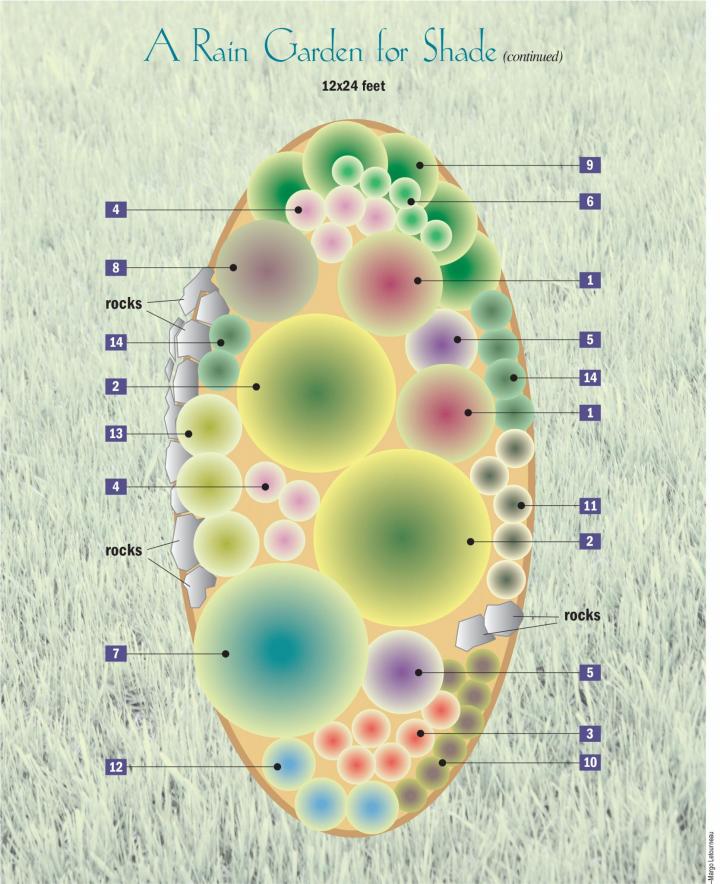
Shade Rain Garden Plant List
In the center, plant #1 to #6. For the drier, outer edge, plant #7 to #14.
- Rhododendrons, especially cold-hardy native rhodora (Rhododendron canadense), which like damp soil and partial sun. They will bloom profusely in the spring. 2 to 4 feet tall and wide; Zones 3 to 6. Two plants.
- Winterberry (Ilex verticillata), which needs one male plant to act as a pollinator, along with the females, if you want a crop of colorful red berries. For this garden size, choose from dwarf cultivars. 3 to 5 feet tall; Zones 3 to 9. Two plants.
- Cardinal flower (Lobelia cardinalis), which grows well in sun or partial shade. It has rich red flowers in late summer. 2 to 3 feet tall; Zones 3 to 9. Six plants.
- Pink turtlehead (Chelone lyonii), which is a trouble-free perennial that doesn’t mind wet feet. It blooms in the late summer to early fall. 2 to 4 feet tall; Zones 3 to 8. Seven plants.
- Purple meadow rue (Thalictrum dasycarpum), which loves a damp spot in partial shade. It can get quite tall and has clouds of purple-tinged white blossoms in summer. 3 to 6 feet tall; Zones 5 to 9. Two plants.
- Wild columbines (Aquilegia canadensis), which are an important source of nectar for hummingbirds and butterflies and thus will draw them to your rain garden. They produce their bicolor red and yellow blossoms in late spring. 1 to 3 feet tall; Zones 3 to 8. Five plants.
- Arrowwood (Viburnum dentatum), which is a nicely rounded shrub with glossy leaves and dark blue berries. It has creamy white blossoms in late spring and colorful fall foliage. 6 to 10 feet tall and wide; Zones 3 to 8. One plant.
- Dwarf fothergilla (Fothergilla gardenii), which has fragrant white flowers that appear before the plant leafs out in the spring. The foliage becomes a neat, crimson mound in the fall. 3 feet tall and wide; Zones 5 to 9. One plant.
- Common bearberry (Arctostaphylos uva-ursi), which is a rugged evergreen ground cover in the heath family. It has white flowers in spring and red berries in late summer. 3 to 8 inches tall, spreading to between 2 and 4 feet wide; Zones 2 to 6. Five plants.
- Coral bells (Heuchera sanguinea), which are colorful foliage plants that send up tall spikes of tiny red, pink, or white flowers in late spring. 6 to 12 inches high and wide; Zones 3 to 8. Seven plants.
- Foam flower (Tiarella cordifolia), which is a deer-resistant plant with white flowers in spring. (Heuchera and Tiarella have been crossed to create a hybrid genus called Heucherella which combines the gorgeous foliage of heucheras with the showy flowers of tiarellas—look for this one!) 5 to 12 inches tall; Zones 3 to 7. Five plants.
- Jacob’s ladder (Polemonium reptans), which is a low-growing, spreading perennial with clusters of light-blue flowers. 8 to 12 inches tall; Zones 3 to 8. Three plants.
- Zigzag goldenrod (Solidago flexicaulis), which bears golden yellow flowers in the fall. 2 feet tall and wide; Zones 3 to 8. Three plants.
- Spotted geranium (Geranium maculatum), which has dainty, pinkish-purple flowers that bloom above the mound of lobed leaves in the spring and often again in the fall. 1 to 2 feet tall; Zones 4 to 8. Six plants.
Download the Rain Garden Plans
Printable rain garden plans for sunny and shady locations can be downloaded and used as a reference when planning plant placement and spacing. With thoughtful layout and plant selection, a rain garden can manage excess water effectively while remaining attractive throughout the growing season. Click here to download the rain garden plans (PDFs) to your computer.
Do you have a rain garden? How did you design it? What plants did you use?

More Like This

Hi Lorri, It depends. The most important thing is to look at how rainfall etc. enters YOUR garden area and position it that way. Note: In these plans, the tallest plants may be in the center, so also think of how the shadows will fall throughout the day in different orientations, especially for the Sun garden.
We wouldn't recommend trying this, as the weight of the full buckets could be significant and may pose a safety hazard, depending on your balcony. If you have an area of the balcony that gets a lot of run-off from the roof, you could place one or two large containers (with drainage holes in the bottoms) and make a sort of mini rain garden. We wouldn't recommend going beyond that!
- « Previous
- 1
- 2
- …
- 10
- Next »

Comments