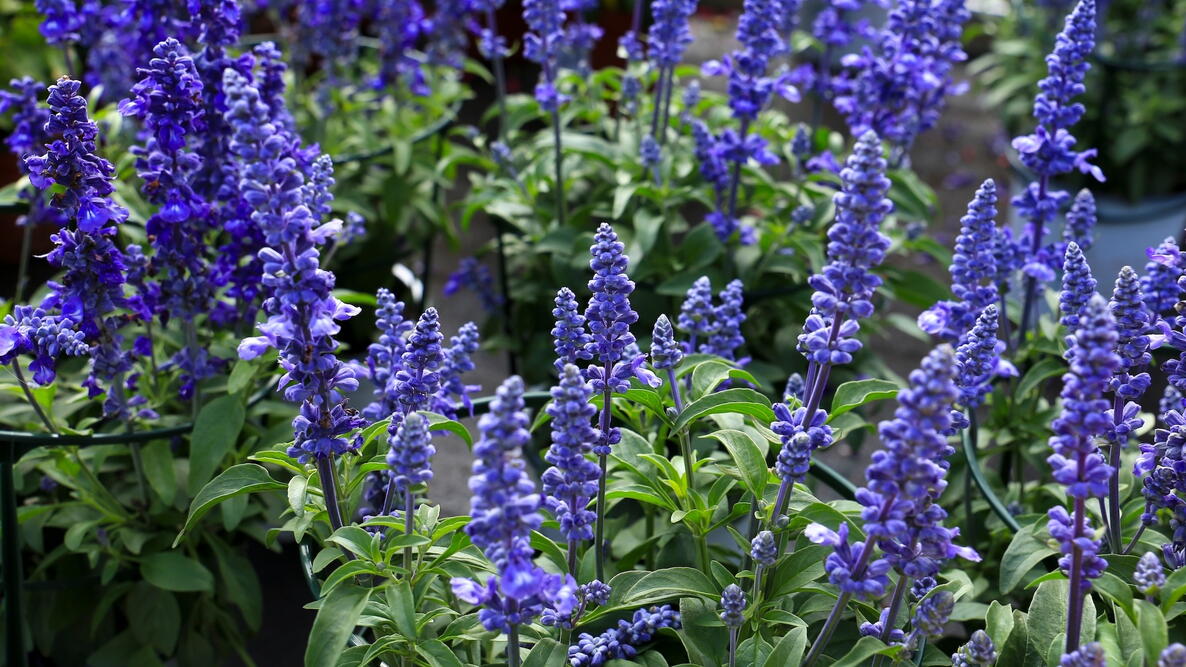

Planting
When to Plant Salvia
Direct-sow salvia seed outdoors after all danger of frost has passed in the spring. See local frost dates.
Where to Plant Salvia
All salvias do best in full sun (6–8 hours of sunlight per day) and well-draining soil. Many varieties (typically those with light-colored flowers) will also do well in part-shade, but flowering will be reduced.
How to Plant Salvia
- Loosen the soil to a depth of 12 inches, removing any large stones or roots. Mix in a 3-inch layer of compost to provide nutrients.
- If planting in a container, add some grit to the compost to improve drainage and nutrition absorption in spring. Plants grown in garden soil don’t need feeding.
- Dig a hole twice the diameter of the container the plant is in.
- Remove the plant from its container and place it in the hole so the top of the root ball is level with the soil surface.
- Space plants 1 to 3 feet apart, depending on the variety.
- Carefully fill in around the plant and firm the soil gently.
- Water thoroughly.
Growing
- Add a 2-inch layer of mulch around the plant to retain moisture and control weeds.
- Water plants during the summer if rainfall is less than 1 inch per week. Salvia does not like excessive summer irrigation.
- Feed container plants in the spring. Plants grown in a garden bed really don’t need feeding during the season.
- To encourage continuous blooms throughout the season, deadhead spent flowers periodically.
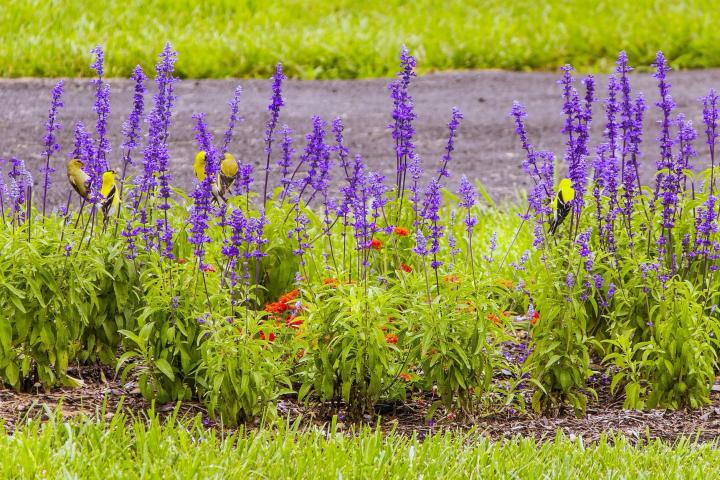
- At the end of the season, leave flowers on plants to encourage reseeding (and to feed the birds).
- Some develop woody lower stems with age; feel free to prune this.
- After the first killing frost, cut stems back to 1 or 2 inches above the soil line.
- Divide perennial salvias every few years. The best time to divide is in early spring before new growth begins. Just lift, divide into clumps, and replant.
- Every spring, apply a new thick layer of compost and mulch again.
Propagating Salvia
For the adventurous gardener, salvia cuttings can be taken in the spring or early fall.
Some salvias often self-propagate, so you might find seedlings you can use in other parts of your landscape!
Before flower buds have developed, take cuttings (remove stems) from vegetative (non-flowering) branches that are about 3 to 5 inches long. Remove the lower leaves and trim each cutting just below a node (a node is where a leaf emerges from a stem).
Insert the cuttings into a pot of pre-watered compost. Cover the pot with a clear plastic bag, trying to position the bag so that it does not touch the foliage.
Place cuttings in a spot with indirect light. After 3 weeks, cuttings should be ready to be potted up.
Types
Part of the mint family (Lamiaceae), the genus Salvia includes about 960 species; many of the tender perennials are grown as annuals in cold regions. Depending on the variety, plants can be 18 inches to 5 feet tall, but many are suitable for containers, too.
These common salvias are usually grown as annuals; they may be grown as perennials in warmer regions:
- Pineapple sage (Salvia elegans): Mexico/Guatemala native; bright red, edible flowers in late summer; leaves emit a fruity fragrance when crushed; up to 4 feet tall; hardy in Zones 8 and up
- Scarlet or Texas sage (S. coccinea): bright red flowers; hardy in Zones 9 and higher; 1 to 3 feet tall
- Scarlet bedding sage (S. splendens): Brazilian native; flowers can be red, purple, orange, lavender, yellow, or white; heart-shaped leaves; up to 2 feet tall
These salvias are usually grown as perennials:
- Autumn sage (S. greggii): blooms from spring to frost in a rainbow of colors; disease-free and drought-tolerant; 2- to 3-foot–tall mounding form
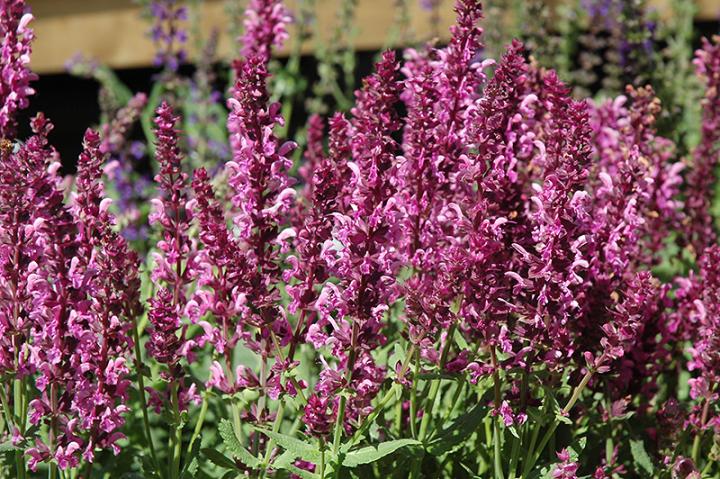
- Hybrid sage (S. x superba): ideal for cold areas; rosy purple blooms in late spring to early summer; rebloom to fall if faded flowers are cut back; 1 to 2 feet tall; ‘Rose Queen’ bears pink flowers
- Pitcher sage (S. azurea var. grandiflora), aka blue sage: aromatic foliage; large, sky-blue flowers in late fall; 3- to 5-foot clumping form
- Peruvian sage (S. discolor): native to Peru; leaves are gray-green on the top, with white undersides; dark purple flowers; spreading, floppy form; 1 to 3 feet tall
More Like This

Unlike annual salvias, which will not return the following year, perennial salvias should show new growth each year. However, many factors can affect their timing. Are these established plants? If so, look for them to start new growth around the same time as last year, although certain stresses may cause delays. Is there any sign of damage to the two plants, from overwintering, animals, or disease/insects? If not, your salvias likely should start growth by mid to late May, but this can depend on species--some emerge later than others. A period of warmer weather may help to wake them up. For more information about how salvias are emerging in your area, you might try contacting a local garden center or your county's Cooperative Extension--contact information can be found here:
https://extension.psu.edu/county-offices
Hope this helps!
Hi Michael,
In your area, it is best to just leave the stems alone until early spring—when the chance of frost has passed—and new growth begins. At that time you can prune away the old stems. This will help to avoid any freeze damage that could take place during any cold stretches this winter.
Hope this helps!
- « Previous
- 1
- 2
- …
- 10
- Next »

Comments