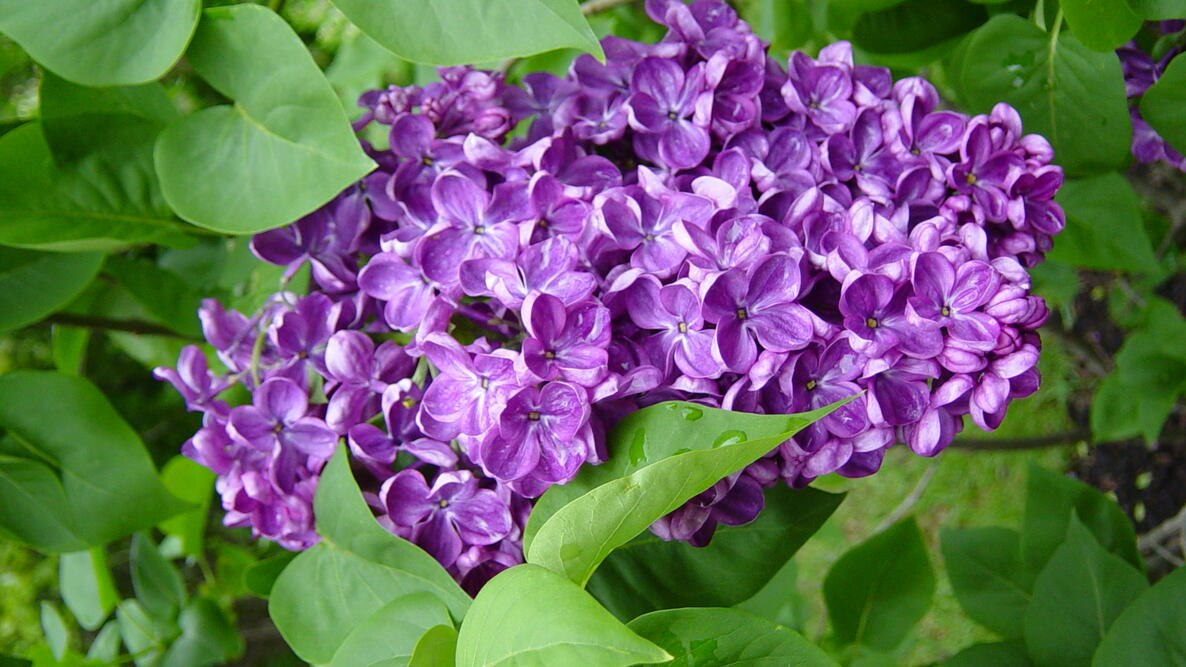
Caption
Huge blooms, wonderful scent.
Planting, Growing, and Pruning Lilacs

Read Next
Types
For early flowers, try Syringa x hyacinthiflora hybrids; they bloom 7 to 10 days before S. vulgaris. Its fragrant blooms attract butterflies and hummingbirds.
The most common and fragrant lilacs are of the S. vulgaris variety:
- Try ‘Charles Joly’, a double magenta flower, an early bloomer.
- Mid-season lilacs include ‘Monge’, a dark reddish purple, and ‘Firmament’, a fine blue.
- Late-season beauties include ‘Miss Canada’, a reddish-pink, and ‘Donald Wyman’, a pink-purple flower.
Uncommon types/varieties include …
- S. x ‘Penda’ Bloomerang Purple: flowers in spring, pauses, then flowers again from midsummer through fall.
- Although common lilacs love cold weather, a few thrive as far south as Zone 8, including cutleaf hybrid S. x laciniata, with fragrant, pale lavender flowers, and S. pubescens ssp. patula ‘Miss Kim,’ with pale, lilac-blue blooms that fade to white.
Small Lilacs
For gardeners, especially those in urban spaces, who just don’t have the room for the traditional larger lilac, there are compact varieties! They’ll even grow in a container on your patio or balcony.
- ‘Baby Kim’ grows only 2 to 3 feet high (and 3 feet wide) in a nicely rounded shape with purple flowers that attract butterflies. Extended hardiness from Zones 3 to 8.
- ‘Little Lady’ (S. x) is a compact lilac that matures to 4 to 5 feet tall and wide with dark pink buds that open to lilac-pink flowers. Hardy in Zones 2 to 7.
- ‘New Age Lavender’ and ‘New Age White’ (S. vulgaris) are super-compact, growing from 4 to 5 feet tall and wide, and bred for mildew resistance. Their fragrant flowers attract butterflies and hummingbirds. Hardy to Zone 4.
Gardening Products
Cooking Notes
Lilac flowers are edible, but flavor varies among cultivars, from no flavor to “green” and lemony flavors. Gather insect- and disease-free blooms early in the day. Avoid any that are unopened or past their peak. Wash the flowers gently in cool water. Pat them dry and refrigerate until ready to use.
Consider making candied lilac flowerets for a special cake decoration: Separate the individual flowers. Using tweezers, dip each one into a beaten egg white, reconstituted egg white powder, or packaged egg whites. Then, dip the flower in finely granulated sugar. Set it aside to dry before placing it on a cake.

More Like This

That sounds delicious!
Hi Dianne,
Sounds like the lilacs have been an important part of your property for many years. While it is hard to say for certain, there are a few things that could be causing your leaves to brown and dry. First of all, it could actually be two different issues. Given last year was hot and dry, your lilacs could have been dealing with drought stress. This year, it could be a fungal or bacteria disease issue that is causing your lilacs to have issues.
If it is a disease issue like blight, it's actually common to occur when spring (not summer) weather is cool and wet. If that was the case during the spring each of the last two years, that might be the cause. If it is restricted to just certain areas of your lilacs, you can pruning affected areas, which will promote new growth. Just be sure to disinfect any tools after each use.
One other cause could be nutrient deficiencies. If you have not added fertilizer in recent times, you might want to get a soil test to see where any deficiencies might be and amend your soil accordingly.
Hope this helps!
- « Previous
- 1
- 2
- …
- 10
- Next »

Comments