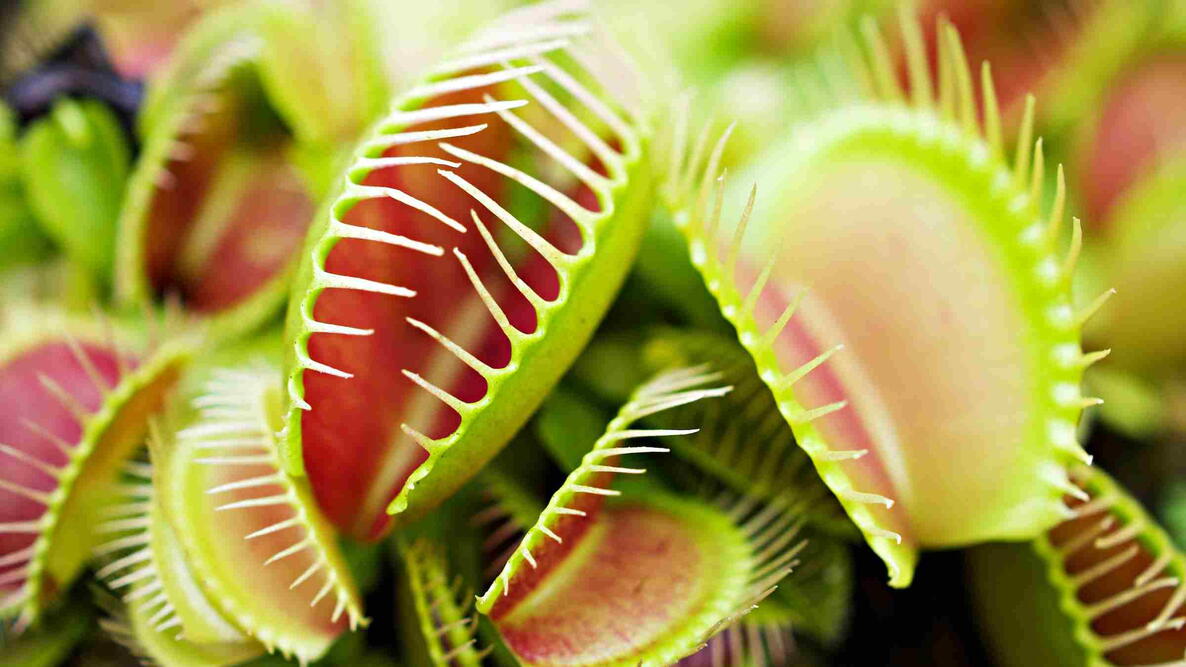
Caption
Tiny traps, big appetite: a close-up of Venus flytrap leaves

Venus flytraps may look like something from another planet, but these carnivorous plants are native to North America. They’re a must-have if you love funky houseplants that stand out. While a bit trickier to grow than your average plant, Venus flytraps can live for 20 years or more with the right care—and they can even be grown outdoors in many regions. Below, you’ll find the basics of Venus flytrap care, plus some insider tips I’ve learned from growing these bug-eating beauties myself.
About Venus Flytrap Plants
The Venus flytrap (Dionaea muscipula) is one of the world’s most famous carnivorous plants. Unlike most houseplants that come from faraway tropical places, this little perennial grows wild in the boggy coastal areas of North and South Carolina. Because of poor and acidic soil, the plant can’t get enough nutrients from the ground—so it adapted to catch its own protein: insects!
The plant’s hinged leaves snap shut when triggered by an unsuspecting bug. Each trap can digest a few meals before it withers away, while new ones grow up from the base. Outdoors, Venus flytraps can usually catch all the insects they need on their own. Indoors, however, you may need to feed them live or freshly killed bugs every few weeks.
Though often sold as novelty houseplants, Venus flytraps are hardy perennials that can live for decades with proper care. The secret is to mimic their natural habitat: give them the right soil, pure water, plenty of sunlight, and a cool winter dormancy. Think of them as bog plants rather than typical houseplants, and they’ll reward you with healthy growth and plenty of snapping action.
In warmer regions (Zones 8–10), Venus flytraps can stay outdoors year-round in open terrariums or pots where they have access to light, air, and insects. In cooler areas, they’ll need protection—either moved indoors in the fall or overwintered in a sheltered spot. For example, I keep mine in a small open terrarium with other carnivorous plants, moving them outside in summer and bringing them back in when cold weather arrives.

Planting
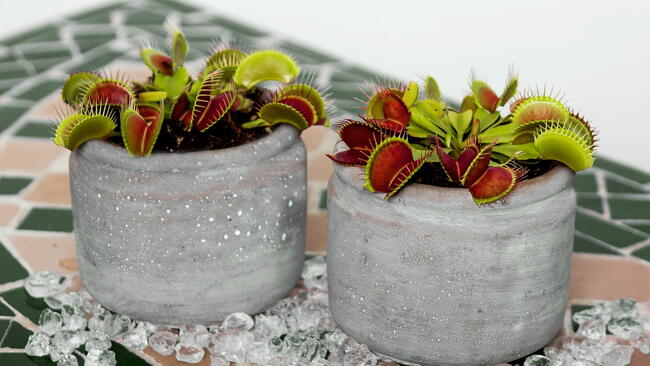
If you want to keep Venus flytraps around for the long haul, you’ll need to do your very best to mimic their natural growing environment. Since these plants love humidity and stay under 12 inches tall, they’re a good choice for terrariums and small grow cabinets. But you can also keep them in terra-cotta or ceramic pots and planters as long as you water them often.
- Select a deep container: Venus flytraps grow best in deep pots and planters, which help to keep their roots moist and insulated from cold. For best results, choose a container with drainage holes that’s at least 4 inches deep and at least 5 inches across for a single flytrap plant. Then, position your container of choice on top of a tray or saucer for easier watering!
- Be choosy about soil: Because they naturally grow in poor and acidic soil, Venus flytraps are sensitive to fertilizer, and they should never be grown in standard potting mixes or in compost, which is too rich for their needs. Instead, select a potting mix blend that’s especially designed for carnivorous plants, or make your own potting mix by blending together 1 part perlite or horticultural sand with 2 parts sphagnum peat moss, sawdust, or bark.
- Plant right: When planting time arrives, hold your flytrap by the base so you don’t accidentally activate the traps. Then, plant your flytrap at the same depth it was growing in its old container, firm the soil around your plant’s roots, and give it a good, deep drink of water. I like to layer a bit of moss on top of my plant’s substrate to keep the soil moist and give my terrarium a more natural look.

Growing
Venus flytraps don’t need to be fed insects often, but it is a necessary part of growing them indoors. You can use either live or dead insects, like small flies, crickets, or freeze-dried worms. But don’t be tempted to feed these plants meat, and make sure that whatever bugs you feed them are no larger than 1/3 of the plant’s trap size. The traps still need to be able to shut fast on their meal!

Each trap only feeds a few times before it dies back, and activating the traps unnecessarily can waste your plant’s energy and weaken flytraps over time. To avoid this, only feed your plants about once every 2 to 4 weeks, and don’t poke the traps just to watch them close. Venus flytraps only shut when two of the “trigger hairs” are activated in short succession, so you may need to brush the traps with a small paintbrush or Q-tip to help them shut if you’re using freeze-dried insects.
Potting and Repotting
How Often to Repot
Although Venus flytraps grow slowly, they should be repotted every 1 to 2 years to freshen their soil and keep minerals from building up in their pots.
When to Repot
Spring is the best time for repotting!
How to Repot
- Handle with care: Hold the base of your flytraps to avoid triggering the traps.
- Plant it right: Fill your new containers with a potting mix that’s suitable for carnivorous plants, plant your flytrap at the same depth it was growing in its old container, and water it in!

During this time, Venus flytrap leaves and traps will darken and die back, which is totally normal. Simply continue to water your plants enough so they don’t dry out, protect fragile terrariums with bubble wrap to keep them from breaking, and resume normal care for your flytraps in spring when your plants start growing again.
If it’s easier, you can also trigger dormancy by placing flytraps in your fridge for a few months!
Propagation
Although Venus flytraps can be grown from seed, this process is a long one and takes between 4 to 5 years to produce a mature plant. However, you can get results much faster by propagating flytraps via division or stem cuttings.
- Division: In late winter to spring, cut mature Venus flytraps into 2 or more sections with a sharp, sterilized knife, or use your knife to remove offsets from the parent plant. Make sure each division has a healthy nest of roots and at least one trap, and plant it ASAP in its own pot with a lean potting mix that’s appropriate for carnivorous plants.
- Leaf cuttings: In early summer, remove a healthy Venus flytrap leaf by pulling it down and out until it separates with a bit of rhizome attached at the base. Plant the cutting in its own pot filled with a carnivorous plant potting mix and cover the pot with clear plastic to hold in humidity. Once the leaf turns black, trim it away, and a new Venus flytrap plant should sprout in its place in about 6 months.


More Like This

Comments