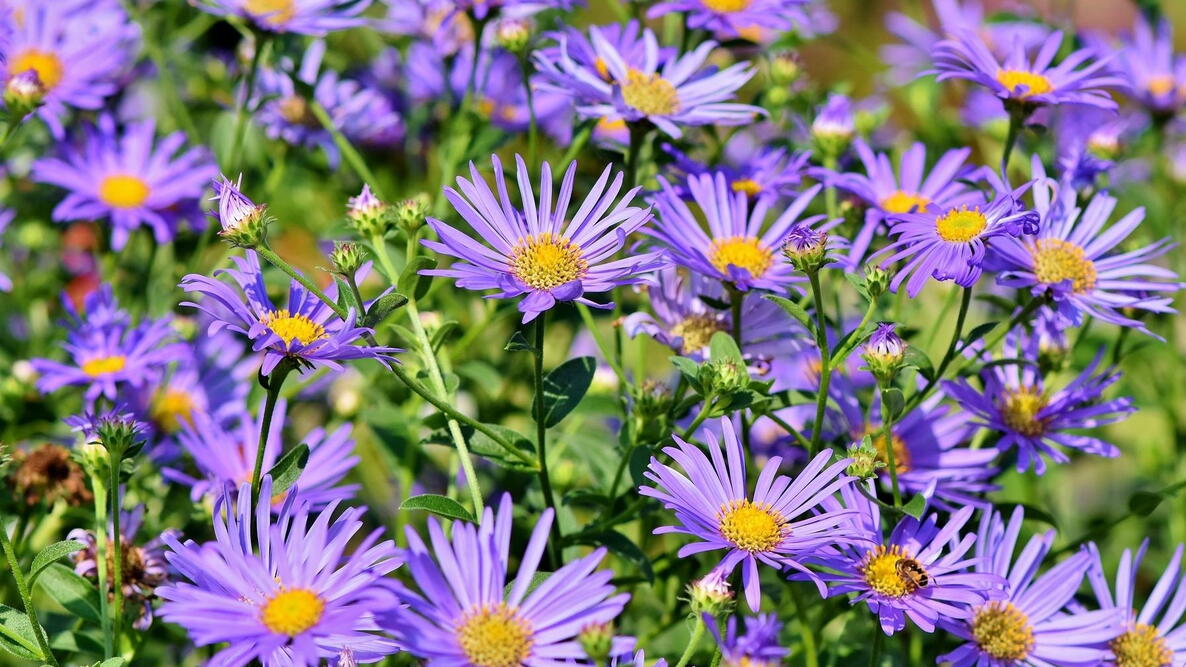

Planting
Where to Plant Asters
Asters prefer areas with cool, moist summers and cool nights in sites with full to partial sun. In warmer climates, asters do not like the hot midday sun. Soil should be moist but well-draining and loamy. Wet clay soil will lead to root rot, and dry sandy soil will lead to plant wilt. Mix 2 to 3 inches of compost into the soil before planting.
When to Plant Asters
- The best time to put young aster plants in the ground is in mid- to late spring after the danger of frost has passed. (See local frost dates.)
- Or, you can plant mature, potted asters when available at garden centers (typically in the late summer or early fall).
- Asters can be grown from seed, but germination can be uneven. If desired, plant seeds in the fall or start them indoors in the winter.
How to Plant Asters
- When planting young aster plants outside in the spring, space them 1 to 3 feet apart, depending on the type and how large they’re expected to get.
- Fully grown asters, such as those available in late summer or early fall, should be planted about 3 feet apart.
- If planting seeds, sow 1 inch deep in pots or flats and refrigerate them for 4 to 6 weeks to simulate winter dormancy. This cold period will kick-start germination.
- Water well, and spread mulch around the plants to keep the soil cool and prevent weeds.
Types
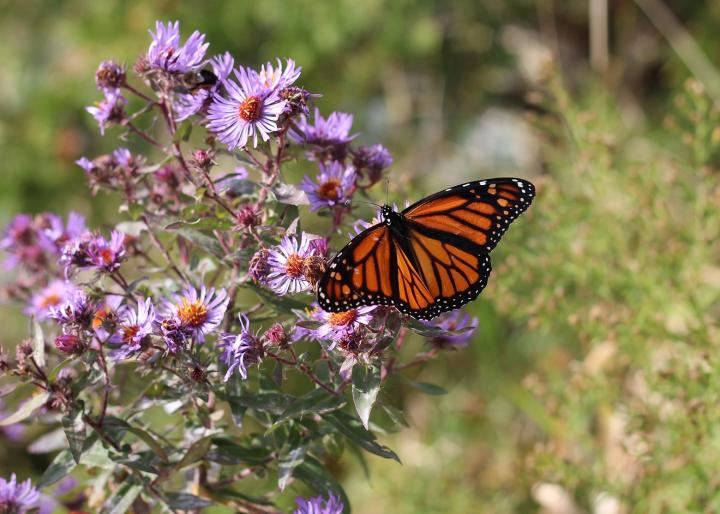
The most common asters available in North America are the New England aster (Symphyotrichum novae-angliae) and the New York aster (S. novi-belgii). Both of these plants are native to North America and are great flowers for pollinators. We recommend planting a native species of aster over a non-native species when possible, so talk with your local Cooperative Extension or garden center about which species are best suited to your area. Look for varieties with disease resistance.
North American Asters
- New England asters (S. novae-angliae): Varieties have a range of flower colors, from magenta to deep purple. They typically grow larger than New York asters, though some varieties are smaller.
- New York asters (S. novi-belgii): There are many, many varieties of New York asters available. Their flowers range from bright pink to bluish-purple and can be double, semi-double, or single.
- Blue wood aster (S. cordifolium): Bushy with small, blue-to-white flowers.
- Heath aster (S. ericoides): A low-growing groundcover (similar to creeping phlox) with small, white flowers.
- Smooth aster (S. laeve): A tall, upright aster with small, lavender flowers.
- Aromatic aster (S. oblongifolium): Multi-branched at the base, stiff upright stems, with lavender or pink flowers.
European/Eurasian Asters
- Frikart’s aster (Aster x frikartii) ‘Mönch’: Hailing from Switzerland, this mid-sized aster has large, lilac-blue flowers.
- Rhone aster (A. sedifolius) ‘Nanus’: This aster is known for its small, star-shaped, lilac-blue flowers and compact growth.

More Like This

Hi JR,
While asters prefer cooler conditions that does not mean the plants can not survive and even thrive during stretches of hotter conditions, especially once they are established. The flowers do best when the temperatures are cooler in the late summer and fall. Since asters prefer moist soil, it is important that they receive enough water/precipitation to keep them growing during hot and/or dry stretches.
Hot weather can cause plants to be affected, which is why it is important in warmer climates to plant them in an area where they receive some shade during the midday sun. And once cooler temperatures return they tend to bounce back quite well.
It's best to divide flowering plants when they are not blooming. Because asters bloom so late into the year, it's usually best to wait until early spring to divide and transplant them (chrysanthemums, too).
- « Previous
- 1
- 2
- …
- 10
- Next »

Comments