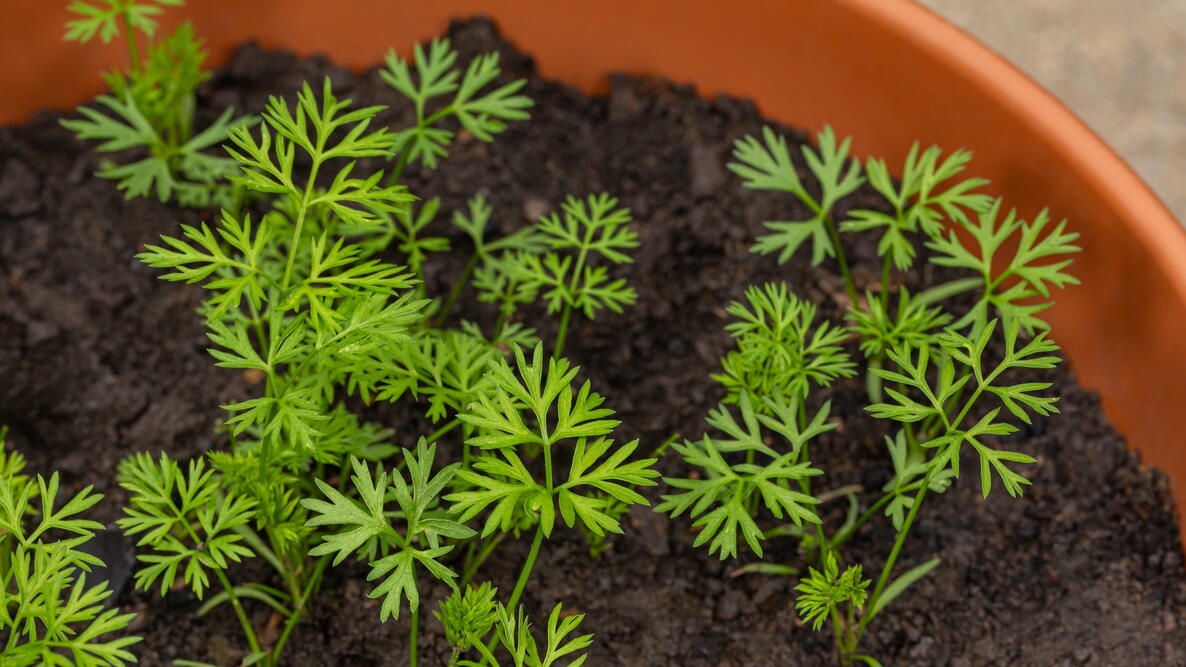
Caption
Carrot seedlings growing in terracotta pot

Carrots struggle to grow in dense or rocky soil and can be plagued by soil-borne pests in vegetable beds. Luckily, you don’t need perfect garden soil to grow carrots, especially if you cultivate them in pots! If you’re ready to get to the root of growing carrots in containers, here’s how to grow long, straight carrots—even if your garden soil isn’t ideal.
Choosing the Right Container
The most important thing to consider when growing carrots in containers is depth. Containers should be at least 18 inches deep if you want to grow standard-sized carrots, or 10 to 12 inches deep for varieties that produce short or rounded roots.
Carrots can be grown in terracotta or plastic pots, buckets, planters, fabric grow bags, and wooden barrels. If you’re not sure where to start, check out our Vegetable Container Size Chart & Pot Size Calculator for quick recommendations.
According to square-foot gardening, a 12-inch-square container can accommodate about 16 carrot plants. You can grow even more carrots in a single container by using succession planting!
I personally like to grow carrots in grow bags (pictured below), as they drain well, are naturally deep, and come in lots of sizes. If you’re growing carrots in other containers, just make sure they’re made of food-safe materials and have drainage holes in the base.

If you have ever harvested forked or funky-looking carrots from your garden, there’s a good chance those carrots grew that way due to dense or rocky soil. Keeping carrots in containers is an easy solution if you have poor soil that doesn’t support carrot root growth.
Early-season varieties grow faster than maincrop carrot varieties, and they don’t require super deep pots, which makes them more flexible in container gardens. That said, you can grow standard-sized and maincrop carrots in containers too, as long as you choose deep planters and don’t mind waiting a little longer to harvest.
My absolute favorite varieties for container gardens are short-rooted and early-season producers:
- Early Nantes
- Chantenay
- Tonda di Parigi
- Parisian
Although many folks think of carrots as purely orange vegetables, carrots come in other colors too—like deep red, purple, yellow, and white! Most of these colorful varieties can be grown in containers as well, provided they have enough room for their roots to develop.

Preparing the Potting Mix
As with other container-grown veggies, it’s important not to use garden soil when growing carrots in containers. Although it’s fine in the garden, standard soil is too dense for containers and may harbor pests and diseases that will compromise the health of growing carrots.
When I grow carrots in pots, I use a quality potting mix intended for edible crops, and then I blend in compost and about ¼ part sand or horticultural grit for improved drainage and fertility.

Planting Carrots in Containers
One thing to know about carrots is that they don’t like to have their roots disturbed. Carrot seeds should only ever be directly sown into the containers you intend to harvest them from!
Like other cool-season crops, carrots can be planted in early spring, as soon as the soil is workable. This usually occurs in March or April, depending on where you live. After that, you can succession sow additional crops of carrots at 2-to-4 week intervals from spring through fall to extend your harvest.
Most gardeners simply scatter carrot seeds over the soil surface and thin the seedlings later. If you prefer a tidier approach, you can sow seeds in rows or poke ¼-inch-deep holes and space them about 3 inches apart.
- To plant carrot seeds, fill up your growing containers with potting mix.
- Evenly and lightly scatter the seeds across the top of the soil line.
- Cover the seeds with about ¼-inch of potting mix.
Tip: If you want to give carrots an extra boost, try mixing a little bone meal into the potting mix at planting time. Bone meal provides phosphorus, which supports strong root development.
After planting, water carrots enough to keep the soil evenly moist and move the containers into a spot that receives at least 6 to 8 hours of direct light per day. Once the seeds sprout, thin out the extras to give the remaining plants room to grow.
Carrot seeds can sometimes struggle to sprout if the soil develops a crust on top. To avoid this, I like to scatter a light layer of straw mulch over my potting mix after planting, but you can also use sand or compost. Companion planting carrots with radishes can also break up soil crusting and help carrots sprout better.
Watering
Carrots should be watered regularly and evenly to help their roots develop. Consistent moisture also helps prevent cracked, tough, or misshapen roots. However, carrots shouldn’t be allowed to sit in soggy soil. I usually water my carrots when the top 2 inches of soil feels dry, which can be daily during summer.
Carrots growing in terracotta pots or fabric grow bags will usually need to be watered more often than plants kept in glazed or plastic containers.
Fertilizing
I always mix compost into my potting mix before planting carrots to give them a boost, and then I fertilize them with a low-nitrogen liquid fertilizer about once every 3 to 4 weeks.
Too much nitrogen can cause carrots to produce lots of leafy growth at the expense of their roots, so avoid high-nitrogen fertilizers.

Common Issues
Growing carrots in containers can help you avoid some of the soil problems that plague garden-grown carrots. Even so, container-grown carrots can suffer from a few common problems if you’re not careful:
- Thin roots. Carrot roots may not bulk up if the plants are overcrowded, underwatered, or grown in a potting mix that lacks sufficient nutrients.
- Deformed roots. Roots may take on curious shapes if they collide with container walls or with one another. Carrots can also develop deformed roots due to nematodes, but this is less likely to occur if you grow carrots in containers and use a quality potting mix.
- Pests. Carrots can sometimes be plagued by aphids, rust flies, and a few other pests—even in containers. These critters can be managed with organic insecticidal soap sprays, but you can also avoid some pest damage by growing potted carrots near scented herbs and alliums.

More Like This

Comments