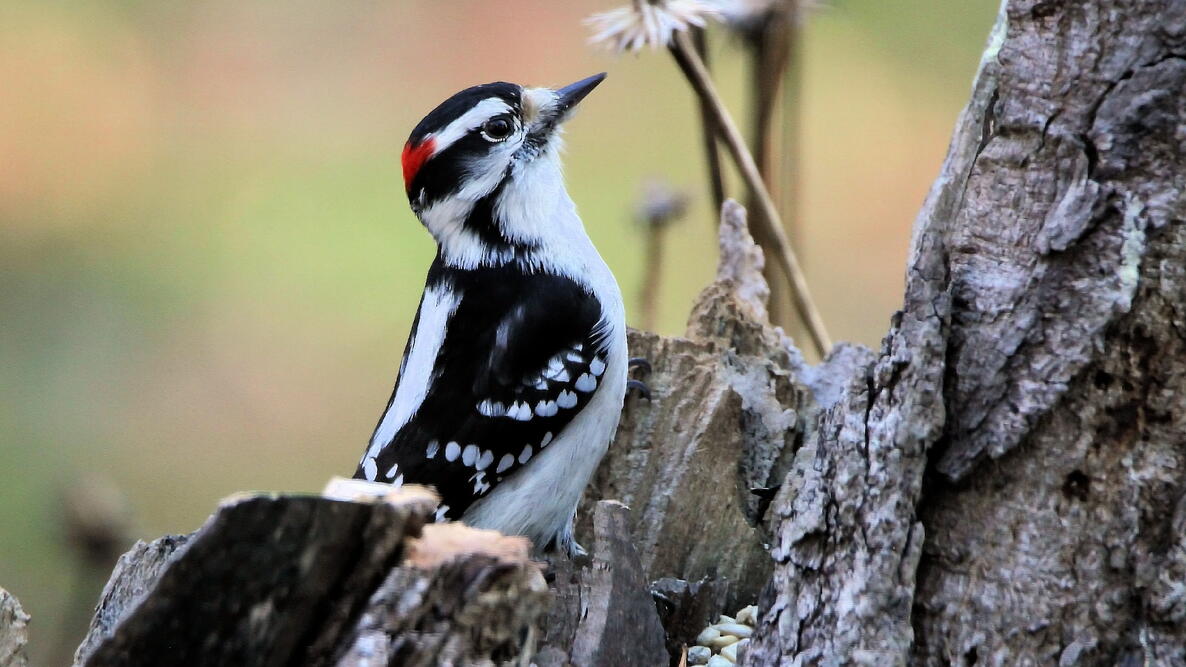

Knock, knock! So, why does a woodpecker peck wood? And what are the different types of woodpeckers you might see in your backyard?
Learn about five fascinating North American woodpeckers, how to identify them, what they eat, where they live, and more—with beautiful photos along the way.
What Are the Most Common Types of Woodpeckers?
Some common North American woodpeckers include the Red-Headed Woodpecker, Downy Woodpecker, Hairy Woodpecker, Red-Bellied Woodpecker, Yellow-Bellied Sapsucker, and Pileated Woodpecker. They vary considerably in size, coloring, habitat, diet, and behavior.
| Woodpecker | Size | Where Found | Key Identification Feature |
|---|---|---|---|
| Red-Headed | Medium | Central & eastern U.S. | Bright red head |
| Downy | Small | U.S. & southern Canada | Small bill, white back |
| Hairy | Medium | Much of North America | Large bill |
| Red-Bellied | Medium | Eastern & central U.S. | Red crown/nape |
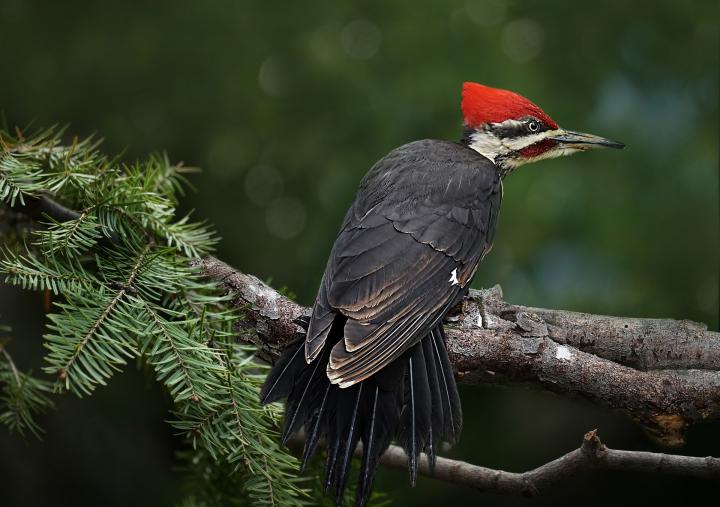
| Pileated | Large | Eastern & parts of western North America | Large red crest |
Red-Headed Woodpeckers
The gorgeous Red-Headed Woodpecker (Melanerpes erythrocephalus) has gone through periods of great decline in the past half-century because of habitat loss. These woodpeckers live year-round throughout the central and eastern U.S., from Florida up through Canada.
Boldly patterned, both males and females look alike, with distinct crimson heads, black backs, large white wing patches, and white bellies.
What’s unusual about the Red-Headed Woodpecker is that it catches insects while in flight! Also, it will actually hide away insects in tree crevices for later, even live grasshoppers, which are wedged so tightly that they can’t escape. This bird also enjoys eating nuts and will occasionally visit bird feeders, especially suet feeders.

The Red-Headed Woodpecker has many nicknames, including flag bird and the flying checkerboard! Photo credit: Samir Husni
Downy and Hairy Woodpeckers
Usually the most likely woodpecker to visit your backyard bird feeder, the Downy Woodpecker (Picoides pubescens), is the smallest of North American woodpeckers, about 6 to 7 inches long and barely outsizing chickadees and nuthatches. It can be found year-round throughout the continental United States and southern Canada. John James Audubon said, “it seems, in fact, to accommodate itself to circumstances and to live contented anywhere.”
Males have a bright red patch on the back of the head, while females have a black patch, but otherwise, the two look very similar. Males prefer to forage on smaller branches, while females prefer larger branches and the tree trunk. Woodpeckers like to drum on trees, preferably dead trees, and metal boxes on communication poles, usually in spring when attracting mates.
To the casual observer, the Hairy Woodpecker (Picoides villosus) looks almost identical to the Downy Woodpecker but is slightly larger with larger bills. Scientists have determined that the smaller Downy Woodpecker has evolved to match the larger Hairy Woodpecker because it confers an advantage by being confused with the larger species.
Both Downy and Hairy Woodpeckers can be attracted to feeders with black oil sunflower seeds, but they especially love suet! (See how to make suet.)
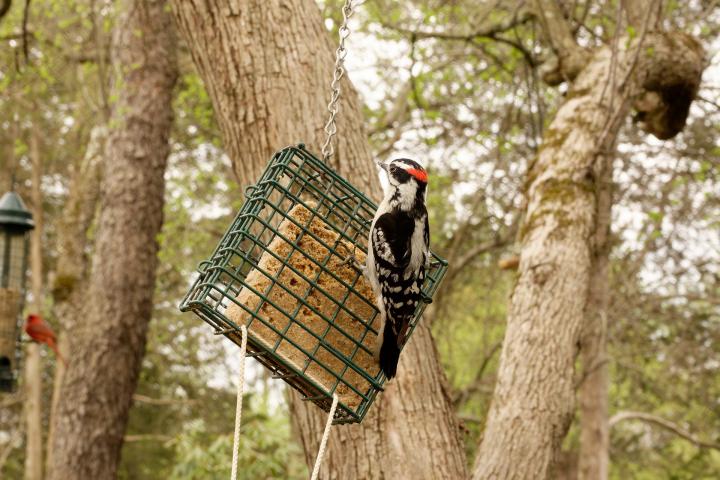
Yellow-Bellied Woodpeckers
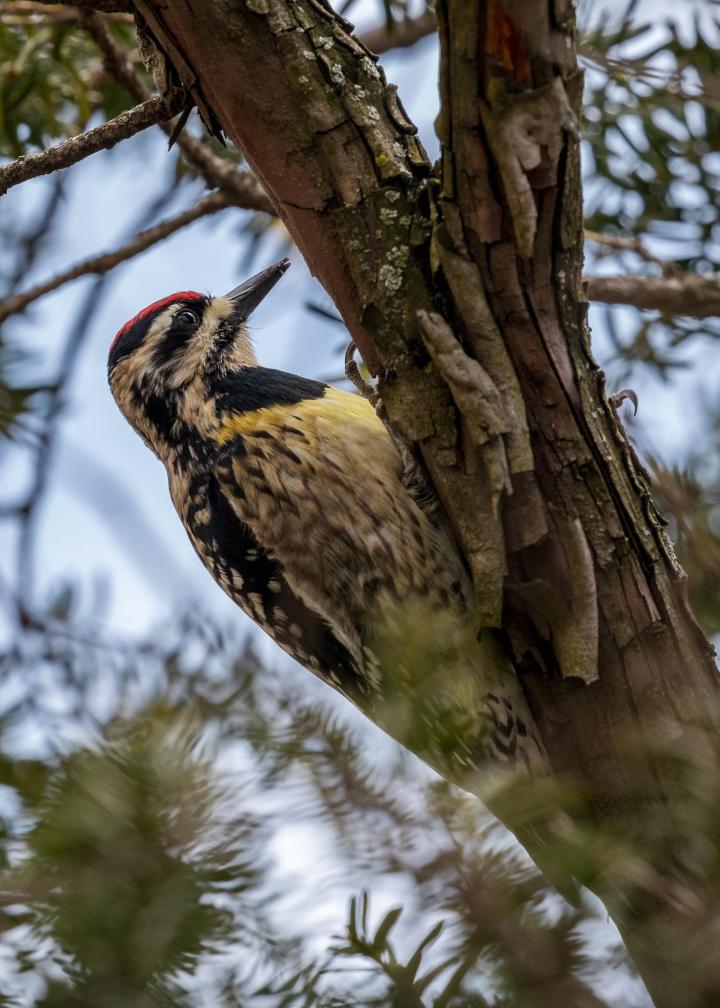
Often called the Yellow-Bellied Sapsucker (Sphyrapicus varius), this medium-sized woodpecker is named for its habit of pecking rows of holes in trees, especially apple trees, and then drinking the sap and eating insects in the sap. The bird will breed in Canada and in the northeastern U.S., but in winter months, it migrates farther south; it’s the only woodpecker in eastern North America that is completely migratory.
Though the Yellow-Bellied Sapsucker isn’t usually a bird feeder visitor, you’ll be able to identify its work by the rows of shallow holes in tree bark, especially the bark of young maples or birch trees. They’ll often sit still on tree trunks for long intervals.
Red-Bellied Woodpeckers
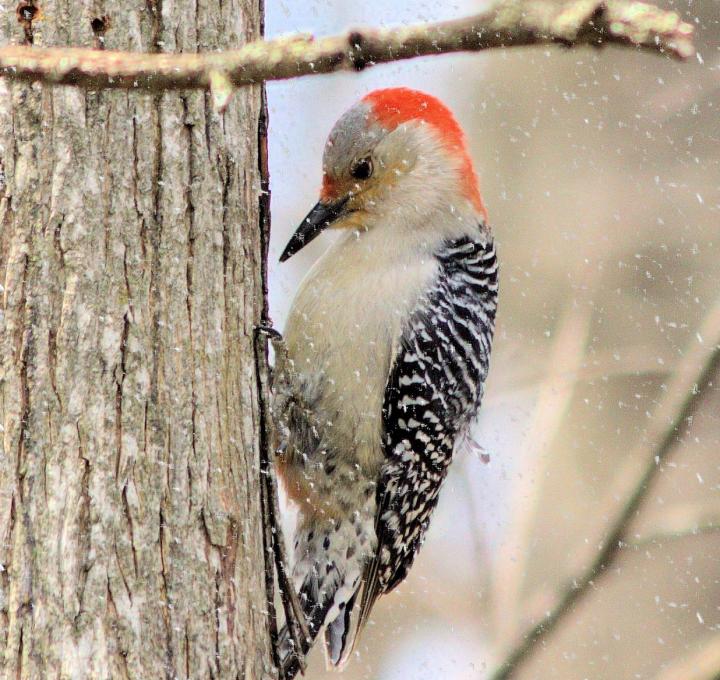
Poorly named (because the reddish-orange color is found mostly on the head), the medium-sized Red-Bellied Woodpecker (Melanerpes carolinus) was once a more southern bird. With a changing climate, it has moved a little more northern, and its range covers the wooded patches from the Midwest across to the East Coast.
With its red crown, this bird looks similar to the Red-Headed Woodpecker (below), but it has a paler tummy and does not have black on its back.
Red-Bellied Woodpeckers are also more common and more easily found at bird feeders because the species eats a variety of seeds and nuts and also likes suet!
Pileated Woodpeckers
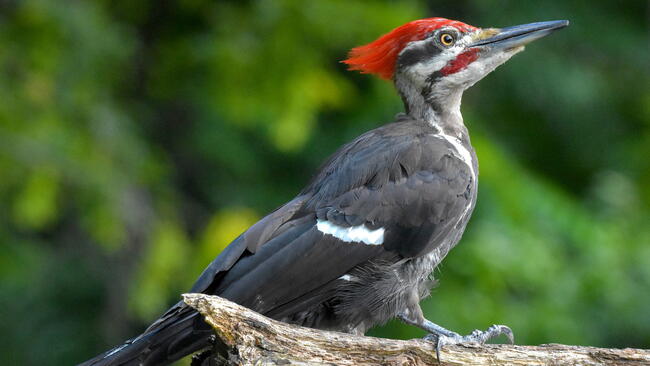
A large, striking, crow-sized bird, the Pileated Woodpecker (Dryocopus pileatus) is the largest woodpecker in North America, reaching up to 18 inches in length. Its population has increased over the past 50 years as many farms have become forested land in much of the United States.
Its sight and hearing are excellent, so it is not seen as often as heard as it whacks at dead trees and fallen logs searching for prey, making wood holes as large as 14 inches in larger trees such as spruce and hemlock. Also, listen for this bird’s amazing call. Hear the sound of the Pileated Woodpecker.
FAQs
Why Do Woodpeckers Peck Wood?
Most folks probably assume that woodpeckers peck at trees for food, which is true. These birds feed on tree-living or wood-boring insects, including larvae or ants from burrows within the wood. However, they also drill to build nests, and they will “drum” at trees to announce their territory. This sounds like pecking in rapid succession and is done many times in a single day—and it can last for weeks or months!
How Do Woodpeckers Avoid Concussions?
When woodpeckers are drilling for food, it’s forceful! They get hit with up to 1,400 g’s of force—14 times the amount that would trigger a concussion in humans. However, woodpeckers are particularly well-adapted for drilling on and into trees without getting a concussion. They have thick skulls with an enlarged brain case designed to absorb a frontal impact. Additionally, the lower part of the beak is longer, so when it strikes wood, the force is transferred through the lower jaw rather than through the skull. They hammer directly into the wood so that the force is evenly distributed.
The bill is a carpenter’s tool, but the tongue, which is long, barbed, and sticky, obtains the food, usually larvae of carpenter ants and other insects. A woodpecker can stick its tongue through small tunnels in the wood. Because a woodpecker’s tongue is so long, it wraps around the skull and through the bill when it’s not being actively used. Muscles contract and relax as the tongue is extended to grab larvae and then retracted.
How Can You Tell a Downy Woodpecker From a Hairy Woodpecker?
Downy and Hairy Woodpeckers look very similar, but the Hairy Woodpecker is larger and has a noticeably bigger bill. The Downy Woodpecker is smaller, about 6 to 7 inches long.
Do Woodpeckers Stay in the Same Place Year-Round?
Some woodpecker species remain in the same area year-round, while others migrate. For example, the Yellow-Bellied Sapsucker breeds in Canada and the northeastern United States before migrating south for winter.
Where Do Woodpeckers Build Their Nests?
Woodpeckers typically excavate nesting cavities in dead or living trees. Depending on the species, their nests may be several feet above the ground and contain little more than wood chips.
How Do I Attract Woodpeckers to My Backyard?
You can attract many woodpeckers by offering suet, sunflower seeds, and other appropriate bird foods in a sturdy feeder. Leaving dead trees or snags when it is safe to do so can also provide natural feeding and nesting habitat.
Woodpeckers love suet! See our recipe for Woodpecker Pudding—a suet–peanut butter concoction that will drive all the wild birds, well, wild!
Enjoy birdwatching? See more backyard bird articles.

More Like This
The first step is to eradicate any insects living in your siding or the woodpeckers will just be back. If the birds are looking for insects, the holes will be small and irregular. You may have to call an exterminator to get rid of the underlying insect problem. Woodpeckers are particularly fond of the larvae of carpenter bees, leafcutter bees, and grass bagworms. Plug and cover holes with wood putty.
If it's a bird storing acorns, that's another issue. Some owners have found reflective streamers or "bird banishers" placed nearby keep the woodpeckers away. Others with extensive damage have resorted to laying aluminum metal down the sides of their boards. For what it's worth, research has shown lighter colored aluminum and vinyl sidings are less likely to be damaged by woodpeckers

Comments