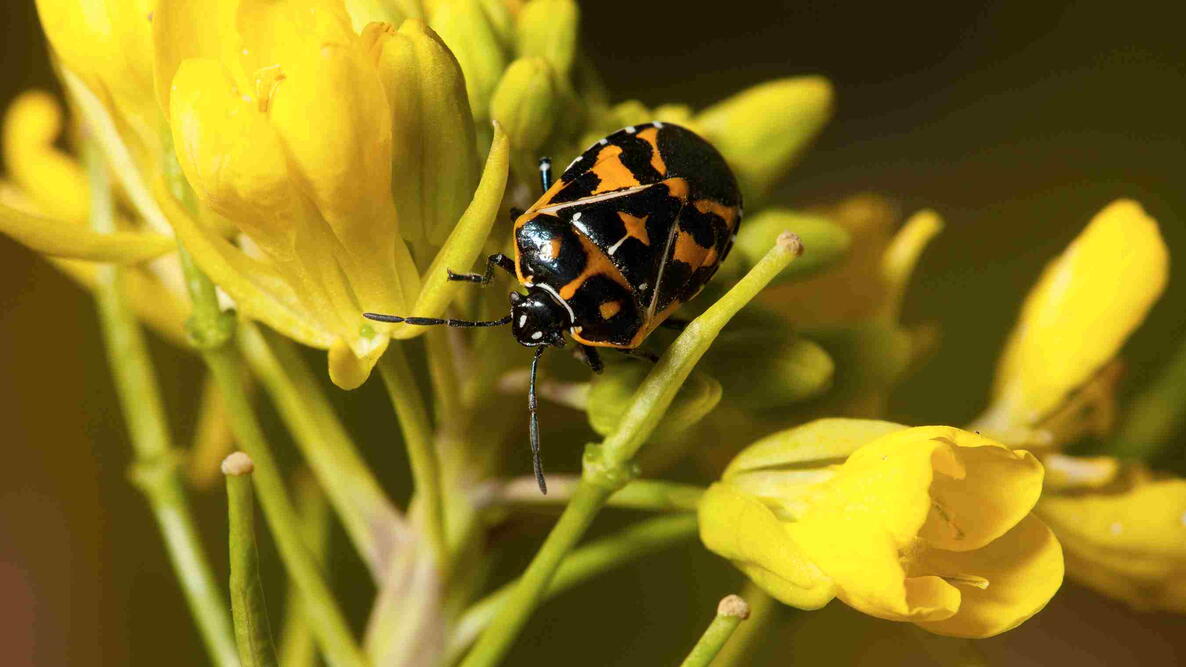
Caption
Harlequin bugs feed on plants in the mustard family, including cabbage, kale, and broccoli.

Something is eating your cabbage, kale, or cauliflower. Again. But what is it? Wilting, stippling, and discoloration on leafy vegetables can be signs of the uniquely colorful harlequin bug. These striking insects may look decorative, but they can cause serious damage to garden vegetables if left unchecked.
What are Harlequin Bugs?
Harlequin bugs are insects in the stinkbug family and are native to Central America and Mexico. Over time, they have spread throughout the southern parts of the U.S. and are now found in southern New England and Pennsylvania. Unlike the common brown stinkbug (see our article here), these bugs are brightly and intricately patterned. They’re sort of the designer stinkbug, looking much more uptown.

Harlequin bugs are small, at only ¼ to ⅜ inch long as adults. They are shield-shaped when viewed from above, with the flat portion of the shield at the head tapering toward the rear. What you’ll really notice, if you look closely, are the intricate markings in red, yellow, or orange.
These bugs feed with a piercing mouthpart that they use to suck up plant juices and are typically found on brassicas, including cabbage, mustard greens, kale, and cauliflower. But they also feed on beans, eggplant, okra, tomatoes, peppers, and weeds, including wild mustard, pigweed, lambsquarter, and shepherd’s purse.
They overwinter as adults, hiding in leaf litter, bark, or dead vegetation, and emerge in early spring. Females lay eggs in double rows on the underside of leaves. In cooler temperatures, the eggs hatch in about 20 days, but nymphs will emerge in as little as 4–5 days when the weather is warm. Freshly hatched nymphs begin feeding, going through five stages before becoming adults. There may be more than one generation of harlequin bugs per growing season.

Identification
How to Identify Harlequin Bugs
These bugs get their name from the fancy patterns on their backs. Look up what a harlequin pattern looks like, and you’ll find it’s an arrangement of diamonds with the points touching. These bugs aren’t quite that regular, but there is a definite geometric pattern to their markings.
Adult harlequin bugs are black, with the pattern in red, orange, or yellow. I suppose this brings up the age-old question: are bumblebees black with yellow markings, or yellow with black markings? The jury is still out. But, if you spot a small, shield-shaped bug in your garden with bright geometric markings in red, orange, or yellow, you’ve probably got a harlequin bug. Nymphs look similar to the adults, although not as intricately patterned. They also don’t have wings.
Harlequin bug eggs are rather distinctive, although small and hard to spot. Look on the underside of leaves for eggs laid in clusters. If you find some, tear that leaf off and use a magnifying glass or reading glasses to look more closely, and you’ll see the eggs are shaped like a barrel with rounded edges. They are typically white with black bands, like the cooperage bands holding a wooden wine barrel together. Of course, destroy the eggs; don’t just toss them in the compost pile.

Signs of Harlequin Bug Damage
These are small bugs, and they don’t devour entire plants like a hornworm. Instead, they use their piercing mouthparts to feed on the plant’s juice rather than chewing holes in leaves.
Early feeding often shows up as white or pale blotches on leaf tissue where plant juices have been removed. Under heavy pressure—especially when many nymphs are present—this damage can worsen, leading to leaf necrosis, wilting, stunted growth, and even plant death, particularly in young plants.


More Like This

Comments