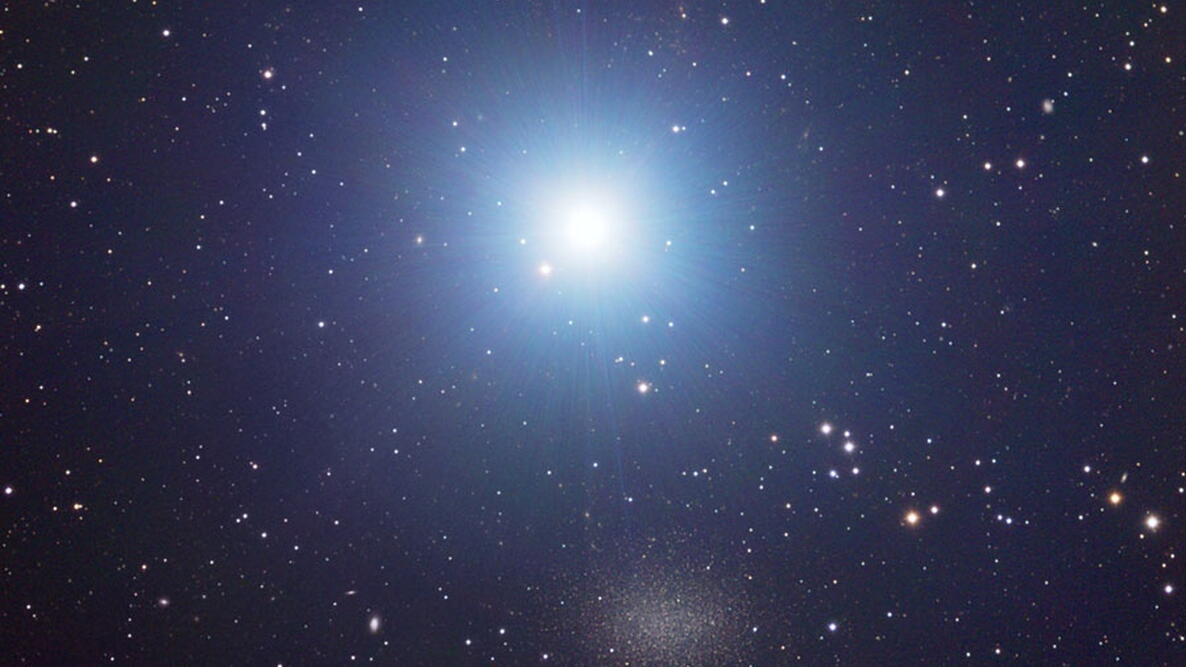

Regulus is one of the brightest stars in the night sky and the dazzling heart of the constellation Leo. Known as the “Little King,” this blue-white star has captured human attention for thousands of years thanks to its royal symbolism, prime position along the zodiac, and rare encounters with planets and the Moon. Easy to spot and rich in history, Regulus is a favorite target for both stargazers and storytellers alike.
While it appears as a single star to the human eye, Regulus has three unseen companion stars, two of which can be seen in telescopes.
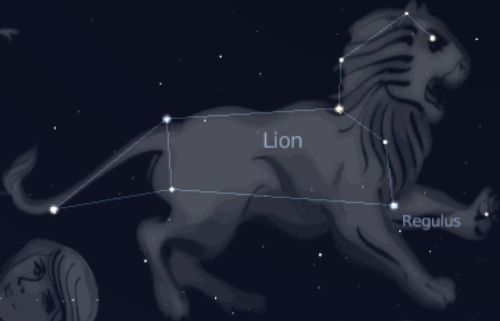
Regulus is the brightest object in Leo. The “Sickle of Leo” makes up the lion’s mane and looks like a backward question mark of stars. Regulus sits prominently at the base of that “sickle” or reversed question mark, making Leo one of the relatively few constellations that actually resembles what it’s supposed to portray.
Why Regulus Is Called the “Little King”
The lion, of course, represents the noble king of the beasts. And Regulus means “little king” in Latin.
Regulus has been famous through the ages, regarded by the ancient Persians, for example, as one of the “four royal stars.” The “little king” was viewed as the most important of the Four Royal Stars of the Persians, which marked the seasons.
Regulus and the Zodiac: A Star on the Ecliptic
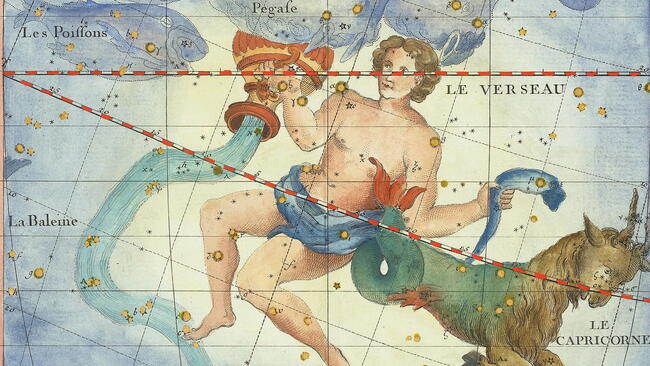
Its fame is largely due to its position almost smack on the ecliptic, the center of the zodiac! This means that as the Sun circles around the sky each year, passing repeatedly in front of the same constellations that were deemed super special for untold thousands of years, it comes closer to Regulus.
The Sun’s motion against the stars is of course due to Earth orbiting around it, giving the Sun a different daily background from our perspective as it shifts one degree (two Sun-widths) per day. We never actually see this because the Sun’s brilliance makes the sky blue and renders invisible everything behind it. Only during a total solar eclipse can we view the stars behind the Sun.
Yet the ancient Babylonians, 4,000 years ago, observing the stars somewhat near the Sun each day just before dawn and again at nightfall, were able to determine the Sun’s daily path and position to a high degree of precision. They discovered the constellations through which the sun passed and called them the zodiac. And they knew that only six bright stars in a few of those zodiac constellations could ever appear next to the Sun, Moon, or planets. Of those, Regulus in Leo the Lion was far and away the closest star to the Sun’s precise yearly path, the ecliptic.
When Regulus Disappears From View
The Sun skims a mere one degree from Regulus each year on August 22. This means that the bright star will be difficult to see for the entire month of August.
The planets, too, being aligned in nearly the same flat plane as the Earth-Sun orbit, periodically pass very near Regulus.
On July 7, 1959, European observers saw the planet Venus pass directly in front of Regulus, an occultation whose rarity is obvious when one realizes that any planet blocking any bright star is unlikely to happen in the average lifetime. Nonetheless, in a stupendous turn of events, there will indeed be a planet/star occultation this very century. Again it will be Venus, and again it will be Regulus, when that nearest and brightest planet totally eclipses the “Royal Star” on October 1, 2044.
It’s the final such spectacle until 2271, and, happily, lies a mere few years in our future.
See our Bright Star Calculator for visible stars in the sky tonight!
The Royal One, the Heart of the Lion
But most of that time, people didn’t call it Regulus.
- Back in the classical Roman era, it was known as Regia, meaning “the Royal One.”
- The Arabs called it Kalb or Qalb, meaning “heart,” since it’s positioned as the heart of the zodiacal lion. Even today, some star maps still label it as Qalb.
- The name Regulus is fairly new, having been coined in the 17th century by Copernicus. This has led some modern scholars to incorrectly assume it was named after the well-known Roman general Regulus, who displayed skill and bravery during battles against Carthage.
Several ancient cultures associated the star with royalty, so the name “Regulus” is definitely apt.
Regulus Star Facts at a Glance
Leaving mythology and the free-associative realm of constellation drawing, the actual physical star Regulus is a commanding presence 85 light-years away.
- Its blue color—one of only five obviously blue stars visible over the US and Canada—reveals a sizzling temperature too hot to have the vaporous metals our own Sun possesses on its gaseous surface.
- A hefty five times bigger than our own Sun, and hovering in a direction aimed away from our galaxy’s center, Regulus is slowly receding from Earth at the leisurely rate of two miles a second.
- Regulus is neither dazzling nor is it a slouch, as it holds 16th place among the brightest stars seen from north-temperate countries. But its main claim to fame is its fortunate position aligned with the plane of our solar system, letting our earthly eyes watch it periodically meet the Moon and planets, and even infrequently to be eclipsed by them.
Frequently Asked Questions
What is Regulus?
Regulus is the brightest star in the constellation Leo and one of the most famous stars along the zodiac. Its name comes from Latin and means “little king.”
Where is Regulus located in the sky?
Regulus sits at the base of Leo’s “Sickle,” a backward question-mark pattern of stars that forms the lion’s head and mane. It marks the heart of the Lion.
Why is Regulus called the “Little King”?
Many ancient cultures associated Regulus with royalty and power. It was considered one of the Four Royal Stars by the ancient Persians and symbolized kingship and authority.
Is Regulus a single star?
Although Regulus appears as a single star to the naked eye, it is actually a star system with three faint companion stars. Two of them can be seen with a telescope.
Why is Regulus important to astronomy?
Regulus lies almost directly on the ecliptic, the Sun’s apparent path through the sky. Because of this, the Sun, Moon, and planets regularly pass near it, creating notable conjunctions and rare occultations.
Now learn about summer’s brightest star, the beautiful Vega!

More Like This




Comments