We’ve highlighted the month’s best bets for backyard stargazers—no telescope required.
Night Sky Tools
Wondering what planets and stars you can see tonight? The answer depends on your location and the date. Enter your city or ZIP code for a personalized view of the night sky.
- Visible Planets Tool — Find out which planets are visible from your location, when they rise and set, how bright they appear, and the best time to look.
- Visible Stars Tool — Enter your city or ZIP code to discover which bright stars are visible in your night sky.
Why Venus Is the Star of July
ALMANAC TIP: New to stargazing? Start with Venus. It’s one of the easiest celestial objects to find in July and shines brightly in the western sky after sunset.
Venus dominates the evening sky this month. In fact, it is the easiest of the visible planets to spot in July 2026. Shining at about magnitude –4, it outshines every star and remains visible for up to two hours after sunset. Often called the “Evening Star,” Venus appears as a brilliant white point of light low in the western sky.
The planet is especially prominent because Venus is approaching its greatest eastern elongation in mid‑August. That’s the point where it appears farthest from the Sun in our sky. That means that Venus stays above the horizon longer after sunset and becomes one of the easiest celestial sights to spot this summer.
What You’ll See
- A brilliant white “star” low in the western sky after sunset
- Visible for up to two hours before setting
- Steady and bright, with little twinkling compared to stars
- Easy to spot, even from suburban and city locations
- Through a small telescope, Venus appears as a crescent
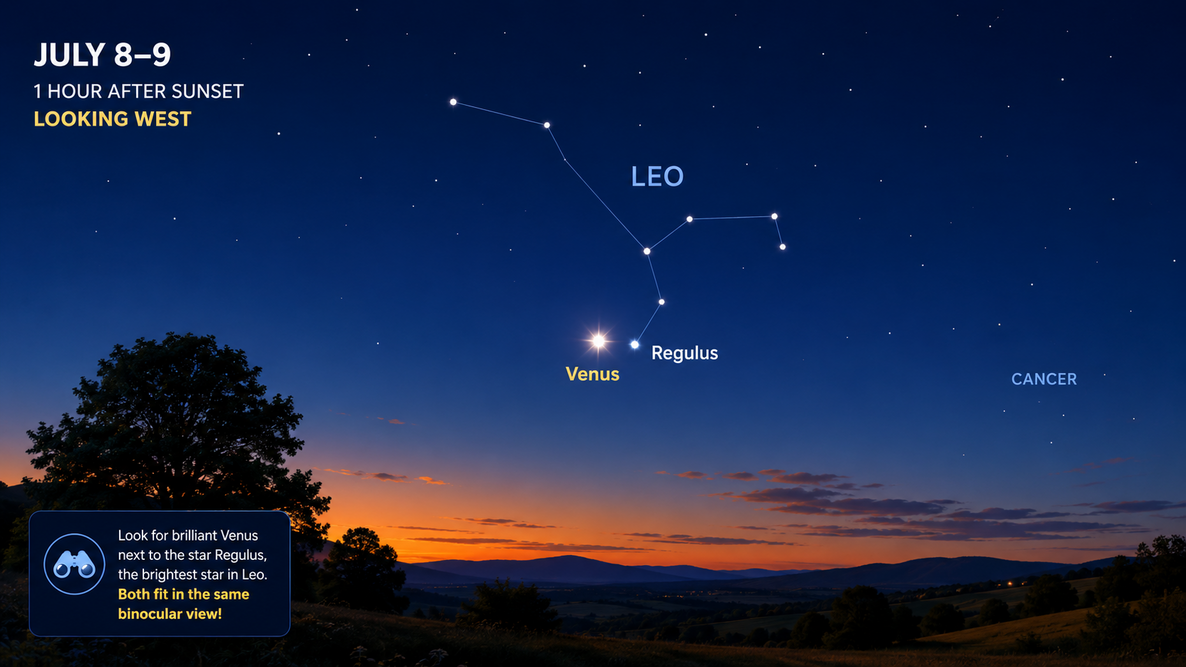
On July 8 and 9, look west about an hour after sunset to see Venus beside Regulus, the brightest star in Leo. Venus easily outshines the star, but Regulus serves as a useful guidepost for finding the brilliant Evening Star. The month’s prettiest sky scene follows on July 16 and 17, when a thin crescent Moon appears beside Venus in the western sky after sunset.
The Moon Visits Summer Stars
As the Moon moves across the sky each month, it passes near some of the season’s brightest stars. These pairings make easy-to-find targets for casual skywatchers.
- July 16–17: Crescent Moon and Venus
- July 20: Moon near Spica, the brightest star in Virgo
- July 24: Moon near Antares, the reddish heart of Scorpius
- July 29: Full Buck Moon. For the best views, look east around sunset on the evenings of July 28 and 29 as the bright Moon climbs into the sky.
For Early Risers
Before dawn on Independence Day, rusty-orange Mars appears low in the eastern sky near distant Uranus. Mars is easy to spot with the naked eye, while binoculars may reveal faint Uranus nearby.
An Almanac Sky Fact
On July 6, Earth reaches aphelion—its farthest point from the Sun for the year, about 94.5 million miles away. Despite being farther from the Sun, Northern Hemisphere summer remains in full swing because the seasons are caused by Earth’s tilt, not Earth’s distance from the Sun.
Meteor Shower Alert
The Southern Delta Aquariid meteor shower peaks on July 30 and 31. Normally a reliable midsummer meteor shower, this year’s display is hampered by bright moonlight from the Full Buck Moon on July 29, which will wash out many of the fainter meteors.
If you miss the Delta Aquariids, don’t worry. The much-anticipated Perseid meteor shower arrives in August and will enjoy excellent viewing conditions thanks to darker skies. See our 2026 Meteor Shower Calendar.
With warm evenings, a brilliant Venus, and several beautiful Moon pairings, July offers plenty of reasons to spend a few minutes looking up after sunset.




Comments