
You may know aquamarine as March’s birthstone, but did you know there’s an alternative? Bloodstone shares the spotlight as a powerful symbol of strength and perseverance. Learn about the meaning, history, and unique characteristics of March birthstones, aquamarine and bloodstone, and discover what makes each gem special.
March Birthstones: Aquamarine and Bloodstone
| Feature | Aquamarine | Bloodstone |
|---|---|---|
| Birth Month | March | March (Alternative) |
| Color | Pale blue to deep blue-green | Dark green with red iron-oxide spots |
| Gem Family | Beryl | Chalcedony (Quartz) |
| Mohs Hardness | 7.5–8 | 6.5–7 |
| Symbolism | Calm, clarity, courage, protection | Strength, bravery, vitality |
| Associated Element | Water | Earth |
| Historical Uses | Protection for sailors, healing, calming tempers | Blood health, strength in battle, protection |
| Primary Sources | Brazil, Madagascar, Pakistan, Nigeria, U.S. | India, Brazil, Australia, U.S., Canada |
| Jewelry Suitability | Excellent for daily wear | Suitable for daily wear with care |
| Typical Cost | Moderate to high | Generally affordable |
| Anniversary Stone | 19th wedding anniversary | Not traditionally associated |
Aquamarine Birthstone
Color and Characteristics
A member of the beryl family, aquamarine gets its coloring from trace amounts of ferrous iron. Aquamarine ranges in color from bluish green, blue-green, and greenish blue to deep blue, and its tones can be very light to moderately dark. The color is typically more intense in larger stones.
Meaning, Symbolism, and Folklore
- The word aquamarine is derived from the Latin words aqua (water) and marina, (of the sea).
- Roman fishermen believed aquamarine would protect sailors and those traveling on the water and bring luck when catching fish.
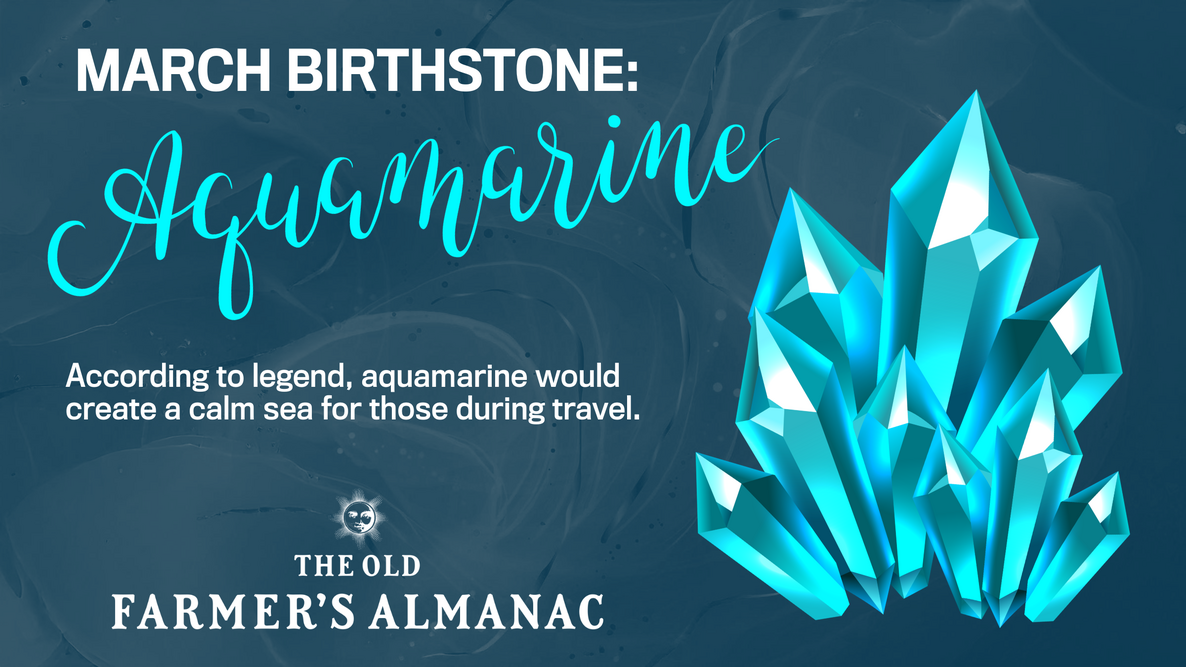
- According to legend, aquamarine would create a calm sea for those during travel.
- Aquamarine was also thought to help cool tempers and allow those who possessed it to remain calm and levelheaded.
- In the Middle Ages, people thought that wearing the stone would prevent poisoning.
- Pliny the Elder, a Roman author and naturalist, believed the stone had natural powers, originating from treasures belonging to mermaids.
- The folklore surrounding aquamarine was related not only to the sea but also to the heavens because of the sky’s reflection in the water.
- Due to a belief that the aquamarine’s reflective properties could unearth things deep within a person’s soul, it was quite popular among healers and mystics.
- Long ago, the act of meditating with aquamarine made people believe it could enhance the possibility of epiphanies.
- Aquamarine is not only the March birthstone but also the celebratory stone for a 19th wedding anniversary.
History of Aquamarine
- Roman doctors used aquamarine to treat overeating and ailments like bloating.
- Medicines were once made from aquamarine powder to cure infections and allergic reactions.
- Beads made of aquamarine have been discovered with Egyptian mummies.
- The Smithsonian Institute is home to the world’s largest cut aquamarine, the Dom Pedro—a 10,363-carat obelisk that is 14 inches long and 4 inches wide.
- In 1936, the government of Brazil gave First Lady Eleanor Roosevelt a dark blue rectangular aquamarine that is now housed at the Franklin D. Roosevelt Presidential Library and Museum in Hyde Park, New York.
Where is Aquamarine Found?
Brazil is known as the primary gem source, but other locations, like Madagascar, Pakistan, Nigeria, and the U.S., also produce aquamarine.
The majority of aquamarine stones come out of the ground with a green tint, but heating will result in a pure blue color.
Aquamarine grows in large, six-sided crystals up to a foot in length, making it ideal for cutting into large gems. One blue-green crystal found in Brazil—19 inches long and 16 inches across—weighed more than 240 pounds.
Aquamarine in Jewelry
Aquamarine gems, with a Mohs Hardness rating of 7.5 to 8, are suitable for everyday wear, require no special care, and are some of the most accessible gems to polish.
A feature of some aquamarine stones is their inclusions, which are made up of long, hollow tubes that can be transparent. The characteristic is an identifier for the beryl family, including the emerald. The gem can also contain crystals; some stones have snow stars—irregularly shaped liquid droplets in a star formation.
Bloodstone Birthstone
Color and Characteristics
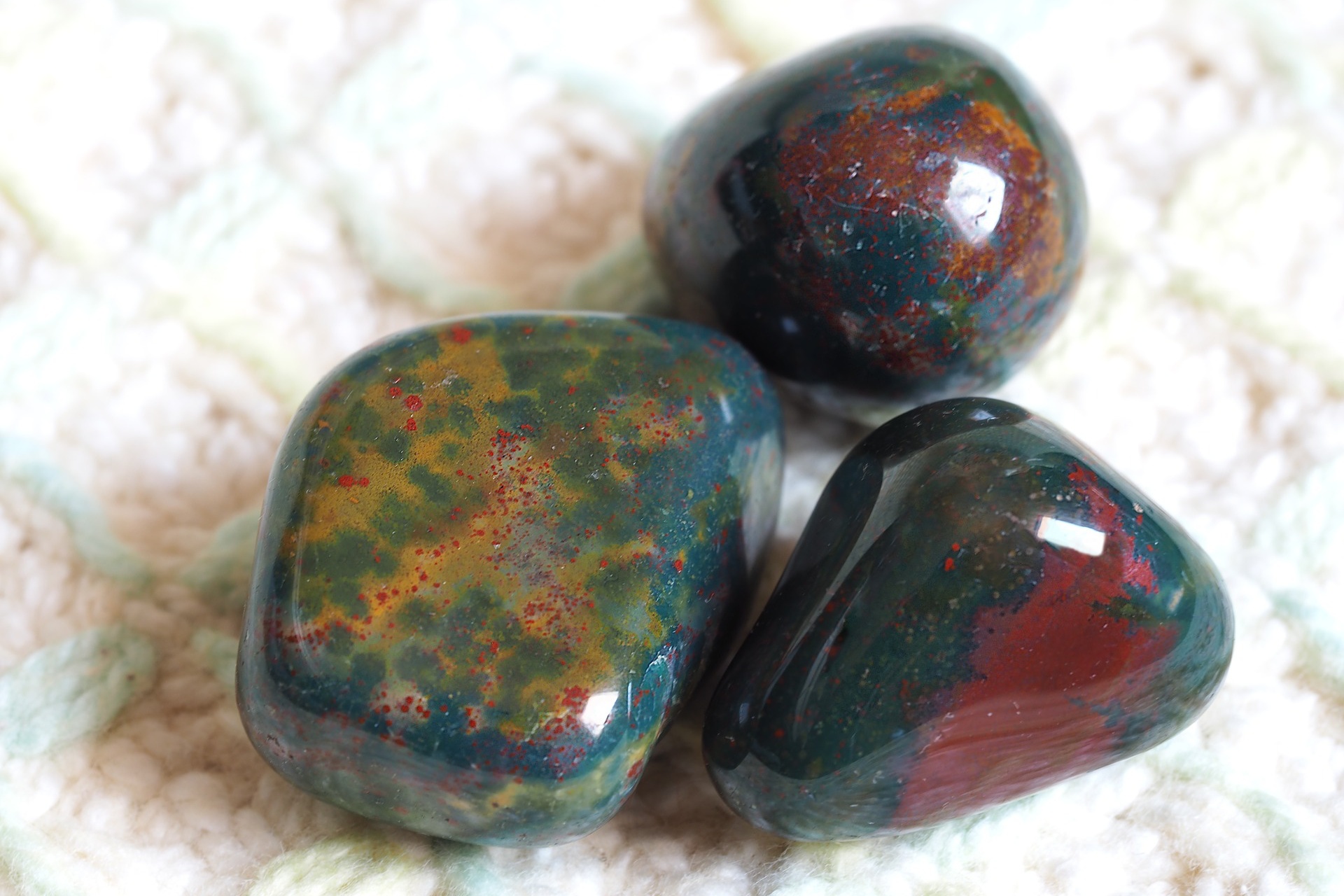
Bloodstone is a type of chalcedony—a form of cryptocrystalline quartz—and the amount of chlorite particles will determine the depth of its dark-green color.
Bloodstone is known for its dark green color with flecks of red spots. The red spots, which can resemble drops of blood, are due to the presence of iron oxide in the stone.
Meaning, Symbolism, and Folklore
- Due to its spots, bloodstones have long been associated with blood. At times, the stone has been believed to help with hemorrhages and blood disorders. Aztecs used bloodstones to help regulate blood flow.
- The gem has been a symbol of bravery through its link to blood and vitality.
- Christians in the Middle Ages, according to legend, associated it with martyrdom and the crucifixion of Christ.
- Some believed the first bloodstone was created when Jesus’ blood dripped on a jasper, turning it into a bloodstone.
- Egyptians believed bloodstones would aid in defeating enemies, as they helped increase strength.
- In ancient times, it was thought that a bloodstone could turn the sun red while also making thunder and lightning occur.
- A bloodstone is associated with being a lucky charm in more modern times. In India, it is crushed and used as an aphrodisiac.
History of Bloodstone
- Bloodstone is also known as Blood Jasper. There are two forms of bloodstone—heliotrope and plasma. Heliotrope is more transparent with red spots, while plasma is opaque with little to no red spots.
- Heliotrope comes from ancient Greek, meaning “to turn the sun” or “sun turning.” It is believed the definition stemmed from how the gem turned blood red in the setting sun.
- Babylonians used bloodstones to make seals and amulets.
- The unique properties of a bloodstone made it popular for jewelry and signet rings.
- An example of a carved bloodstone with the seal of the German Emperor Rudolf II can be found at the Louvre in Paris.
Where Bloodstone is Found
Bloodstones are found embedded in rocks or as pebbles in riverbeds. The most prominent source of the gem is India, although it is also found in Brazil, Australia, the United States, and Canada, among other locations worldwide.
Bloodstone in Jewelry
For the most part, bloodstones are relatively inexpensive. The stone’s color and number of red spots are the primary factors in its worth. Those with a greater number of red spots typically are priced higher.
With a Mohs Hardness rating of 6.5 to 7, bloodstones are suitable for everyday jewelry, but be careful not to store them next to harder stones, as scratching may result.
Frequently Asked Questions
What are the birthstones for March?
March has two birthstones: aquamarine and bloodstone. Aquamarine is the primary birthstone, while bloodstone is considered an alternative option.
Why does March have two birthstones?
Some months have multiple birthstones due to historical traditions, cultural variations, and gemstone availability. Both aquamarine and bloodstone symbolize strength and perseverance, making them fitting for March.
Which March birthstone is more expensive?
Aquamarine is generally more expensive than bloodstone, especially larger stones with deep blue coloring. Bloodstones are usually more affordable and valued based on color depth and the number of red spots.
Can aquamarine be worn every day?
Yes. With a Mohs Hardness of 7.5–8, aquamarine is durable enough for everyday jewelry and requires minimal special care.
Is bloodstone a real gemstone?
Yes. Bloodstone is a natural gemstone and a form of chalcedony quartz. It has been used in jewelry, seals, and talismans for thousands of years.
Learn More
- See all birthstones by month!
- Enjoy our birth flowers by month.

More Like This

Comments