
Master green beans with our complete planting and care guide

Read Next
Planting
Beans grow best in well-draining soil with normal fertility and an acidic to neutral pH (6.0–7.0). They don’t typically need supplemental fertilizer because they fix their own nitrogen in the soil. However, particularly poor soil should still be amended with aged manure or compost in the fall prior to planting (or about a week before planting in the spring).
Beans don’t like having their roots disturbed, so set up any supports for pole beans prior to planting.
When to Plant Beans
- Beans grow best when direct-seeded outdoors. Sow any time after the last spring frost date, when the soil has warmed to at least 55°F (12°C). Don’t plant too early, as cold, moist soil will delay germination and could cause the seeds to rot.
- Tip: To get a head start on planting, place black plastic or landscaping fabric over your garden beds to warm the soil prior to sowing seeds.
- Do not start green bean seeds indoors. Due to their fragile roots, they may not survive transplanting. Plus, they’re such fast growers that there’s no real advantage to starting them early indoors.
How to Plant Beans
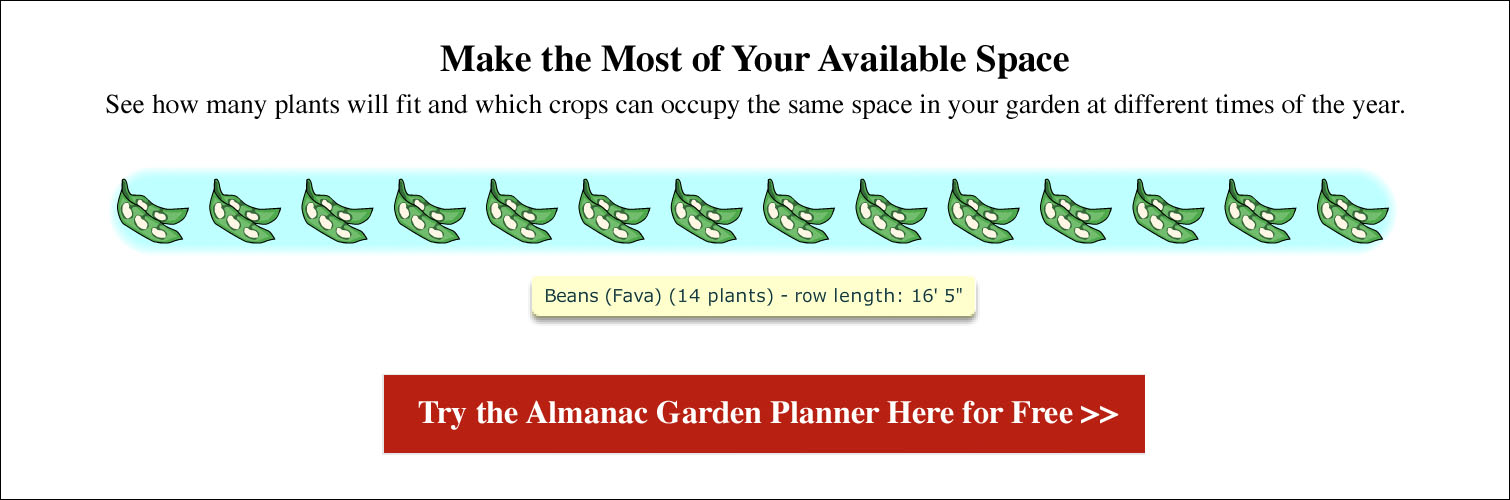
- Sow bush beans 1 inch deep and 2 inches apart in rows 18 inches apart.
- Sow pole beans 1 inch deep, placing them around supports.
- Tip: Plant pole and bush beans a little deeper in sandy soils, but not too deep. Seedlings cannot push through soil that is too deep, heavy, dense, packed, and/or mulched; they will break their “necks” in trying to emerge.
- For pole beans, set up trellises, stakes, or other supports prior to planting so that the plants’ fragile roots are not disturbed.
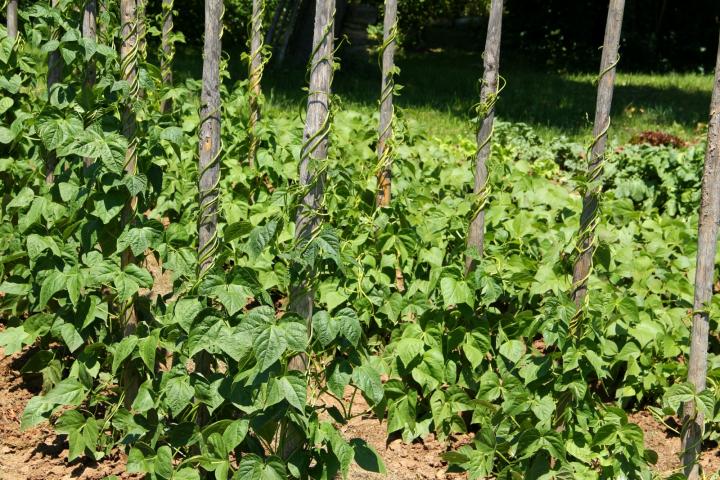
- One option is to create a teepee: Tie three or four (or more) 7-foot-long bamboo poles or long, straight branches together at the top and splay the legs in a circle. Then, plant three or four seeds around each pole. As vines appear, train them to wind up the poles. For more stability, wrap string/wire around the poles about halfway up, encircling the tepee; this gives the vines something to grab.
- Another easy support for them is a “cattle panel”—a portable section of wire fence—16 feet long and 5 feet tall. The beans will climb with ease, and you won’t have to get into contorted positions to pick them.
- For a continued harvest that lasts all summer, sow seeds every 2 weeks. If you’re going to be away and unable to harvest, skip a planting. Beans do not wait for anyone!
- Practice crop rotation (planting crops in different areas each year) to avoid the buildup of pests and diseases in one spot.
How to Grow Beans From Planting to Harvest
Growing
- Mulch soil around bean plants to retain moisture; make sure that it is well-draining. Beans have shallow roots, so mulch keeps them cool.
- Water regularly, about 2 inches per square foot per week. If you do not keep beans well watered, they will stop flowering. Water on sunny days so that foliage will not remain soaked, which could encourage disease.
- If necessary, begin fertilizing after heavy bloom and the set of pods. Avoid using high-nitrogen fertilizer, or you will get lush foliage and few beans. A side dressing of compost or aged manure halfway through the growing season is a good alternative to liquid fertilizer.
- Weed diligently but carefully to avoid disturbing the beans’ roots.
- Pinch off the tops of pole bean vines when they reach the top of the support. This will force them to put energy into producing more pods instead.
- In high heat, use row covers over young plants; hot weather can cause blossoms to drop from plants, reducing the harvest.
Growing Green Beans in Containers
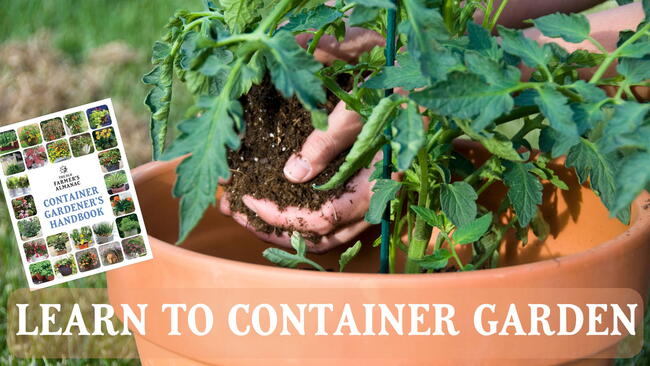
You can also grow green beans in containers! An 8-inch-deep, 8-inch-wide container will hold one bush plant, while a 5-gallon pot will hold up to three bush or pole plants. For pole beans, plan to provide support in or immediately outside of the container. Fill the container with potting mix and rich compost.
Beans grow best when direct-seeded (not transplanted) into the soil, whether it’s in a container or the ground. After all danger of frost has passed, sow into warm (55°F or higher), moist soil. Put two beans into each hole between 1 and 1-1/2 inches deep. Eliminate the weaker one after germination by cutting the stem. (Do not allow two plants to coexist in one hole; neither will thrive.)
To care for your container of green beans, provide 6 to 8 hours of sun per day. Whenever the soil is dry, water to a depth of 1 to 2 inches. Fertilize with a low-nitrogen formula (5-10-10) diluted to half-strength to avoid excess foliage growth. Apply at planting time and when plants begin to flower.
Types
When it comes to green beans, the options are endless. Here are several types and varieties to consider:
- Chinese (aka Asian) long beans (aka yardlong or asparagus beans): slender, 1- to 2-foot pods. Try ‘Orient Wonder’, ‘Red Noodle’, or ‘Yardlong’. All pole.
- French green beans (aka filet or haricots verts): thin, tender, 3- to 5-inch pods. Try ‘Calima’, ‘Masai’, or ‘Maxibel’; in a container, plant ‘Mascotte’. All bush.
- Italian/Romano: wide, flat 6- to 8-inch pods even in the hottest summers. Try ‘Early Bush Italian’, extra-large-pod ‘Jumbo’, or ‘Roma II’. All bush.
- Purple beans: 5- to 6-inch pods are deep purple when raw and turn green when cooked. Try ‘Amethyst’, ‘Royal Burgundy’, or ‘Velour’. All bush.
- Snap beans (aka string or stringless): slender, 5- to 7-inch pods. Try ‘Blue Lake 274’ (bush), heirloom ‘Kentucky Wonder’ (bush or pole), or ‘Provider’ (bush).
- Yellow wax beans: 5- to 7-inch pods have a milder flavor than green varieties. Try stringless ‘Cherokee’ (bush), classic ‘Golden Wax’ (bush), or ‘Monte Gusto’ (pole).
If you are planting your green beans in containers, we suggest bush or pole beans. Many compact varieties are available, and many standard beans can be grown in containers as well. Here are some of our favorite bean varieties for containers.
- Phaseolus lunatus ‘White Dixie Butterpea’: 16 to 24 inches tall; three to four small lima beans per pod; excellent for hot weather climates.
- P. vulgaris ‘Derby’: tender, round, 7-inch-long pods form on 18-inch plants; resistant to bean common mosaic virus.
- P. vulgaris ‘Mascotte’: prolific producer; 5- to 6-inch fruit on 16- to 18-inch-tall plants; resistant to anthracnose, bean common mosaic virus, and halo blight; variety name is French for “mascot” and symbolizes good luck.
- P. vulgaris ‘Topcrop’: vigorous heirloom that sets heavy crop of pods 6 to 7 inches long on 15- to 18-inch-tall bushes; resistant to bean common mosaic virus.
- P. coccineus ‘Hestia’: dwarf runner bean; 12- to 14-inch-tall plants produce 8-inch-long pods; if desired, leave beans to dry on plant and harvest as dried beans for chili, soups, and stews.
- P. vulgaris ‘Rattlesnake’: heirloom; vines up to 10 feet long produce 8- to 10-inch-long green pods with purple speckles; drought-resistant; heat-tolerant.
Read more about some of our favorite varieties of green beans.
Gardening Products
More Like This



Test you soil to make sure it has the right pH. Lime will make it more alkaline--don't add any more unless the soil is more acidic than optimum. Beans like it slightly acidic to around neutral, depending on the type: around 6.0 to 7.5. Also make sure that your seeds are viable (new seed packets would be fine). Cold soil will slow germination, and some bean varieties will take longer than others to sprout. Lots of water or rain can rot the seeds. Also, when mulching before seeds sprout, you might want to provide only about a 1/4 inch layer (or avoid the actual spots where the seeds are planted); otherwise, the seeds may have trouble pushing through (when plants establish, you can provide a thicker layer), and the soil might be kept cooler than optimum for sprouting. Or, you could just avoid mulching until after the seeds have sprouted and become more hardy. For grass clippings, let them brown and dry before applying them to the vegetable bed, and avoid those clippings from lawns treated with pesticides.
Ideally, beans should be planted in the final container, as they do not like being transplanted, either that, or you can plant them in peat pots and then when the seedlings are ready, plant the entire peat pot in the final spot [make sure the top rim is slightly (1/4 inch) below soil level, or it will wick away water from around the seedling], whereupon the peat pot will break down in the soil. When transplanting a bean seedling to its final spot, handle it very gently so as to disturb the roots as little as possible. Be sure to plant it at the same depth that it was in the pot (they are fussy). Squash has fragile roots, so when transplanting, be very gentle; ideally, like beans, they should be planted in their final site.
Most seedlings should be transplanted to individual containers when they grow their second or third set of true leaves. The first "leaves" to appear will be the cotyledons, which are not true leaves, and will often have a different shape that the true ones.
If your plants are already outdoors, then you don't need to worry about hardening off. [If they are indoors, you'd need to gradually introduce them to outdoor conditions, by placing them in a shaded, protected area for a few hours each day, increasing the amount of time each successive day--take them in at night. After about 7 to 10 days, they should be ready to plant outdoors.]
Tomatoes usually emerge within 5 to 10 days, it could be that your other seeds may germinate soon; cooler soil temperatures may delay germination. Make sure the soil is at optimum temperature, and don't over- or underwater. Also, the older the seed is, the less will sprout. Transplant tomato seedlings the first time to individual pots when they have their second pair of true leaves (about 3 to 4 inches tall); transplant to the final spot when they are about 6 to 10 inches tall, after they have developed a healthy root system and a good set of leaves.
It depends on the insect and the damage. Some insects lay eggs in the leaves and the larvae will hatch inside (leaf miners), or spider mites weave webs on them. In those cases, where the insect would remain on the leaf and you can't remove the insect, remove the leaf. However, it sounds like yours have been damaged by, as you say, snails and tomato worms and perhaps other caterpillars, and/or maybe a beetle (such as a bean leaf beetle). These will wander over several leaves or plants. If you don't see signs of eggs (or if you do, you can knock them off), and the leaf appears to be coping (healthy green), then you should probably leave it be. (If they are clearly dying, though, then remove them to avoid diseases invading.)
If this were a disease, however, especially a virus, it sometimes would be best to remove the affected leaves to help prevent spreading.
If there are too many damaged leaves, or too many removed, the plant would suffer, as it wouldn't be able to make enough food.
- « Previous
- 1
- 2
- …
- 10
- Next »

Comments