
Learn how to choose, plant, and care for plum trees with this complete growing guide

Read Next
Growing
How to Care for Plum Trees
Watering
- Be sure to water the young trees heavily every week during the first growing season to help promote growth. Then, water regularly. It’s best to water the plant deeply at the soil line, then let the soil dry out (though not completely) and water again.
- If rain is lacking, water your tree well into mid-October to give it plenty of moisture through the winter months.
Fertilizing
- Do not fertilize young fruit trees until they have set a crop.
- Once established, fruit production requires regular fertilizing all year long. If there’s good fruit set, fertilize with one pound of calcium nitrate per tree or 1½ lb. 10-10-10. Cut back the nitrogen in fall and winter to avoid encouraging new growth in those seasons.
General Care
- Are you having pest issues? Talk to your local cooperative extension for natural solutions that work in your area.
- To help control pests and diseases, remember to prune your trees to keep them open. You can also mulch around the trees in the spring to help control weeds, but be sure to remove the mulch in the late fall so that no pests use it over the winter. You can also lightly cultivate the soil around your trees in late spring to eliminate any pests in the soil.
- In the fall, rake away all debris and fallen trees.
- To prevent winter injury: Consider a tree wrap or guard around the lower trunk, especially for a young plum tree.
- Keep an eye on the lower bark and branches for mouse or rabbit damage; if this could be a problem, you may need to install tree guards or fence in young trees with chicken wire for the winter.
How to Prune Plum Trees
When to Prune
- Prune in early spring or mid-summer to avoid infection. The best time for pruning is usually spring for young trees and mid-summer for established ones.
- Do NOT prune in the fall. Winter injury and infection may occur.
Thinning Fruit
“Thinning” is the process of removing developing fruit from a tree in order to increase the overall quality of the produced fruit and to prevent damage to the tree.
- Thinning is usually done about a month after blooming ends in the spring.
- Leave 2-4 inches between each fruit, removing those in between.
- Thinning helps to prevent branches from breaking under the weight of the fruit. If branches do break, prune them back to undamaged wood, ideally cutting back to a natural fork to avoid leaving stubs.
Pruning: Japanese Plum Trees
- If you have a Japanese variety, the best pruning method is to create an “open center” shape, where the central trunk is cut short and several large branches radiate outwards from it’s tip. In the summer of the first year, cut the vigorous shoots that form on the top of the tree by two or three buds. After about a month, check the tree. As soon as you have three wide-angled branches, spaced equally apart, cut back any other branches so that these three are the main branches. In the early summer of the second year, cut back the branches in the middle of the tree to short stubs and prune any shoots developing below the three main branches. After the third year, remove any shoots in the center of the tree to keep its shape.
- Japanese types require heavy pruning to help keep them in shape and to produce better fruit. It is also good to thin out the fruit on these types of trees. You should space the plums about 3 to 4 inches apart on each branch.
Pruning: European Plum Trees
- If you have a European variety, the best pruning method is to create a central leader. This shape features a central trunk with branches that spiral out every 5 to 8 inches, making sure that no branch is directly above another. The training for such a system begins in the early summer of the first year, during which time you should remove any shoots that form within 18 inches of the ground. The end result should resemble a Christmas tree.
- European types do not typically require fruit thinning because they do not produce as much fruit as Japanese types. However, the fruit on these types should be spaced about 2 inches apart on each branch.
For more pruning tips, check our spring pruning guide.
Types
- For a European type, try the ‘Stanley’. This semi-freestone type works great for the eastern, midwestern, and some of the northwest regions of the U.S. It is self-fertile, meaning no cross-pollination is necessary. It’s harvested in late August, producing medium to large plums with dark blue skin and greenish-yellow flesh and is great for cooking, canning, or eating fresh.
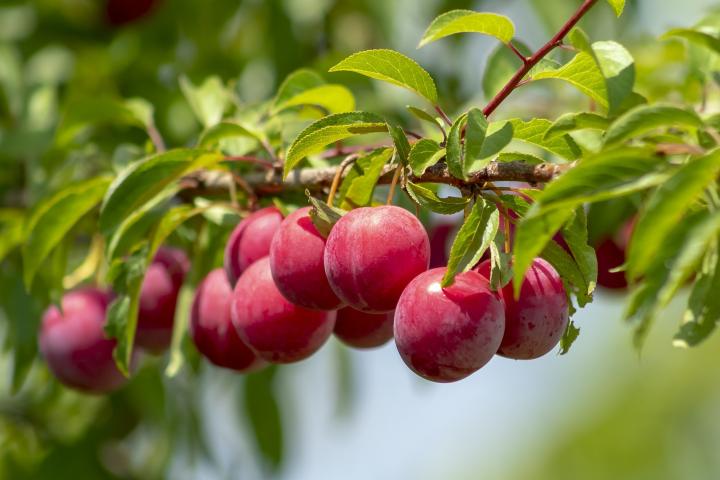
- For a Japanese type, try the ‘Satsuma’, which produces large, dark-red plums. This kind is good for eating fresh and canning because of its sweet taste.
- American hybrid trees, such as ‘Alderman’, ‘Superior’, and ‘Underwood’, are all popular choices. These trees combine the taste of the Japanese variety with the hardiness of the European variety. These types work well for regional extremes.
Gardening Products
Cooking Notes
- Plums are great for making jams or jellies.
- Plums can also be stored through freezing or drying them (dried plums are prunes), learn how to dry fruit with a dehydrator.
More Like This


Comments

Here is a good reference page on how to renovate old fruit trees: http://extension.psu.edu/plants/gardening/fphg/pome/pruning/pruning-a-special-case-renovating-old-fruit-trees
Hi Terry,
Depending on the variety you have you may need a different variety of plum for cross pollination. Check the chart at
http://ucanr.edu/sites/fruitreport/files/132874.pdf
It may take five to six years after planting before the trees will produce fruit. When the trees are between 8 and 10 years old they will have maximum fruit production.
During the summer after the first winter pruning, remove the numerous water sprouts that will grow on the heavily pruned tree. Avoid pruning shears. Pull the shoots off the trunk in mid-June when they are about 10 to 12 inches long. Keep pulling these shoots off throughout the season on the major scaffolds. The shoots can be pulled off safely as long as their bases remain tender and green. Stop when the base of the shoot becomes woody and does not easily pull off.
Fruit drop can happen for many reasons: 1) Do you see any sign of insects? Plum curculio is a snout beetle that causes problems and you need to use a fruit tree spray at petal drop and up to 6 weeks after. 2) How is your soil? Plum trees do not do well in wet or compact soil; well-drained sandy loam is best. 3) Do you have plenty of sunshine? 4) Do you have pollinators? Unpollinated flowers will bear fruit, but they abort. 4) Are you thinning your fruit? 5) Are you watering enough? The amount of water needed depends on the size and age of the tree and weather conditions, but a first-year tree uses 5 to 10 gallons of water per week in the summer. The soil on the surface may be dry, but the soil at the root zone needs to be moist 4 to 6 inches down. Occasionally, you can dig down and see if it's moist (but not water logged).
- « Previous
- 1
- 2
- …
- 10
- Next »

If you're planting this type of plum tree, just keep in mind that it has a wider spread (15 to 20 feet). As with most plums, plant in fertile, well-drained soil and ensure periodic deep watering in summer months. See this page for more plum planting information.