
Get ready for hawkwatching!

Every fall, hawks puts on quite a show as they take flight by the thousands for their annual migration. Where are the hawks going? Learn more about this amazing natural spectacle—and how to help migrating hawks.
Do Hawks Migrate South for the Winter?
Most hawks migrate south in autumn, though not all hawks. You’ll see Red-tailed Hawks, Cooper’s hawks, Sharp-shinned hawks and many other start streaming through the air.
Migrating hawks travel southward out of Canada and the northern United States, along both coasts of North America, around the Great Lakes, over the Great Plains, down the Appalachians and the Rockies, pressed together into the funnel of Mexico. Some pour down into Central America.
The birds don’t know each other: they just find themselves shoulder to shoulder, wing to wing, headed in the same direction!
Most songbirds migrate at night, when a couple chirps above us or a shadow zipping in front of the moon are our only clues to the presence of thousands overhead. Some flocks of birds are so large, they appear as “blooms” on the radar maps of meteorologists.
When do Hawks Migrate?
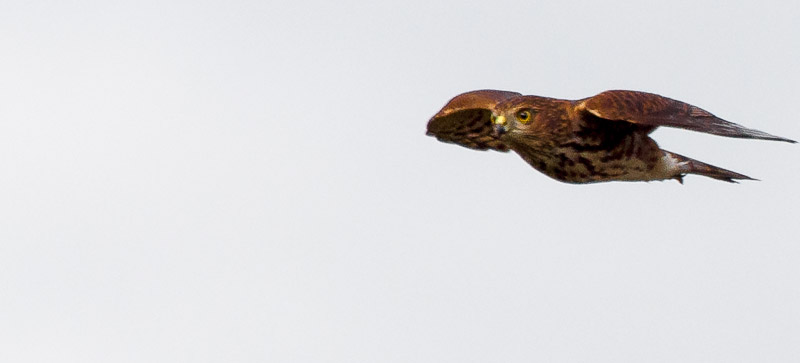
Most hawks migrate in October, though timing can range from September to mid-November based on weather and other factors.
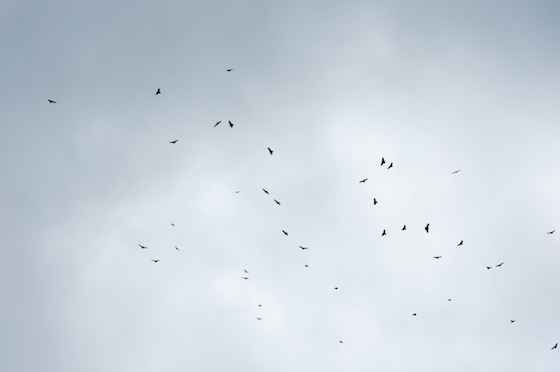
From any hilltop in North America, on a clear day in October, you may see dozens, even hundreds of hawks, falcons, eagles, and their relatives, either singly or in small groups, all streaming by southward. One day the skies are empty and the next day they’re full, as if someone had turned on a spigot.
Ospreys abandon their local ponds, harriers their marshes, falcons their cliff ledges.
Merlins, little angular missiles with wings stuck out like an anchor’s flukes, go zipping by almost too fast to register.
Sharp-shinned Hawks, long-tailed dashers of the forest, harass each other with the reckless abandon of fighter pilots.
A Golden Eagle, ravens swooping at him from above like gnats, cruises past without twitching a muscle, its six-foot frame throwing an even larger shadow.
.jpg)
This is delightful not because it doesn’t make sense, but because the sheer scale of it is so hard to comprehend. My tastes have changed as I’ve gotten older: a Shriner on a tiny scooter seems tame compared to a kettling cloud of Broad-winged Hawks overhead, rising in a towering thermal, silent, on their long way down to the tropical forests of Brazil.
When to Watch Hawks
The best times to watch hawks are in mid-morning (10 to 11am) and mid-afternoon (3 to 4pm). Why? This is the peak thermal activity in the skies, which gives the quickest ride for migrating birds!
In autumn, hawks are especially attracted to a sunny day after a cold front passes with northwest winds about 15 to 20 mph for good speed!
Where to Watch Hawks
If you’d like to join a hawkwatch, the best sites are generally on mountain ranges and shorelines throughout North America are places where hawks concentrate in significant numbers. Hawk migration counts are conducted at many locations where raptors are known to be abundant. The Hawk Migration Association of North America (HMANA) lists over 1,000 hawk migration sites in North America. Find a hawkwatch site in your area!
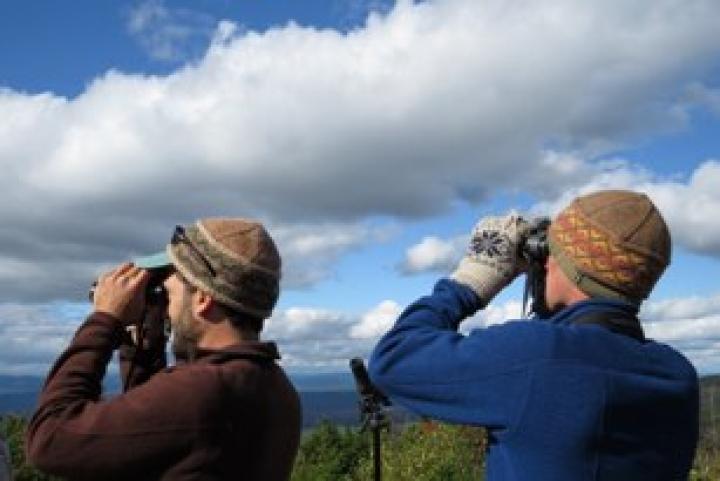
Hawkwatching from the Pack Monadnock Raptor Observatory in NH. Photo: Cynthia Nichols.
When you go to a hawkwatch site, bring a pair of binoculars if you can, along with sunscreen, a hat, sunglasses, food & water, and warm clothes on the colder days.
Or, dust off your old pair of opera glasses and spend an afternoon scanning the skies where you live. Let us know what you see. The parade is strung out over the whole continent, but it’s certain to pass your door!
Learn more about bird migration and how birds know when to migrate!



Comments

Why do geese fly in a V? Because it would be too hard to fly in an S! Just kidding. There are 2 purposes:
1. It conserves their energy. Each bird flies slightly above the bird in front of them, resulting in a reduction of wind resistance. The birds take turns being in the front, falling back when they get tired. In this way, birds can fly for a long time before they must stop for rest.
2. The second benefit to the V formation is that it is easy to keep track of every bird in the group. Flying in formation may assist with the communication and coordination within the group. Fighter pilots often use this formation for the same reason.
A good question...the tropics should be a land of plenty, right? It comes down to raising a family. Although food's available all year round down south, there are so many birds competing for it that the youngsters would never survive. Birds come northward to be able to spread out and find a territory big enough to support a nest of hungry chicks.
It's a compelling image--hummingbirds riding along on a vulture's back--but alas, there's no evidence for it. As Annie B. notes below, those hummers have to do it all on their own power. (Which might be even more amazing.)
- « Previous
- 1
- 2
- …
- 10
- Next »

That's a very good point. Too many. Here's a helpful reference guide to answer your question. As it says, "Determining what factors are different between areas with high fatality rates and low fatality rates can help us to install wind facilities in areas where they will have the least impact while still gaining the benefits of wind energy."