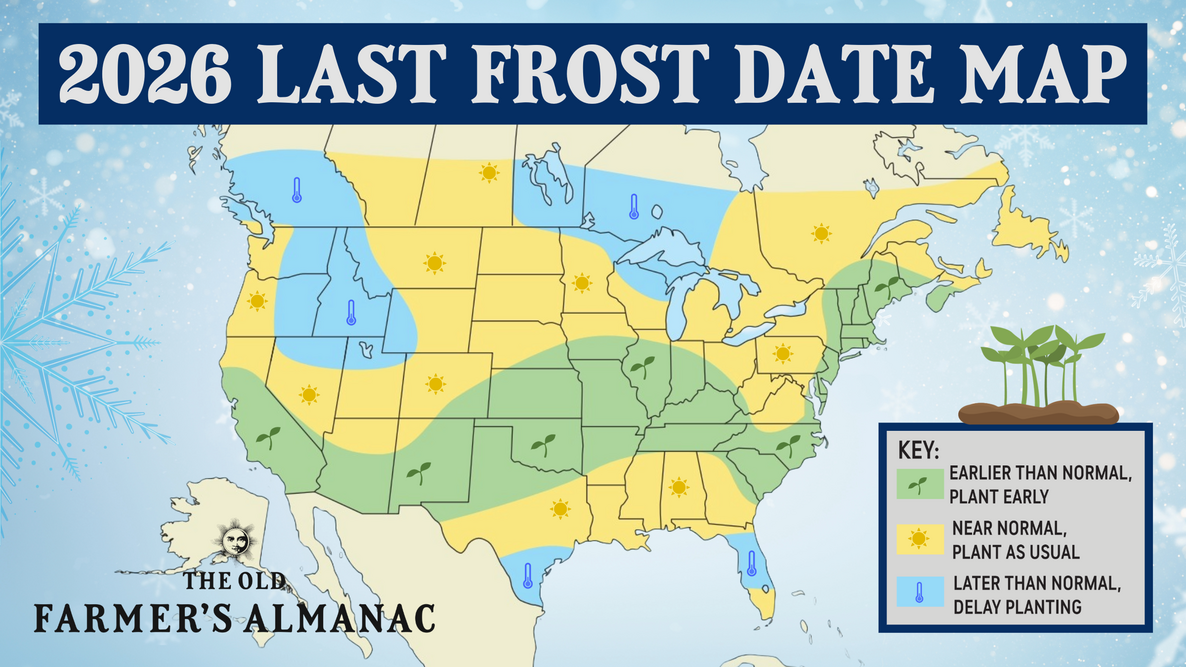
The Old Farmer’s Almanac introduces a new 2026 Last Frost Date Map to show whether your last spring frost this year is likely to be earlier, about the same, or later than the long-term norm.
While our traditional Frost Date Calculator shows the 30-year average—the typical last frost for your ZIP code—the 2026 map is a forecast for THIS season; it combines long-range weather forecasts with historical frost averages to show how 2026 may deviate from that average.
Most differences are modest (about 1–2 weeks), but even a few days can matter. In some areas, this map allows gardeners to get a jump on the season; in others, it helps avoid disaster. It’s designed to guide earliest plantings—especially frost-tolerant vegetables and flowers that thrive before consistently warm weather arrives.
2026 Last Frost Date by Region

May be shared with attribution and a link to this page: Almanac.com/Frost-2026
How to Read the Map
The map is divided into three colors. Find your location’s color to see whether your last spring frost is expected earlier (green), near-normal (yellow), or later (blue) than the long-term average.
| Color | Meaning | Description |
|---|---|---|
| Green Areas | Earlier Than Normal | If your region is green, the last spring frost is expected about one to two weeks earlier than average—but keep frost protection handy. |
| Yellow Areas | Near Normal | If your region is yellow, frost timing should be close to the historical average (roughly ± one week). |
| Blue Areas | Later Than Normal | If your region is blue, the last spring frost is expected aroughly a week or two later than usual; delay early plantings and protect young plants; soils and nights may stay cooler longer. |
Regional Highlights from the 2026 Map
The map shows broad swaths of green, yellow, and blue. Here’s how regions shape up across the U.S. and Canada this year:
| United States | Description |
|---|---|
| Northeast | Green (earlier than normal) across Boston and much of New England. |
| Atlantic Corridor | Green across parts of New Jersey, New York City, and Philadelphia. |
| Southeast | Green across the Carolinas and eastern Georgia—expect a longer spring planting window. |
| Florida | Blue (later) in central areas near Orlando; yellow (near normal) in the north and southern tip. |
| Appalachians | Yellow (near normal). |
| Ohio Valley | Green in Kentucky and much of Indiana; yellow in parts of Ohio and West Virginia. |
| Deep South | Yellow overall (near normal). |
| Upper Midwest | Yellow overall; blue at the northern tips. |
| Lower Lakes | Yellow across Michigan and Great Lakes cities, including Chicago. |
| Heartland | Green (earlier) across parts of Missouri and Kansas; yellow in northern Iowa. |
| Texas–Oklahoma | Green in the north near Oklahoma City; yellow in central zones; blue in southern areas near San Antonio. |
| High Plains | Yellow across Nebraska, northern Colorado, and the Dakotas. |
| Intermountain | Blue across Idaho, eastern Oregon/Washington, northern Utah and Nevada. |
| Mountain West | Blue in northern Montana; yellow elsewhere. |
| Pacific Northwest | Yellow across Seattle, Portland, and coastal zones. |
| Pacific Southwest | Green across many low-elevation California and desert regions. |
| Canada | Description |
| Southern British Columbia | Blue (later than normal). |
| Prairies | Yellow overall; blue in parts of the east. |
| Southern Ontario | Yellow across the east; blue across the west. |
| Southern Quebec | Yellow overall. |
| Atlantic Canada | Yellow overall; green in southern Nova Scotia. |
Gardening Tips Based on Your Map Color
Use this map to fine-tune early-season plans for cool-season crops and pair it with the Almanac Planting Calendar to plan by crop and days-to-maturity.
If Your Area Is Green (Earlier Than Normal)
An earlier-than-normal last frost suggests freezing temperatures may end sooner than average. This creates opportunities for earlier garden activity—but brief cold snaps are still possible.
- Get a head start: Consider sowing peas, lettuce, and spinach 1–2 weeks earlier.
- Have frost protection ready: Row covers, cloches, and cold frames protect seedlings on chilly nights.
- Check soil temperature: Soil can remain cool; wait on warm-season transplants until the soil is consistently warm.
- Gradually harden off seedlings: Acclimate indoor starts before transplanting.
If Your Area Is Yellow (Near Normal)
Expect typical timing. Use the Frost Date Calculator and standard planting windows, but stay alert to local variability.
- Follow averages: Plant according to your ZIP’s historical dates.
- Prep soil: Add compost and fix drainage ahead of planting.
If Your Area Is Blue (Later Than Normal)
Delay and protect. Later frosts increase risk for early planting—wait for soils and nights to warm.
- Delay outdoor plantings of tender crops.
- Use raised beds or protection tools to improve soil and drainage.
- Stagger sowings so later plantings can compensate if early seedlings struggle.
Tips for Everyone
As gardeners, precautions don’t change—whether frost ends early, late, or on time. Here’s a quick refresher:
- Watch the weather: Nighttime lows are often the best clue for frost risk. Learn how to predict frost.
- Observe your garden: Cold, wet soil can delay germination even without frost.
- Know your crops: Cool-season plants tolerate chill; warm-season crops need frost-free nights and warm soil.
- Soil temperature is the gold standard: Check our germination chart for ideal soil temps by crop.
- Use the Almanac Garden Planner to design beds and schedule plantings.
Looking Ahead
The 2026 Last Frost Date Map doesn’t replace long-term averages—it adds a forecast layer for this year. Think of it as another tool: watch the weather, trust your soil, and protect tender plants when in doubt. Use the map with the Frost Date Calculator and the Planting Calendar to start the season with better information.

Comments