
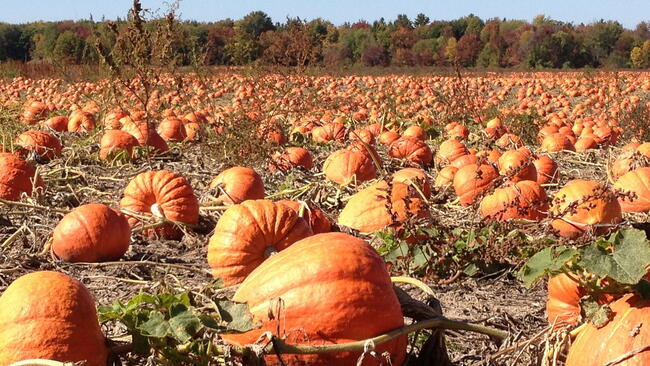
After you harvest a pumpkin from the field, it is a good idea to “cure” it. This hardens the skin so that it stores for months instead of mere weeks. See our article on how to cure and store a pumpkin (plus a video with more information).
Yes, pumpkins can be eaten straight away once harvested, but if you plan to keep them for longer you’ll need to cure them first and store them correctly.
When is the Pumpkin Ready?
You can tell if your pumpkins are ripe by looking at its stem. If the stem has died off and hardened, the pumpkin should be ripe. It will sound hollow when slapped, and if you push your thumbnail into the skin it should dent but not puncture it. Of course, you should also have an idea of when the pumpkin is mature by counting back the “days to maturity” on the seed packet.
Harvest pumpkins before any hard frosts.
See more information about harvesting pumpkins on the Almanac’s Pumpkin Growing Guide.
Curing Your Pumpkin
Curing allows the pumpkins to last longer for months instead of weeks. Curing hardens their skin to protect it from decay and rot. If you cure your pumpkin, it will last until Christmas! Some varieties of winter squash will even last until spring if cured.
To cure your pumpkins, cut the stem with a sharp knife, leaving 4 inches attached to the pumpkin. This minimizes the risk of molds or fungal spores developing within the fruit. Brush off any dirt.
Lift and move pumpkins carefully by cupping the fruit in your hands – don’t use the stem as a handle!
Keep pumpkins in a dry, warm place such as a greenhouse, a sunroom, your doorstep, a dry part of your garden, or sunny windowsill for at least 2 weeks.
Then carefully turn the fruits upside down and leave for another 2 weeks. This insures that the skins harden up properly. Polish your pumpkins with a little olive oil on a cloth to make them moisture-tight, and they’re ready for storage.
Pumpkin Problems
Powdery mildew
As soon as you see any whitish, powdery or furry patches, cut off the leaves and compost or burn them. Powdery mildew can be controlled with a simple spray of milk and water diluted at a rate of about 40% milk to 60% water, applied to both sides of the leaf. Spray liberally so that the leaves are dripping. Spray preventatively, before you see the signs of powdery mildew. Spray in bright light, and repeat every 10 days.
If powdery mildew has spread to the stem, the stem will decay and have white coloration. Avoid choosing pumpkins with powdery mildew on the stem if you are planning to cure and store.
Squash bugs
Another problem can be squash bugs. If you see any squash bugs on your pumpkins, harvest them as soon as possible and then cure the pumpkins away from the garden.
Broken stem
Again, do NOT carry the pumpkin by the stem! If you accidentally break a stem while the fruits are still growing, as long as it has not become completely detached from the rest of the stem, it can be repaired. Make sure the edges of the broken part are in contact with one another, then pile organic mulch on top. Make sure to cover the point where the nearest leaves grow from, and water it well. The plant will then be able to send down new roots and repair itself.
Storing Pumpkins
Store pumpkins in a dry, frost-free, well-ventilated shed or room at temperatures of up to 68°F. Place them on a thick layer of newspaper or straw on a wire rack to allow air to circulate. Don’t store them near other fruits such as apples, which emit ethylene gas that can speed up aging. Check on your stored pumpkins them regularly.
Want to plan a garden with pumpkins next year? They take a lot of space but our garden planning tool will help you out. Get a free trial of the Almanac Garden Planner.

More Like This

Yes, pumpkins grow multiple fruits per plant. Select just two or three pumpkins per plant and remove all the others to focus the plants energy on your chosen fruit.
- « Previous
- 1
- 2
- …
- 10
- Next »
