Caption
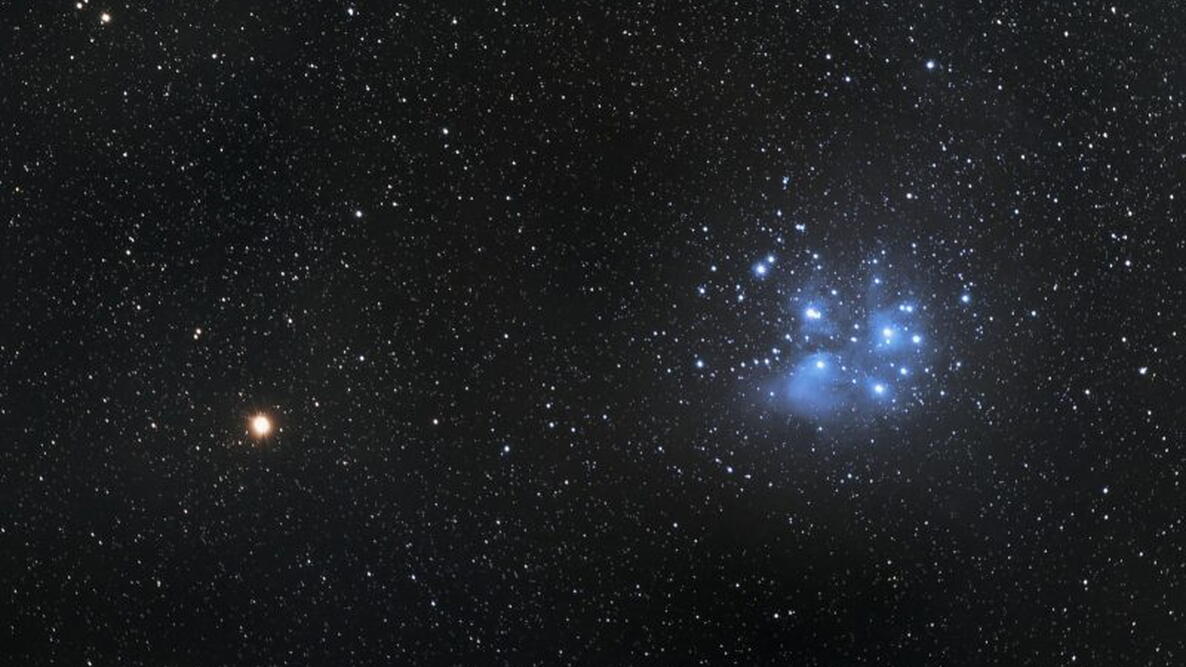
The stunning Pleiades, photographed on April 1, 2019, by Abhijit Patil. (See more at abhijitpatilphoto.com and @abhijitcpatilphotography on Instagram).

The Seven Sisters, also known as the Pleiades star cluster, is one of the most recognizable patterns in the night sky. This sparkling group of stars, sometimes called a “tiny dipper,” becomes especially noticeable in the fall and spring evenings, when it rises at nightfall and glitters low in the west above the setting Sun. But why are they called the Seven Sisters when most people only see six stars? Let’s explore the astronomy, mythology, and meaning of this famous star cluster.
Why Is the Pleiades Star Cluster Called the Seven Sisters?
The seven sisters come from Greek mythology. The Pleiades were the seven daughters of Atlas, a Titan who held up the sky, and the Oceanid Pleione, the protectress of sailing. The sisters have names: Alcyone, Asterope, Electra, Celaeno, Maia, Merope, and Taygete.
How Old Is the Pleiades?
No obstetrician attended the birth of the Pleiades, 60 million years ago. As these fiercely hot suns awakened from the dazzling and dangerous gaseous nursery, the newborn stars materialized like a distant sunrise in the skies of Earth, 400 light-years away.
The Pleiades gave the ancients a sense of time. Over 10,000 years ago, hunter-gatherers in the Paleolithic period were able to observe the Pleiades appear in late October and disappear in April, thus signaling winter’s end and the beginning of the new agricultural season. (They are summer stars in the Southern Hemisphere with the opposite interpretation.) We know this because representations of this prominent pattern of stars appear on paintings in the cave of Lascaux (France), which date from 15000 BCE (before the common era).
Pleiades Meaning and Symbolism in Ancient Cultures
In ancient times, the Pleiades had a strange, sinister reputation. Such medieval rituals as the pagan Black Sabbath and All Hallow’s Eve (which evolved into our own Halloween) were set to occur when the Pleiades reached their highest point at midnight. It is speculated that the rituals could have originated as a sort of commemoration of an ancient catastrophe that resulted in great loss of life. Some believe they may be linked to the Atlantis myth, itself perhaps a legend that evolved from the awesome eruption of the Santorini Volcano in 1450 BC that devastated the Minoan civilization on nearby Crete.
 The Pleiades had an odd importance to civilizations throughout time and around the world. In Egypt, they were revered as one of the forms of the goddess Isis. In ancient Persia, the date on which they reached their highest midnight ascendancy was marked with ceremony. In Mayan and Aztec culture, this same yearly occasion had a forbidding undertone and was given tremendous importance.
Pleiades and the Subaru Connection
In Japan, their ancient name is Subaru. For decades, the six companies that merged to produce automobiles in 1953 placed a crude star map of the Pleiades on each of their cars. Over the years, one star has been portrayed as brighter and increasingly separated from the others. Does this reveal some cryptic corporate infighting?
The real thrill comes when the proper instrument is pointed their way. Not a giant telescope; that would be a mistake. Far better is a simple pair of binoculars because low power and a wide field are the ticket. Suddenly, dozens spring into visibility, and their blue-white color becomes obvious as well. Indeed, this is probably your binocular’s single most amazing celestial vista.
But, to the naked eye, most people count exactly six stars.

Why Can We See Only Six Stars in the Seven Sisters?
Why have civilizations as disparate as the ancient Greeks, Australian Aborigines, and Japanese all possessed legends of the “lost Pleiad,” which have persisted through the centuries? Even two thousand years ago, a Greek poet wrote:
“… their number seven, though the myths often say … that one has passed away.”
It’s true that most people can only see six stars today (with the unaided eye). However, if you have modern binoculars or a telescope, you may see that seventh star and possibly even an eighth star.
Why might these stars be more difficult to see today than in ancient times?
One clue is that, as binoculars reveal, they’re blue—a color that indicates stellar youth. Young hot stars are often unstable, gobbling up their nuclear fuel in an adolescent frenzy that frequently produces instability.
They’re in their infancy even today. And, since such massive stars die young, the Pleiades will be long gone when most of the galaxy’s stars are still enjoying middle age. Toddling gracefully across the skies, the newborn sisters are only for now.

More Like This







Comments