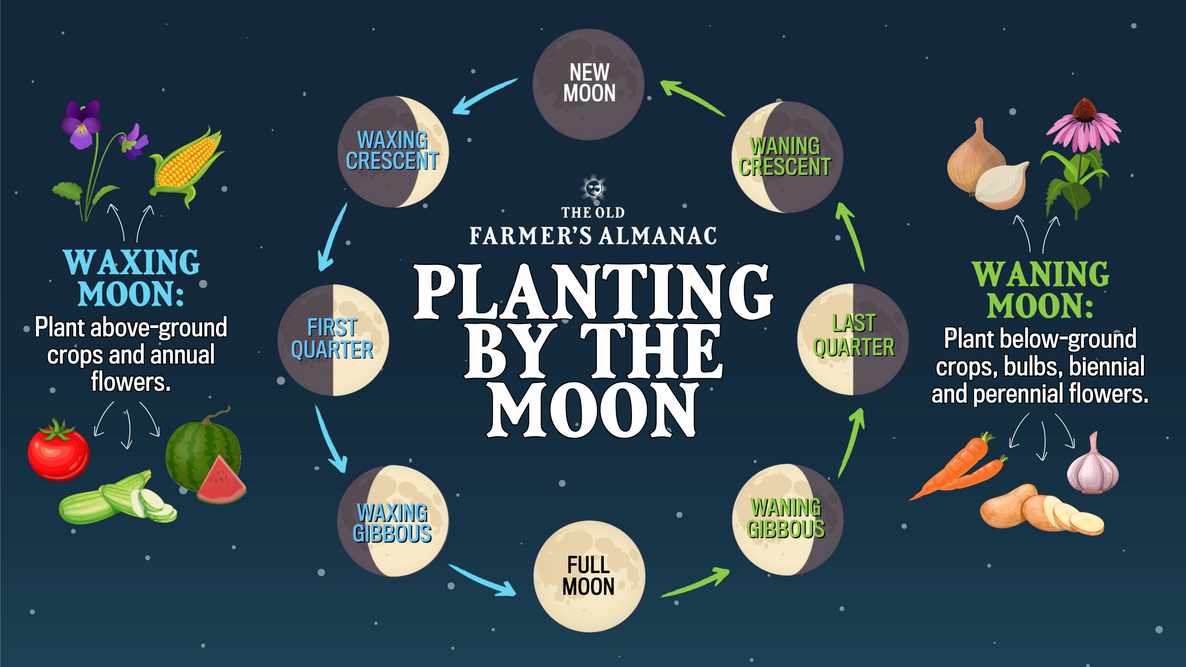
Caption
Planting by the Moon is based on a lunar calendar!

Planting by the Moon is an age-old practice that gardeners and farmers have used for hundreds of years. The Old Farmer’s Almanac includes the Moon phases in its planting calendars, and many old-time farmers swear it results in healthier, more productive gardens. Here’s how it works.
What Is Planting by the Moon?
From what we’re seeing, many trend watchers are confused about Planting by the Moon. No, it’s not about gardening at night—or planting in your PJs!
It’s a simple practice based on the idea that the cycles of the Moon affect plant growth. Just as the Moon’s gravitational pull causes tides to rise and fall, it also influences moisture levels in the soil.
Seeds absorb more water between the New Moon and the Full Moon because moisture is increasingly drawn to the soil’s surface during this period. This extra moisture causes seeds to swell, promoting stronger germination and better-established plants.
Throughout history, people have planted according to the Moon’s phases—from the Ancient Egyptians to the Romans. Pliny the Elder, a Roman historian, wrote about the Moon’s influence on agriculture. Even in completely different regions like China and Africa, the Moon’s cycles were considered in planting practices.
Many Native American tribes followed the lunar calendar for planting, as did the Founding Fathers of the United States. Benjamin Franklin, the father of the modern almanac, published the lunar calendar to help Colonial farmers, a tradition that continues with The Old Farmer’s Almanac.
Today, some modern farmers, especially those interested in sustainable gardening, still consider the Moon cycle when planting. One example is agriculturalist John Jeavons, the father of the biointensive gardening movement.
Planting by the Moon Calendar
To discover WHEN to plant by the Moon, see The Old Farmer’s Almanac’s Gardening Calendar.
This calendar, updated every year, calculates the correct Moon phase for all your common vegetables, herbs, and fruit.
Note that Moon phase gardening is reasonably straightforward. It considers two periods of the lunar cycle:
- The time between the New Moon and the Full Moon (the waxing of the Moon) and
- The time between the Full Moon and the New Moon (the waning of the Moon).
It’s best to plant certain types of plants during the waning of the Moon and other types during the waxing.

How to Plant by the Moon’s Phases
To plant by the Moon, follow these guidelines:
- Plant your annual flowers and fruit and vegetables that bear their harvest above ground (such as corn, tomatoes, watermelon, and zucchini) during the waxing of the Moon. This means from the day the Moon is new to the day it is full. As the moonlight increases night by night, plants are encouraged to grow leaves and stems.

- Plant flowering bulbs, biennial and perennial flowers, and vegetables that bear crops below ground (such as carrots, onions, and potatoes) during the waning of the Moon. This means from the day after it is full to the day before it is new again. As the moonlight decreases night by night, plants are encouraged to grow roots, tubers, and bulbs.

The Moon, Plants, and Gravity
The Moon also impacts plant growth through geotropism—how plants grow in response to gravity. Roots grow downward in the direction of gravitational pull, and stems grow in the opposite direction (i.e., upwards). This behavior can be easily demonstrated with potted plants. Lay one on its side, and the stem will grow upwards. Or, consider a tulip bulb: if you plant the bulb incorrectly with the pointed end down, it will turn around and send its shoots upward, even though it’s in total darkness.
Past Almanac editor Janice Stillman describes how Planting by the Moon works.
Frequently Asked Questions
Is this the same thing as Best Days by the Moon?
No, if you came to this page looking for our Best Days calendar, go to the complete Best Days Timetable. Planting by the Moon is astronomical, depending on the Moon’s phase. Astronomers base their studies on research and observation. What folks call the “Best Days by the Moon” is astrological, based on the Moon’s positioning and a belief that its position in the zodiac affects events on Earth.
Do you have scientific evidence that Planting by the Moon works?
While there is some evidence that the Moon phases might have a small impact on plant growth, other studies say it’s folklore. (We say, doesn’t folklore always contain a kernel of truth?) Many experienced farmers swear by this practice and have had great success. Be realistic and remember that many factors considerably influence plant growth: soil quality, sunlight, water, air circulation, weather conditions, plant varieties, and pest management.

What if the Moon cycles don’t align with the time I want to plant?
We hear you! If your goal is to get your seeds in the ground as soon as possible and not wait for the Moon phase to align, it’s a judgment call. If you can only garden on the weekends, get your seeds in the ground whenever your busy schedule allows. Here at the Almanac, we’re a practical bunch. It is a fun and traditional practice, and we plant by the lunar cycle when it makes sense for the rest of our lives.
Seeds will certainly grow perfectly well any time of the month they are planted if they’re given the nourishment and care that they need. Planting by the Moon is a way to capitalize on the magnetic and gravitational impact of the Moon.
Finally, don’t forget to check out the Planting by the Moon calendar, a tool that customizes your planting dates by the last spring frost and lunar cycles based on your exact zip or postal code.
Ready to grow? We have all the information to plant, grow, and harvest your favorite veggies, herbs, fruit, flowers, and shrubs in the Almanac’s free library of Growing Guides.
Do you plant by the Moon? Do you think the technique helps you grow better crops? Let us know in the comments!

More Like This


Hi Viola,
Thanks for your question. Our astrologer identifies July 9-10, August 5-7, and September 2, 3, 29, and 30 as the best days for setting posts in the coming months. That said, while conditions may be favorable on those days, that doesn't guarantee your posts won't rot. Proper treatment of the posts before installation, and dry ground on installation day, should be factors taken into consideration as well.
Good luck with your project!
Hi Jane Anne,
Welcome back to the Almanac! Despite appearances to the contrary, our content and coverage evolves each year. It is always out goal to retail as many of the features that long-time readers love, while continually reaching out to new readers. It's a bit of a juggling act, and we hope you find plenty to keep you entertained, and hopefully, coming back each year. In our 2025 issue. you'll find info on Gardening by Moon Sign on p. 224, and the Best Days chart starting on p. 226. Enjoy!

Thank you for bringing this to our attention. We have expanded the entry on the corn growing-guide page to include the method discussed on this Gardening by the Moon page.
Different traditions (such as between families, generations, cultures, or locations) have arisen as to the best time to plant corn. Many lunar gardeners plant when the Moon is waxing to encourage vigorous, healthy growth; that is what we talk about on this page. However, according to another long-standing tradition, as mentioned on the corn growing-guide page, it is said that corn planted under a waning Moon grows more slowly but yields bigger ears. We have shared both methods on our Web site, but apologize for the confusion with the conflicting information. We hope that the revision will help to make things clearer for our readers.
Thanks again!
- « Previous
- 1
- 2
- …
- 10
- Next »

Comments