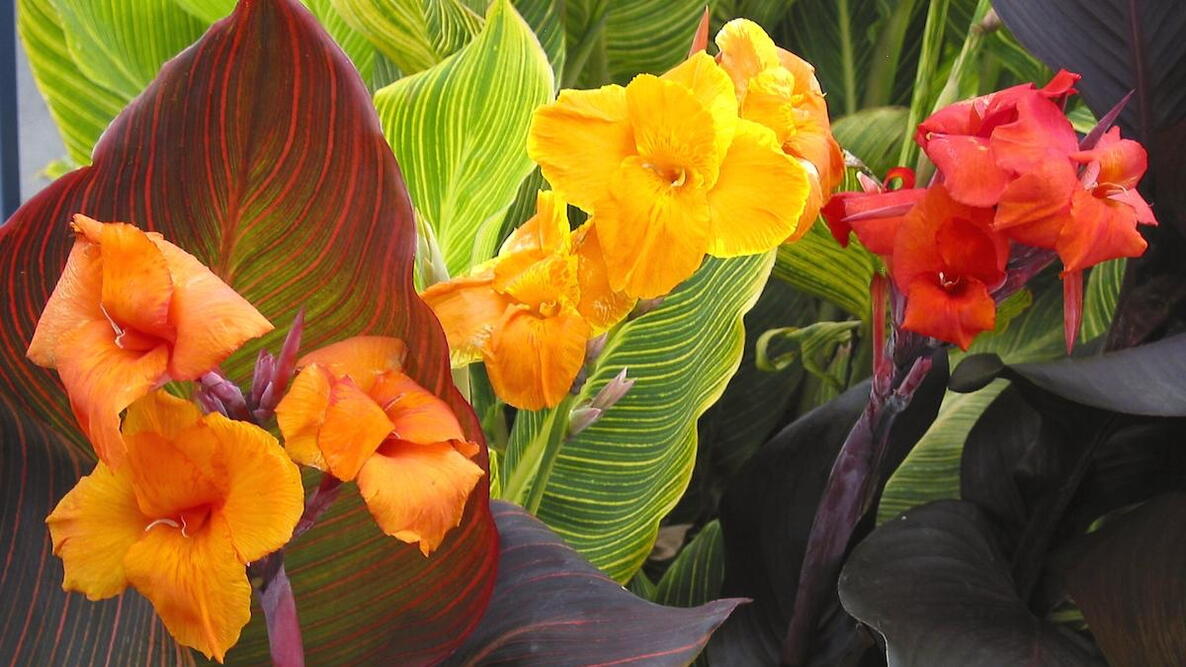
Caption
Canna Tropicanna®: The original Tropicanna, Tropicanna Gold, and Tropicanna Black

Planting
When to Plant Cannas
- Cannas can not tolerate cold temperatures. The soil must be 60ºF or warmer before planting rhizomes—often the time when folks put tomatoes in the ground. See our Planting Calendar for tomato-planting dates. Dig a small hole 2 inches deep and insert a thermometer to determine soil temps.
- In cold, short-season areas, start canna rhizomes in pots indoors or in a greenhouse, ready to transplant outdoors at the right time.
Where to Plant Cannas
Cannas need full sun for good flowering and consistently moist soil with a pH of around 6.0–6.5. Add lime before planting if your garden soil is acidic (low pH). Position plants away from strong wind; their large, soft leaves are vulnerable to damage.
How to Plant Cannas
- Space rhizomes 1-1/2 to 2 feet apart to give cannas enough room. Containers need to be at least 18 inches in diameter (per rhizome).
- Before planting, loosen the soil to a depth of 1 foot, then mix in 2 to 4 inches of compost.
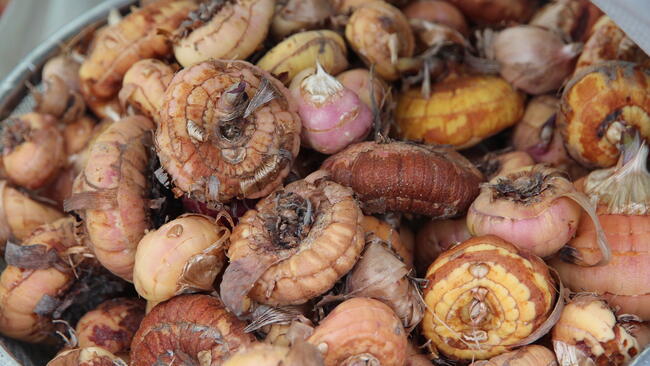
- Dig a hole 2 inches deep and set the rhizome 1 to 2 inches below the soil with the “eyes” (bumps or nodes, which are growth sprouts) pointed up.
- Cover with 1 to 2 inches of soil. Tamp firmly.
- Water thoroughly, then withhold water for as long as three weeks and watch for signs of growth. Cannas are slow to sprout. Once sprouted, water at least once a week by slowly soaking the area around the roots.
- Full foliage color develops when days are warmer (59ºF or more). Blooms should appear in 10 to 12 weeks.
- Cannas should not need to be staked, as they have strong, upright stems.

Growing
Watering
Cannas need wet soil. If the soil doesn’t remain moist, provide a good soaking once a week and every other day during the hottest weeks of summer—water freely in dry spells. Maintain a thin layer of mulch to help retain moisture.
Fertilizing
Where the soil is fertile, fertilizer is optional. However, cannas are big eaters and would benefit from slow-release fertilizer at planting and twice during the growing season. Fish emulsion fertilizer, which is a little higher in nitrogen, is a beneficial organic alternative. Higher nitrogen fertilizers tend to increase canna height. Rose or tomato food products are also suitable.
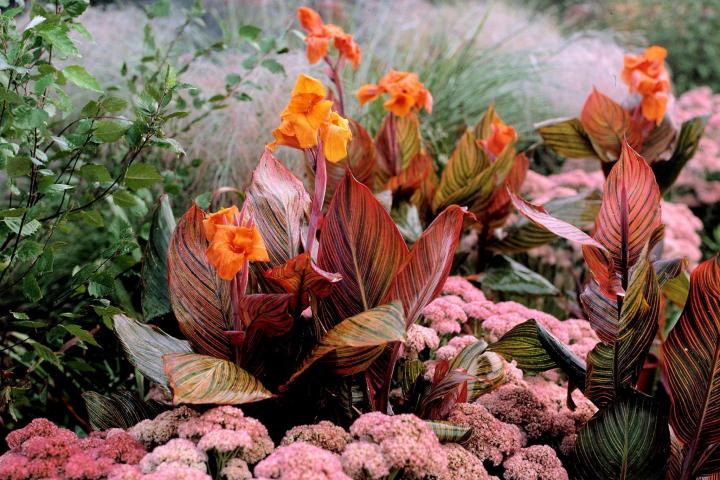
Photo Courtesy of Anthony Tesselaar Plants
Deadheading Cannas
- To promote blooming, check your canna every few days to deadhead (i.e., remove spent flowers).
- When deadheading, use small garden pruners or scissors. Do not pinch with your fingers.
- Canna stems grow several flowers on a single stem. Snip off only the spent flower where it joins the main stem, leaving the other spikes to continue to bloom.
- Once all the flowers on a single canna spike have bloomed, you may cut that part of the stem back, but avoid cutting off any new budding spikes.
Cutting Back and Pruning Cannas
After the entire plant has been deadheaded several times and with flowers no longer forthcoming, cut the flower stem back to the foliage.
Only at the end of the growing season should you cut the plant—down to around 6 inches off the ground.
If the plant looks “trashy” or the leaves get sunburnt, however, you can simply trim off the brown edges (like a haircut) or trim off any dead leaves at the bottom near the stem.
Be careful not to nick the main stem. If the stem is damaged, cut it back to the ground.
You may see seed pods on your canna! These seed pods will make more cannas, so you can clip them off and put them right in the soil of your cannas; it may take a few years to get going, but you’ll have more cannas in the future.
How to Store Cannas for Winter
In Zones 7/8 and warmer, cannas can be left in the ground year-round. After frost kills the foliage, cut in-ground plants back to 4 inches. Add a healthy layer of straw or leaf mulch in the fall to protect rhizomes from the cold as the plants overwinter in place. (Note: Zone 7 doesn’t always experience canna-killing winter temperatures, so it’s a judgment call.)
Bring cannas grown in pots indoors into a garage or basement for winter. Keep them dry (do not water) until spring’s nighttime temperatures are consistently above 50°F, typically after the tulips have bloomed in northern areas. Only then move them outside for the summer.
In Zone 6 or colder, it is necessary to dig up (lift) in-ground cannas in the fall and bring them inside for the winter. After cutting the canna back (as above), dig out the rhizome with a shovel. Avoid damaging the rhizome by digging about 1 foot away from the stem. With your hands, gently loosen the soil and lift out the clump. Shake off the soil and cut off any foliage. Divide clumps into 3 to 5 rhizomes, each with eyes.
Cure the rhizomes in the sun or in a garage or closet for a few days to toughen them up and help them resist rot. Wrap each rhizome in a newspaper or a paper bag, along with a small amount of dry growing medium, such as peat moss, to absorb moisture and prevent rot. Rhizomes should not touch each other.
Store cannas over the winter in a dry place where the temperature will not drop below 40ºF. Often, this is a basement, attic, or garage. Check the rhizomes a couple of times over the winter to make sure that they don’t dry out. Mist with a bit of water, as needed. If you find rot, trip it away or discard the entire rhizome.
When spring’s nighttime temperatures are consistently above 50°F, replant outdoors. Make sure each divided piece has at least one eye; from it, new leaves will grow. Blooms should appear in 10 to 12 weeks.
Types
- ‘City of Portland’: 4 to 5 feet tall; green foliage with coral-pink flowers
- Ehemann’s canna: 5 to 8 feet tall; green foliage with deep rose-pink flowers
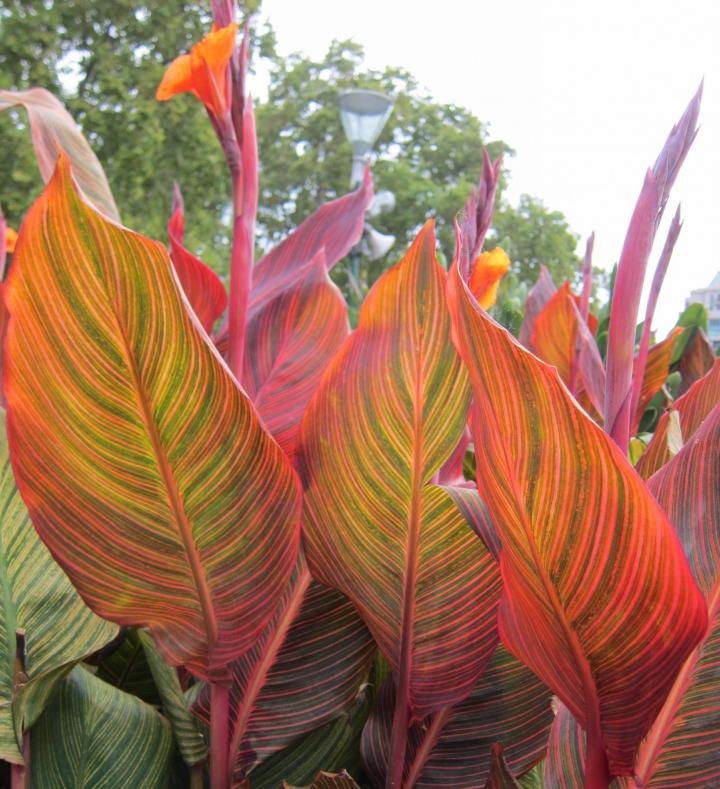
- ’Pretoria’, aka Bengal Tiger: 4 to 6 feet tall; variegated yellow-and-green-striped foliage with orange flowers
- ‘Futurity Red’: 2 to 4 feet tall, on average; burgundy foliage with crimson flowers; self-cleaning (drops spent flowers)
- ‘Toucan Yellow’: 2 1/2 to 4 feet tall; deep green foliage with golden-yellow flowers
- For a tall canna, the Canna Tropicanna® is a popular choice. Growing 4 to 6 feet tall, ‘Tropicanna’ boasts tangerine, iris-like blooms and exotic bronze foliage. Plant in the back of your garden bed or large containers for a dramatic statement on your porch or patio.
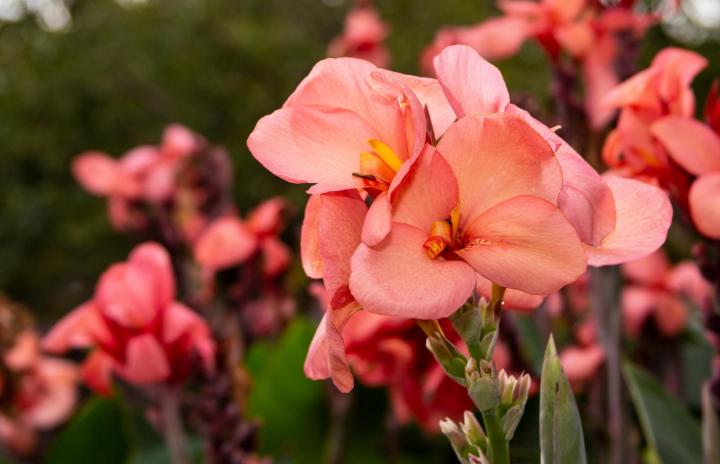
- A medium-size gem is ‘Los Angeles’, which has large, deep pink florets and opens out so that you can see the face. Growing 4 to 5 feet tall, this canna blooms from June to August.
As well as medium- to tall-size cannas, you can find smaller “dwarf” sizes and dramatic “giant” sizes!
- Dwarf cannas stand 2 to 4 feet tall and are easy to fit into our downsized modern gardens. ‘Picasso’ is a real attention-getter with bright yellow flowers and deep red leopard-like spots; it blooms from July to frost. ‘Wyoming’ has dark burgundy stems and lush orange flowers that bring life to a quiet bed from mid-summer until frost.
- Interested in a giant canna? One of the most popular is ‘Musifolia’, which grows up to 8 feet! With 3-foot-long red-vein leaves and red blooms, it makes a statement.

More Like This


Hi, Karen. Cannas are susceptible to canna leaf rollers, Japanese beetles, root-knot nematodes, slugs, snails, and spider mites, just to name a few. Since you are not sure exactly what is eating your plants leaves, try treating with neem oil. It can control many pesky pests.
Hi, Olinda. Canna tubers can be eaten raw or cooked.
Hi Shirley,
Canna lilies are tall plants with extensive root systems so they need large, sturdy containers—at least 18 inches in diameter per rhizome—to thrive. It is likely that your medium pot will not be sufficient enough for your plant to reach its full potential, so it would be best to upgrade to a larger container that can both support root system growth and reduce the chance that it will become top heavy and tip over as it matures.
Given that your plant is in the midst of its growing season, you will want to wait until it finishes blooming for the season and its foliage begins to die back before transplanting to a new container. When you do transplant, you will want to use fresh potting mix and follow the planting tips outlined above.
Hope this helps!
Hi Nan,
You should leave you canna plants in the container during the winter months. Depending on how low temperatures are expected to get, you can leave them outside or bring them indoors and place in a cool, dry location.
In the spring, you can then remove the rhizomes and plant them directly into the ground. Depending on the size of your rhizomes, you can also divide at this time. Just make sure each divided piece has at least one eye. If you chose not to divide, remember that cannas should be divided every 3 to 4 years.
When planting in the ground, give your cannas room to grow as the rhizomes will spread.
- « Previous
- 1
- 2
- …
- 10
- Next »

Comments