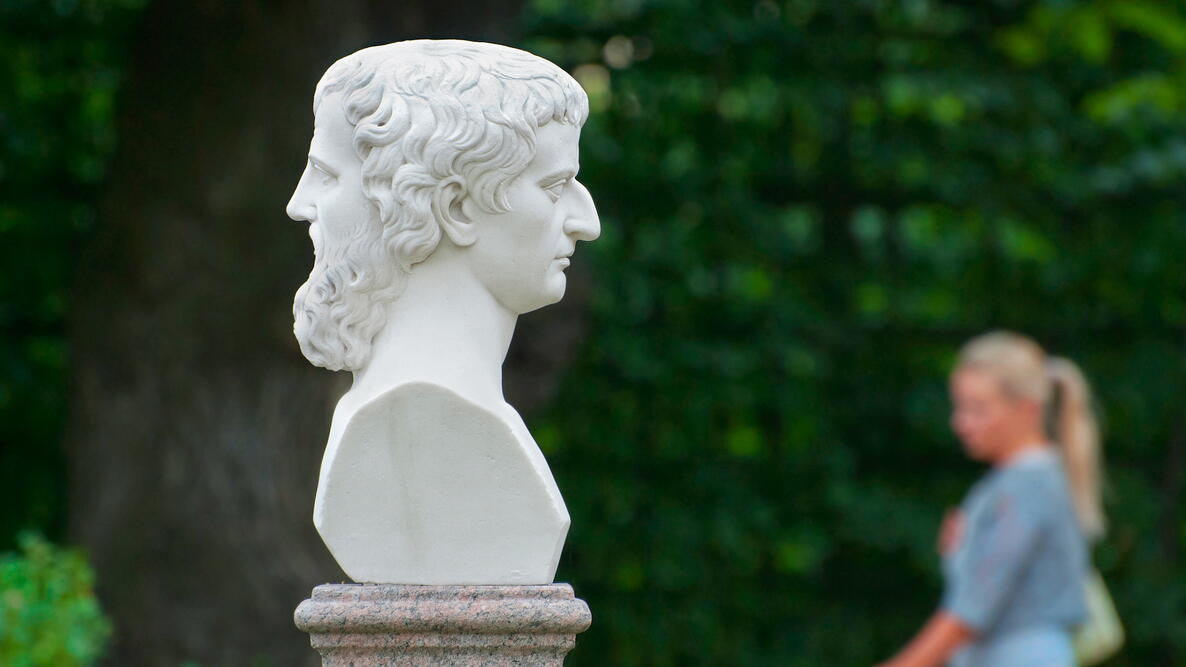
Caption
Janus with two faces.

New Year’s resolutions actually go back to ancient times! Let’s explore what’s behind this tradition and more practical ways towards self-improvement. Plus, we also compare the top 10 resolutions from the 1940s to those of today!
Short History of New Year’s Resolutions
From the Babylonians who resolved to return borrowed farm equipment to medieval knights who would renew their vow to chivalry, New Year’s resolutions are nothing new.
In 2000 B.C., the Babylonians celebrated the New Year during a 12-day festival called Akitu (starting with the vernal equinox). This started the farming season to plant crops, crown their king, and make promises to pay their debts. One common resolution was the return of borrowed farm equipment (which makes sense for an agriculturally based society).
The Babylonian New Year was adopted by the ancient Romans, as was the tradition of resolutions. The timing, however, eventually shifted with the Julian calendar in 46 B.C., which declared January 1 as the start of the new year.
January was named for the two-faced Roman god, Janus, who looks forward to new beginnings as well as backward for reflection and resolution. The Romans would offer sacrifices to Janus and make promises of good behavior for the year ahead.
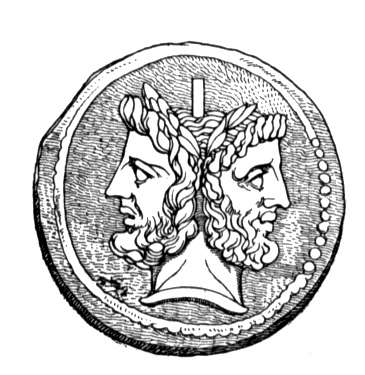
Janus was also the guardian of gates and doors. He presided over the temple of peace, where the doors were opened only during wartime. It was a place of safety where new beginnings and new resolutions could be forged.
If you think about the land and the seasons, the timing of early January makes sense for most of Europe and for North America, too. The active harvest season has passed. The holiday frenzy is ending.
As our founder, Robert B. Thomas, said, this is a time “of leisure to farmers … to settle accounts with your neighbors … now having been industrious in the summer, you will have the felicity of retiring from the turbulence of the storm to the bosom of your family.”
New Year’s resolutions were also made in the Middle Ages. Medieval knights would renew their vow to chivalry by placing their hands on a peacock. The annual “Peacock Vow” would take place at the end of the year as a resolution to maintain their knightly values.
By the 17th century, New Year’s resolutions were so common that folks found humor in the idea of making and breaking their pledges. A Boston newspaper from 1813 featured the first recorded use of the phrase “New Year resolution.” The article states:
“And yet, I believe there are multitudes of people, accustomed to receive injunctions of new year resolutions, who will sin all the month of December, with a serious determination of beginning the new year with new resolutions and new behavior, and with the full belief that they shall thus expiate and wipe away all their former faults.”
How Resolutions Have Changed
In the United States, New Year’s resolutions are still a tradition, but the types of resolutions have changed.
As a legacy of our Protestant history, resolutions in the early 1900s were more religious or spiritual, reflecting a desire to develop stronger moral character, a stronger work ethic, and more restraint in the face of earthly pleasures.
Over the years, however, resolutions seem to have migrated from denying physical indulgences to general self-improvement, like losing weight. Medical sociologist Natalie Boero of San Jose State University suggests that today’s resolutions are also a reflection of status, financial wealth, responsibility, and self-discipline—which isn’t that different from how the New Year’s resolution tradition began.
See the difference:
Resolutions From 1947 - Gallup Poll
1. Improve my disposition, be more understanding, and control my temper
2. Improve my character, live a better life
3. Stop smoking, smoke less
4. Save more money
5. Stop drinking, drink less
6. Be more religious, go to church more often
7. Be more efficient and do a better job
8. Take better care of my health
9. Take a greater part in home life
10. Lose (or gain) weight
Today’s Resolutions
1. Lose weight
2. Get organized
3. Spend less, save more
4. Enjoy life to the fullest
5. Stay fit and healthy
6. Learn something exciting
7. Quit smoking
8. Help others fulfill their dreams
9. Fall in love
10. Spend more time with family
10 Tips for Making Resolutions
A “resolution” is often worded as NOT doing something. But that’s not a great way to make small improvements in your life. Here are some tips.
Frame Your Resolution Positively
1. Avoid wording your resolution negatively, such as “quitting” or “stopping” a behavior. For example, say, “I want my nails to grow” instead of “I want to stop biting my nails.” Take a photo of your nails every day and log your progress.
2. Set aside time on your calendar to pause and reflect. Love coffee? Sit down during coffee mornings with a journal or notebook and write out your status. If it helps, piggyback this task on another one you already do. For example, if you check your calendar and day’s events at a certain time, this is a good time to check your progress against your goal.
3. Keep it simple. Settle on one or two goals. Not a big list. For example, our founder, Robert B. Thomas, resolved to “begin the New Year’s square with every man.” This meant that he settled his debts.
4. Pick a goal you think will make you feel better. Not just something that you think you should do or what society is telling you to change. For example, if you do wish to lose weight for health, how about saying, “I want to eat more interesting salads” for lunch and then go find all the yummy toppings you can find—artichoke hearts, avocados, tomatoes, pickles, capers, olives, and protein.
5. Define a goal that is specific and measurable. Saying, “I want to be more helpful to others,” is vague. But saying, “I am going to help the needy by signing up for the church’s food pantry each month” is specific. Keep track of your progress in a notebook or journal.
6. When you think about what you wish to achieve, consider what obstacles could get in your way and see how to remove those barriers. If your goal is to take your pills or vitamins each day and you are forgetful, get a 7-day pill box. When you refill once a week on Saturday night, check to see whether you need to renew your prescriptions.
7. Define a goal that is time-bound and realistic. Plan for a month at a time, not a lifetime. For example, resolving to retire in 5 years may not be realistic, but creating a monthly budget and setting aside all your surplus towards retirement may be an achievable goal. Each month, track your spending and then see where you’re overspending without realizing it.
8. Create an incentive. For example, if you want to stop using your phone at dinner, put it in a basket nearby. If you take it out of the basket, you must give a family member at the table a dollar.
9. Change up your routine. For example, if you aren’t brushing your teeth long enough, perhaps come up with another task to do while you brush your teeth—such as wiping down the bathroom mirror! Perhaps you need a tool to help reach your goals! For example: “I resolve to be on time to meetings this week.” To achieve your goal, set an alarm with a 5-minute reminder before any meetings.
10. If you slip up, don’t worry about it. But if you slip again, reconsider your plan. Are you too ambitious? If you plan to walk 5 days a week, scale it back to 3 days and plan which days you’ll walk to get into a schedule. How about walking before you eat lunch so that you can enjoy it after your walk?
There’s also the idea of “self-trickery.” Maybe that’s a better fit for you than making hard-and-fast resolutions.
Whether we resolve to return borrowed farm equipment (as the Babylonians did) or drop a few pounds, we’re tapping into an ancient and powerful longing for a fresh start by setting resolutions.
Another Approach
More people succeed at New Year’s resolutions than you might think. A Marist poll of 1,074 adults found that 68% of them who’d made a resolution had kept it.
But if you’re still not sold on the tradition of resolutions, try a different approach. Take a piece of paper and list a few regrets about the past year. Then toss that scrap of paper into the fire! Janus, the two-faced symbol of the new year, would approve.

More Like This







Here are a few 19th-century sources that refer to some Roman traditions regarding Janus.
On page 733 of Curiosities of Popular Customs and of Rites, Ceremonies, Observances, and Miscellaneous Antiquities by William S. Walsh (published in 1898 by J. B. Lippincott Company), Walsh states: “Among the Romans, after the reformation of the calendar, the first day of January, as well as the entire month, was dedicated to the eponymic god Janus. . . . Throughout January the Romans offered sacrifices to Janus upon twelve altars, and on the first day of that month they were careful so to regulate their conduct that their every word and act should be a happy augury for all the ensuing days of the year.”
On page 66 of The Churchman, a Magazine in Defence of the Church and Constitution, Volume IV, from January to June, 1841, published in London by William Edward Painter, it says: “The first of January was kept as a high festival by the heathens, who offered sacrifices on that day to Janus. In such veneration was it held by the Roman people in particular, that, although their festivities were marked by excesses of every description, not only were the most deadly animosities suspended, but enemies, however inveterate, mutually refrained on this day from even passing a reflection on the character or conduct of each other. It was also the chosen period at which every work of art, of science, or of labour, was commenced.”
As to the temple of Janus and the tradition of the doors, here is some further information:
On page 435 of Bibliotheca Classica: Or, A Classical Dictionary by John and Thomas Dymock, published in London in 1833 by Longman, Rees, Orme, Brown, Green, & Longman, it says: "Numa Pompilius built a temple to him at the foot of Argiletum, which was to be open in time of war, and shut in time of peace. The latter only took place three times during the period of seven hundred years after its erection, the first under Numa, the second at the end of the first Punic war, and the third after the battle of Actium. . . . Macrobius gives [Janus] different names: Janus Geminus, Janus Quirinus, Janus Patulcius, and Janus Clausius, the last two from the doors of his temple being open in war, and shut in peace. . . ."
There are also ancient Roman coins showing Roman emperor Nero on one side. The other side depicts the Temple of Janus with its doors closed, surrounded by the words: PACE P R TERRA MARIQ PARTA IANVM CLVSIT S C. As we understand it, this means roughly "The peace of the Roman People having been established on land and sea, he closed the doors of Janus."
Hope this helps!

Thanks for sharing. That is such a good idea. Telling your story with a positive vs sad perspective seems a wise way to create new patterns of thought for the future. Our chosen attitude creates more of the same. All the best to you in the new year!
- « Previous
- 1
- 2
- …
- 10
- Next »

Comments