


Malapropisms Explained: Hilarious Word Mix-Ups and Famous Examples

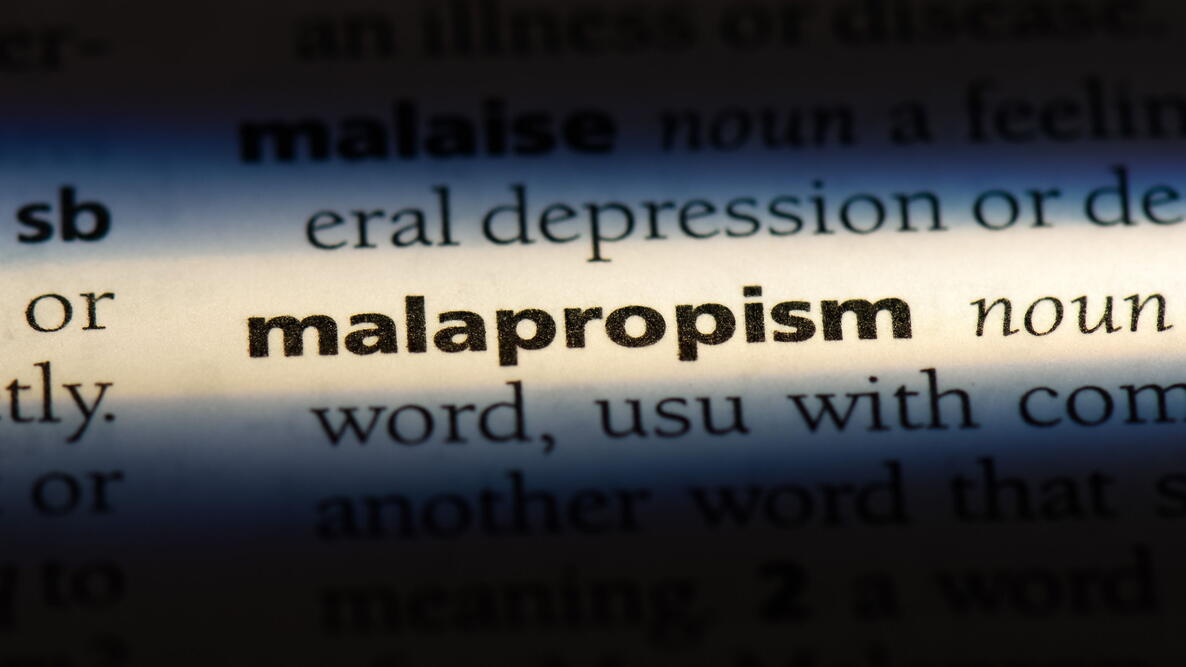
Malapropism in the dictionary
Subhead

What Is a Malapropism? Funny Word Mistakes That Make Us Laugh

Written By: Judson D. Hale Sr. Editor Emeritus

Here at the Almanac, we have fun collecting malapropisms, the incorrect use of a word instead of another word that sounds similar; these word mangles and slipups can be quite humorous! 

Malapropisms are accidental word substitutions that sound similar to the intended word but produce humorous or nonsensical results. They’ve appeared in everyday speech, classic literature, and even political speeches for centuries.

What is a Malapropism?

We all make mistakes when we speak or write English. It’s not an easy language. But when people accidentally misuse words in a way that ends up being comical we call the result a malapropism.

For example:

“I’m fading into Bolivian.” [oblivion] 
–Boxer, Mike Tyson

The word “malapropism” comes from the French mal a propos, meaning “not appropriate.”  (Note that that root word mal means “ill” or “bad.”)

Funny Everyday Malapropisms

Here are some more examples of malapropisms that illustrate the meaning:

  • Yep, a colleague of ours once noted that she preferred “decapitated coffee.”
  • Another friend claimed her boyfriend “took her for granite.”
  • Hospital “sightings” have included “old timer’s disease,” “prostrate cancer,” “chickenpops,” “smiling mighty Jesus” (for spinal meningitis), and “65 roses” (for cystic fibrosis).
  • A longtime Navy man was once reported to have died from “sea roaches of the liver.”
  • One woman told us that she was going through “mental pause,” before adding that her husband had quit smoking, “cold duck.” (Did she mean that he had quit drinking Cold Duck?)
  • Another was said to have told a counselor that she couldn’t have a sexually transmitted disease because, despite a recent “falling down,” both she and her husband were unfailingly “monotonous.”
  • And then there was the gastrointestinal patient who apparently got confused on the word “spectrum” and said of a beautiful sunset, “It had all the colors of the rectum.”.”

Who Was Mrs. Malaprop?

William Shakespeare often used malapropisms for humor in his comedies (example, the character of Dogberry in his 1598 play, Much Ado About Nothing).

Then, in 1775, an Irish playright introduced a character named Mrs. Malaprop into his play The Rivals. It was a comedy of manners and the character Mrs. Malaprop would mangle words. Here are a few of Mrs. Malaprop’s lines from the play:

  • Illiterate him, I say, quite from your memory.  [obliterate]
  • “She’s as headstrong as an allegory on the banks of Nile” [alligator]
  • “If I reprehend anything in this world it is the use of my oracular tongue, and a nice derangement of epitaphs!” [comprehend, vernacular, arrangement, epithets]

Classic Malapropisms You’ve Probably Heard

Here are some more malapropisms (all real, not fictional!). Can you identify the misused word? 

  • If you wish to submit a recipe for publication in the cookbook, please include a short antidote concerning it.
  • In Venice, the people travel around the canals in gorgonzolas.
  • The mountain is named for the Reverend Starr King, who was an invertebrate climber.
  • I took up aerobics to help maintain my well-propositioned figure.
  • The only sure-fire way to avoid teenage pregnancy is through obstinance.
  • Senators are chosen as committee chairmen on the basis of senility.
  • The fun and excitement of childhood are nothing compared to the fun and excitement of adultery.
  • The marriage was consummated on the altar.
  • Too many Americans lead a sedimentary life.
  • He died interstate.
  • The food in our cafeteria is so bad it’s not fit for human constipation.
  • Who do you think you are, some kind of hexagon of virtue?
  • We have to deal seriously with this offense as a detergent to others.
  • Medieval cathedrals were supported by flying buttocks.

Political Malapropisms That Made Headlines

Of course, the funniest malapropisms are often the ones made by those in the public spotlight, especially politicians. Here is a sample of some real doozies:

  • “This is unparalyzed in the state’s history.” [unparalleled] –Gib Lewis, Texas Speaker of the House
  • “Republicans understand the importance of bondage between a mother and child.” [bond] –Dan Quayle, Vice President
  • “I am surprised, frankly, at the amount of distrust that exists in this town. And I’m sorry it’s the case, and I’ll work hard to try to elevate it.” [alleviate] –President George W. Bush
  • “States are lavatories of innovation” [laboratories] –Texas Governor, Rick Perry
  • “He was a man of great statue” [stature] –Thomas Menino, Mayor of Boston
  • “The police are not here to create disorder, they’re here to preserve disorder.”  [order] –Richard Daley, Mayor of Chicago

Frequently Asked Questions

What is a malapropism?

A malapropism is the incorrect use of a word that sounds similar to the intended word, often creating a humorous effect.

Why are malapropisms funny?

They replace a correct word with an unexpected one, often producing absurd or embarrassing meanings.

Are malapropisms intentional?

Usually not. Most occur accidentally, though writers often use them deliberately for comic effect.

Did any of the above malapropisms make you laugh or smile? They are indeed real; we’re not making them up. So don’t you cast asparagus at us!

Heard a malapropism in the wild? Share it below—we’re always adding to our collection!

About The Author
Judson D. Hale Sr.

Judson D. Hale Sr.

Editor Emeritus

Jud Hale is the Editor Emeritus of The Old Farmer’s Almanac; Jud was the 12th editor of The Old Farmer’s Almanac (since 1792!) and joined the parent company Yankee Publishing in 1958 as an Assistant E...