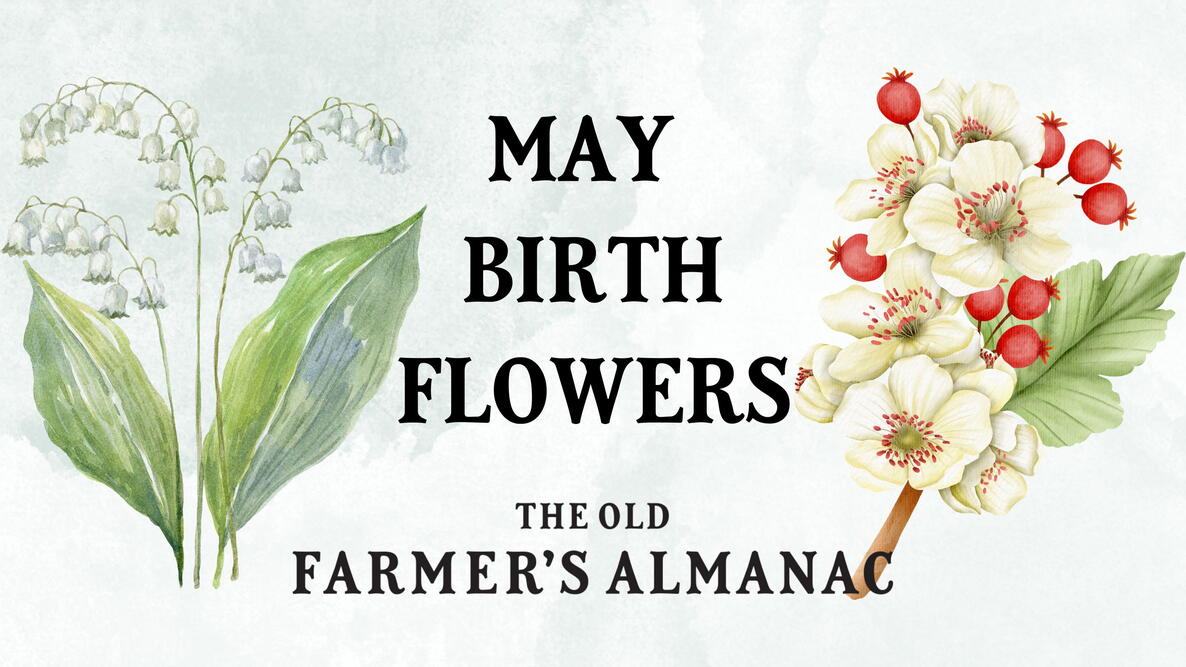

The May birth flowers—lily of the valley and hawthorn—are rich in history, symbolism, and seasonal beauty. From the delicate, sweet-scented bells of lily of the valley to the vibrant clusters of hawthorn blossoms, these flowers represent purity, hope, and renewal. Learn their meanings, origins, and how to grow them in your garden.
What Are the May Birth Flowers?
Lily of the valley, with its dainty, small, bell-shaped white flowers, is a perennial ground cover that spreads aggressively, given the right conditions. These flowers represent sweetness and purity.
Hawthorn is a flowering shrub in the rose family with flowers that bloom in May in small white, red, or pink clusters. Small berries, called haws, sprout after the flowers. The hawthorn is a longstanding symbol of hope.
Lily of the Valley
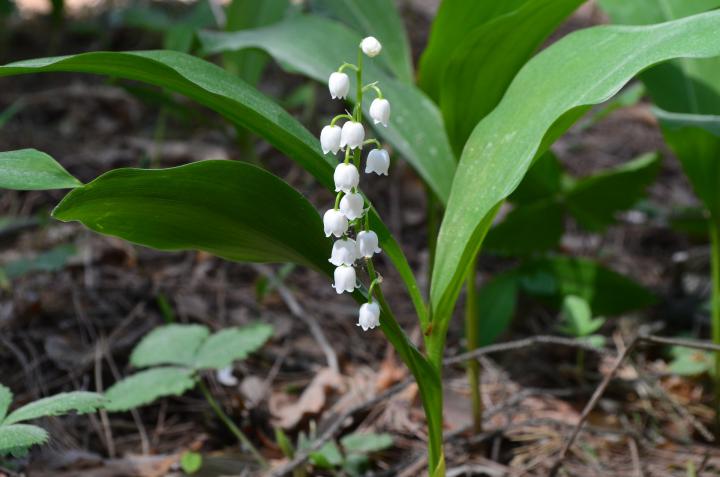
Also known as Our Lady’s Tears, May lily, and May bells, lily of the valley (Convallaria majalis) is not actually a lily but rather a member of the asparagus family, Asparagaceae. Native to Eurasia, it has become naturalized in North America, having been planted in home gardens for its simple foliage and lovely flowers.
It produces pendulous, bell-shaped white flowers with a strong, sweet smell. It can also produce pink or purple blossoms.
Learn how to grow lily of the valley flowers in our growing guide.
Lily of the Valley: Meanings and Symbolism
- In ancient astrology, lily of the valley was said to be protected by the son of the goddess Maia. In Greek mythology, that son was Hermes; for the Romans, it was Mercury.
- According to legend, lily of the valley fell in love with the song of the nightingale and only bloomed when the bird returned to the woods in May.
- It is also believed that Apollo created the ground cover flower for nymphs to walk on.
- This flower has been associated with motherhood, sweetness, purity, and humility. It signifies a return to happiness, likely due to its time of bloom and the anticipation of summer.
- In Christian lore, lily of the valley came to be from Eve’s tears after she was expelled from the Garden of Eden. It has also been said that lily of the valley sprouted from the tears of Mary at the site of Christ’s crucifixion.
Lily of the Valley in History
- In the 1500s, King Charles IX was gifted a lily of the valley for good luck on May Day, and each year following, he continued the tradition of gifting the flowers for luck.
- In France, the tradition of gifting lily of the valley continues as a symbol of good luck.
- In Serbia, lily of the valley is picked on St. George’s feast day, and people decorate their homes with the flowers to bring about good luck and prosperity.
- The flower is mentioned numerous times in the Bible and has also been associated with Christ’s second coming.
- Thomas Jefferson recorded the flower in a list of hardy perennials that grew at his Monticello home.
- Due to its sweet fragrance, lily of the valley is a popular choice for wedding bouquets. In Holland, newlyweds have been known to plant lily of the valley in their garden to bring about luck in their marriage. The flowers were also part of the bridal bouquets of Princess Diana and Kate Middleton.
- In Helston, England, the lily of the valley is worn during the Furry Dance, a centuries-old celebration observed on May 8 each year.
- Lily of the valley is the national flower of Finland.
Hawthorn
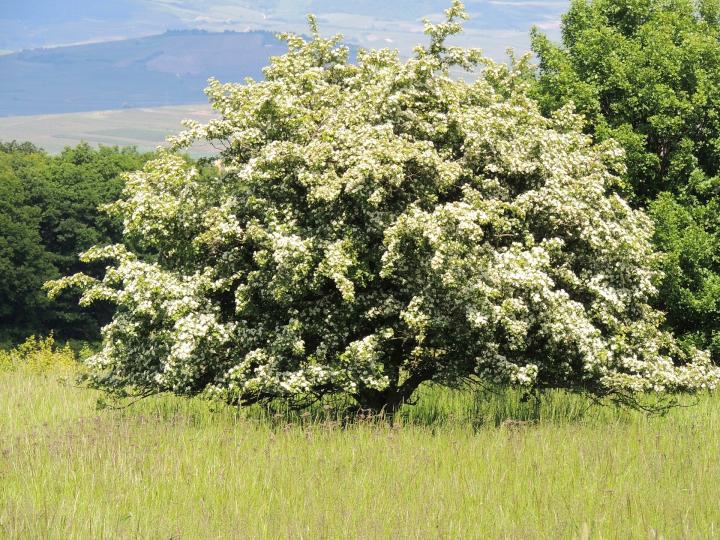
Hawthorn belongs to the genus Crataegus and is a member of the Rosaceae (rose) family, which also includes many food crops such as apples, cherries, and pears. Its genus name is derived from the Greek words kratos, meaning strength, because of the great strength of the wood, and akis, meaning sharp, referencing the thorns of most species. Hawthorn can be traced back to the Old English word hagathorn, with haga meaning hedge.
Hawthorn are found in Europe and Asia, as well as North America. There are hundreds of species of hawthorn, which are small, dense trees or shrubs that can grow up to 30 feet tall.
Hawthorn: Meanings and Symbolism
- Hawthorn have long been a symbol of hope. Other associations include its ability to mark the entrance to other worlds, with a strong connection to fairies.
- Ancient Greeks were said to use its branches during wedding processions, while in Celtic lore, hawthorn was thought to heal a broken heart.
- According to Serbian lore, it was once believed that stakes made from hawthorn could slay vampires.
- Hawthorn are associated with the pagan symbol of fertility.
- It was once thought that bringing a hawthorn blossom inside would be followed by illness and death. During medieval times, the smell of hawthorn blossom was associated with the Great Plague.
- Many have believed that a hawthorn’s bloom marked the point of change from spring to summer.
Hawthorn in History
- The hawthorn’s link to May Day is undeniable. For this reason, it has been customary to decorate the celebration with flowering hawthorn branches, most notably in the form of May Day garlands.
- In 1923, the white hawthorn blossom was recognized as the state flower of Missouri.
- Hawthorn has been used for medicinal purposes for years, including to treat heart and blood diseases, as well as chest pains, blood pressure issues, and high cholesterol. The majority of its medicinal value is found in its fruit pigments.
- Hawthorn leaves and fruit are edible. When picked young, the leaves can be used in salads. The fruit can be eaten on its own or used to make jelly and wine.
- The shrike—a type of bird—will impale its (already dead) prey onto a hawthorn’s thorn, allowing the bird to eat more comfortably.
Frequently Asked Questions
What are the birth flowers for May?
The May birth flowers are lily of the valley and hawthorn, symbolizing purity, sweetness, and hope.
What does lily of the valley symbolize?
Lily of the valley represents purity, humility, motherhood, and a return to happiness.
What does hawthorn symbolize?
Hawthorn symbolizes hope, love, and protection; it is often associated with spring and renewal.
Are hawthorn berries edible?
Yes, hawthorn berries can be eaten fresh or used in jellies and wines.
Learn More
- See more Birth Month Flowers.
- See May’s Birthstone: The Emerald!
- See everything you need to know about The Month of May
- Check out our Birthdays Page to find fun birthday facts, history, folklore, and more!

More Like This

Hi, Lynn. The answer is yes, they are poisonous. While many plants and flowers are edible, this one should never be consumed.
- « Previous
- 1
- 2
- …
- 10
- Next »

Comments