How to Prevent Mice
Mouse traps are not only inhumane but also don’t keep mice out of your house. It’s more important to prevent mice with exclusion methods that deter mice from entering your home in the first place. Here’s what to do first.
1. Do a Pest Inspection
Do your own interior and exterior pest inspection to find exactly where they’re getting in. Remember, you’re looking for any gaps the size of a dime or larger. Get a flashlight. Walk around your foundation; look under the foundation to see if the mice can get into your crawlspace. Walk around the roofline (get a ladder if needed). Check the dryer vent.
Pest experts say that mice also do a “walk-around” and are often drawn to gaps where they can smell nice warm air flowing out of your house. Look at all vents and screens. Look for any signs of chewing at the bottom of garage doors. (And keep those garage doors shut!)
Then, pack all those small gaps with steel wool. Do NOT use spray foam, which rodents chew through. Larger gaps might need to be closed with 1/4-inch mesh.
2. Remove Easy Food and Water Sources
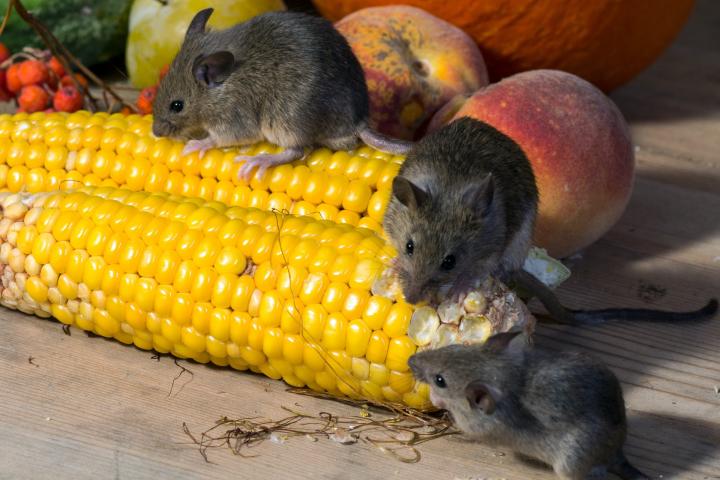
Also, look for any food and water that mice could access. Open garbage bins? Spilled birdseed? Leaky hoses? Water bowls? Store all your grains, pet food, garbage, and bird food in metal containers or heavy plastic boxes. Also, don’t leave pet food dishes full of kibble at night or you’re inviting any mouse in the house to dinner.
3. Remove Easy Hiding Places
As you do your walk around, look for easy hiding places such as firewood stacks, thick leaves or ground cover along the foundation, any clutter, or anything leaning against your house. You’ll need to do a big outdoor cleanup project and clear everything around your foundation by at least 1 foot.
4. Remove Nesting Material
Don’t leave old rugs, blankets, clothes, or any soft, fluffy nesting material around your attic, basement, or garage. Store everything in containers made of metal or heavy plastic. Avoid cardboard and paper boxes, which mice like to chew.
In the garden, avoid using straw as mulch or any fluffy mulch that provides nesting places. Do not mulch heavily nor put mulch near the base of trees.
Getting Rid of Mice
We’re not big fane of poison or traps. First, we’d prefer not to kill animals. But also it doesn’t really work long-term, as more mice will just move in. The first step is to seal up those entry points and make sure you remove all the food, water, and nesting materials. Then, you will need to control the population already in your home:
- If you must, use a humane mouse trap or snap trap baited with peanut butter near mouse paths.
- Consider getting a cat! Some cats enjoy hunting more than others, but all can help to take care of mice in your home to various degrees. If you do get a feline helper, do not put out mouse poison, which can be harmful if your cat catches a mouse that has eaten it.
Natural Ways to Deter Mice
To discourage mice from entering your home and garden, here are some natural solutions:
- Try a mouse repellent containing ammonium; see your local garden center. For some reason, ammonia smells like predator urine. You can even make your own ammonia traps by putting small caps filled with the liquid near mouse entry points.
- Mice do not like any mint or pepper smells. Try sprinkling cayenne pepper near mouse-prone areas (or create a sachet). Soak cotton balls in peppermint oil.
- Mice are also repelled by camphor, lavender, and wormwood. You can find dried lavender in health food stores and some garden centers.
- Sometimes just the scent of cats will be enough to deter mice from returning to an area. One reader says that sprinkling kitty litter around entrances to the house works well; after all, it smells like cat urine!
- Try using dryer sheets to keep mice out of linen closets or stored clothes.
- If you must, use a humane mouse trap or snap trap baited with peanut butter near mouse paths.
- Sonic mouse deterrents (which make beeping noises) may also be effective.
- In the garden, try cultivating some plants that are believed to repel mice, including mint, lavender, pennyroyal, garlic, and onion.
- To protect bulbs, cage them or surround the bulb with crushed gravel in the planting hole.
- Wrap tree trunks with tree wrap or hardware cloth at their base. Be sure to remove come spring to avoid harming the tree!
See more about common garden pests like rabbits and moles.



Comments