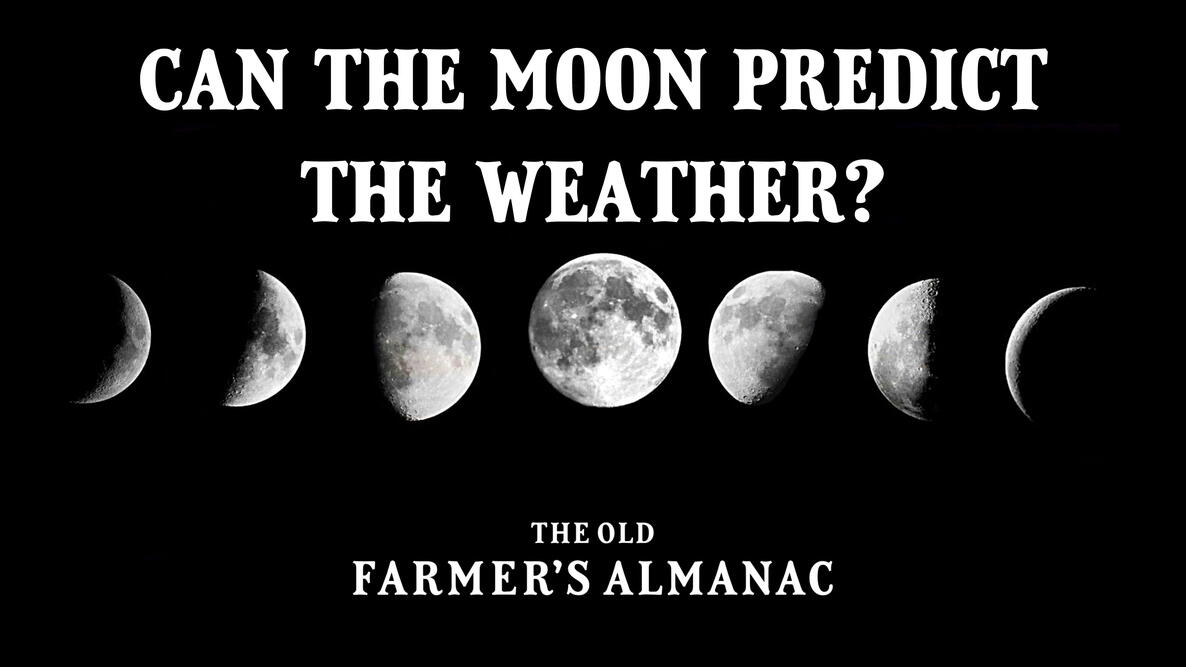
Before weather apps and satellite maps, people watched the sky—and the Moon was one of their most trusted guides. Its steady rhythm offered a sense of order in an unpredictable world, and over time, patterns seemed to emerge between lunar phases and changing weather.
This Weather by the Moon calendar, first printed in The Old Farmer’s Almanac in 1834, reflects those long-standing observations. While it isn’t a modern forecast, the chart provides a fascinating snapshot of how earlier generations believed storms, frosts, and fair weather followed the Moon’s lead—and why this bit of lunar lore still sparks curiosity today.
Weather By The Moon Calendar
See the Weather by the Moon calendar below showing what sort of weather will probably follow the Moon’s entrance into any of its quarters.
The calendar below is derived from “A Table Foretelling the Weather Through All the Lunations of Each Year, or Forever,” which first appeared in The Old Farmer’s Almanac in 1834.
It is the result of many years of actual observation and shows what sort of weather will probably follow the Moon’s entrance into any of its quarters. For example, the day that the Moon enters its first quarter may be stormy.
Note: This table is shared for its historical interest. It was created by Dr. Herschell for the Boston Courier, so it may have regional bias. In addition, it was created 175 years ago. It is not meant to be compared with our annual long-range weather forecasts for The Old Farmer’s Almanac; we rely far more on our projections of solar activity.
All the same, it raises the question: Does the Moon affect the weather? Is this folklore? Or, is there a relationship between weather and the Moon and Moon phases?
To read this chart, you’ll need to reference the year’s Moon phases. See our customized Moon Phase Calendar.
Weather by the MoonTime of Change | Summer | Winter |
|---|
| Midnight to 2 a.m. | Fair | Hard frost, unless wind is south or west |
| 2 a.m. to 4 a.m | Cold, with frequent showers | Snow and stormy |
| 4 a.m. to 6 a.m | Rain | Rain |
| 6 a.m. to 8 a.m. | Wind and rain | Stormy |
| 8 a.m. to 10 a.m | Changeable | Cold rain if wind is west; snow, if east |
| 10 a.m. to noon | Frequent showers | Cold with high winds |
| Noon to 2 p.m. | Very rainy | Snow or rain |
| 2 p.m. to 4 p.m | Changeable | Fair and Mild |
| 4 p.m. to 6 p.m. | Fair | Fair |
| 6 p.m. to 10 p.m. | Fair if wind is northwest; rain if wind is south or southwest | Fair and frosty if wind is north or northeast; rain or snow if wind is south or southwest |
| 10 p.m. to midnight | Fair | Fair and frosty |
Click to expand chart (PDF).
Frequently Asked Questions
Does the Moon really affect the weather?
The Moon does influence Earth—most notably through ocean tides—but its effect on daily weather is limited. While lunar gravity can subtly impact atmospheric tides, modern science does not support the Moon as a reliable weather predictor.
What is the Weather by the Moon chart?
The Weather by the Moon chart is a historical table published in The Old Farmer’s Almanac in 1834. It links the time of day when the Moon enters a phase (New, First Quarter, Full, or Last Quarter) with expected weather conditions.
Is Weather by the Moon scientifically accurate?
No. The chart is based on observation and tradition rather than modern meteorology. It is shared today for historical and cultural interest, not as a forecast tool.
Why did people once rely on the Moon to predict the weather?
Before modern instruments, the Moon was one of the most reliable natural timekeepers. Farmers noticed repeating patterns between lunar cycles and seasonal conditions, leading to weather lore passed down through generations.
Does The Old Farmer’s Almanac still use the Moon to forecast weather?
While the Almanac honors traditional practices like Gardening by the Moon, its long-range weather forecasts today rely on solar science, climatology, and modern data analysis, not lunar folklore alone.
Can I use Weather by the Moon to plan gardening or travel?
You can enjoy it as a historical reference, but for practical planning, it’s best to rely on modern forecasts and localized weather data.
Have you ever noticed weather changes lining up with the Moon’s phases? Share your experience—folklore often begins with observation!




Comments