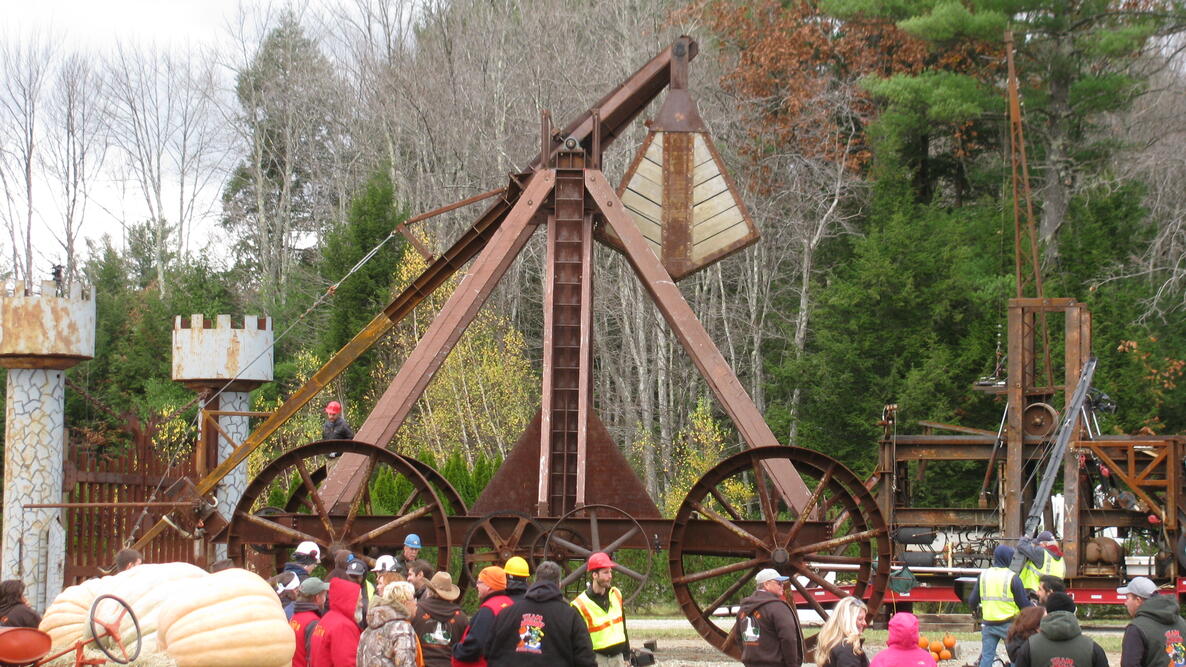

This autumn, I drove past an unusual sight in rural New Hampshire: a giant contraption towering above crowds of cheering people. Suddenly, I saw the machine’s “arm” swing forward to hurl something through the air—why, was that a flying pumpkin?
Indeed, I had discovered pumpkin chunkin’—an unusual competition that involves catapulting pumpkins over great distances, in this case, over 2,000 feet!
Part Americana, part medieval device, this unusual activity uses a 60-foot steel throwing machine called a trebuchet, a type of catapult.
What are Trebuchets?
Catapults and trebuchets were first used in the first century B.C. as arrow-shooting machines and later used in medieval times to lay siege to castles. The word catapult comes from the Greek kata, meaning downward, and pultos, meaning shield. The literal translation is “shield piercer.”
As I joined the crowd, the speaker informed us that trebuchets use a weighted beam that swings a sling carrying large, round rocks—in this case, the projectile is a pumpkin or another safe object. A trebuchet uses gravity as its source of energy. The big box thing is cranked up by hand. When the weight drops, it whips around the throwing arm holding the pumpkin.
The common catapult is a bit different in that it simply launches a projectile from a winched-down bucket at the end of a giant arm.
What is Pumpkin Chunkin’?
The folks working the trebuchets were definitely guys into building machines. I met farmers, construction workers, and backyard engineers. A few guys were definitely into medieval armaments, too.
I also came across groups of students with small trebuchets. They clearly loved to build and explore the physics of how to throw an object the furthest. It’s really an exciting project for any student.
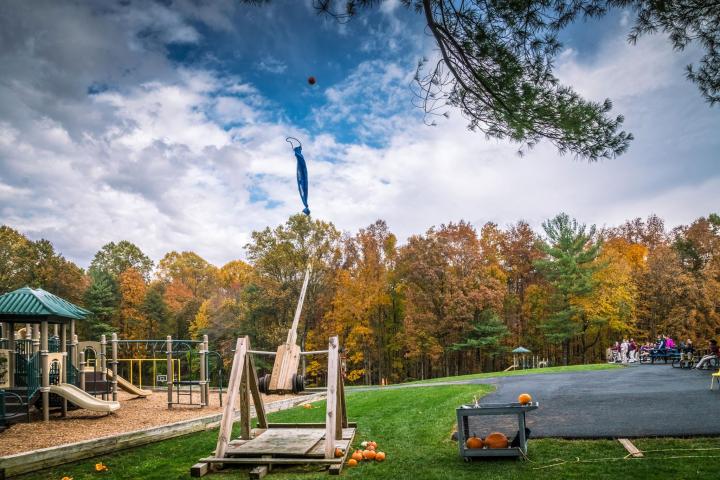
Mechanics aside, this was a very strange life for our orange squash friends!
A pumpkin was loaded into a basket, a countdown started, and then the pumpkin flew high, traveling hundreds of yards across a barren field until it smashed near a stone “castle” built on the hilltop.
Everyone cheered if the trebuchet worked and sighed a compassionate “ahhh” if it failed. A couple of people felt bad for the squashes, even though most were overgrown and inedible.
I guess some pumpkins are made into pumpkin pies to be gobbled up. Some are carved into jack-o’-lanterns to smile on Halloween.
And some get to be high-flying pies in the sky before crashing back to Earth from whence they came.
Frequently Asked Questions
How far can a trebuchet throw a pumpkin?
Large trebuchets can hurl pumpkins over 2,000 feet! Smaller versions built by students or hobbyists may throw pumpkins anywhere from 50 to several hundred feet.
What’s the difference between a trebuchet and a catapult?
A trebuchet uses a counterweight and gravity to swing an arm and sling the projectile, while a catapult uses tension (like a winched arm or twisted rope) to launch an object.
Where did pumpkin chunkin’ start?
Pumpkin chunkin’ competitions began in the late 1980s in Delaware and have since spread across the U.S. as a quirky fall festival tradition.
Can you build a mini trebuchet at home?
Yes! Many schools and hobbyists build small-scale trebuchets for fun and as a hands-on physics project. Always use safe, inedible pumpkins or similar objects when testing.
Why use pumpkins?
Pumpkins are plentiful in the fall, easy to grow, and heavy enough to make for exciting long-distance launches—plus, it’s a fun seasonal tradition!
Would you try building a mini-trebuchet at home? Share your pumpkin chunkin’ stories below!

More Like This



Comments