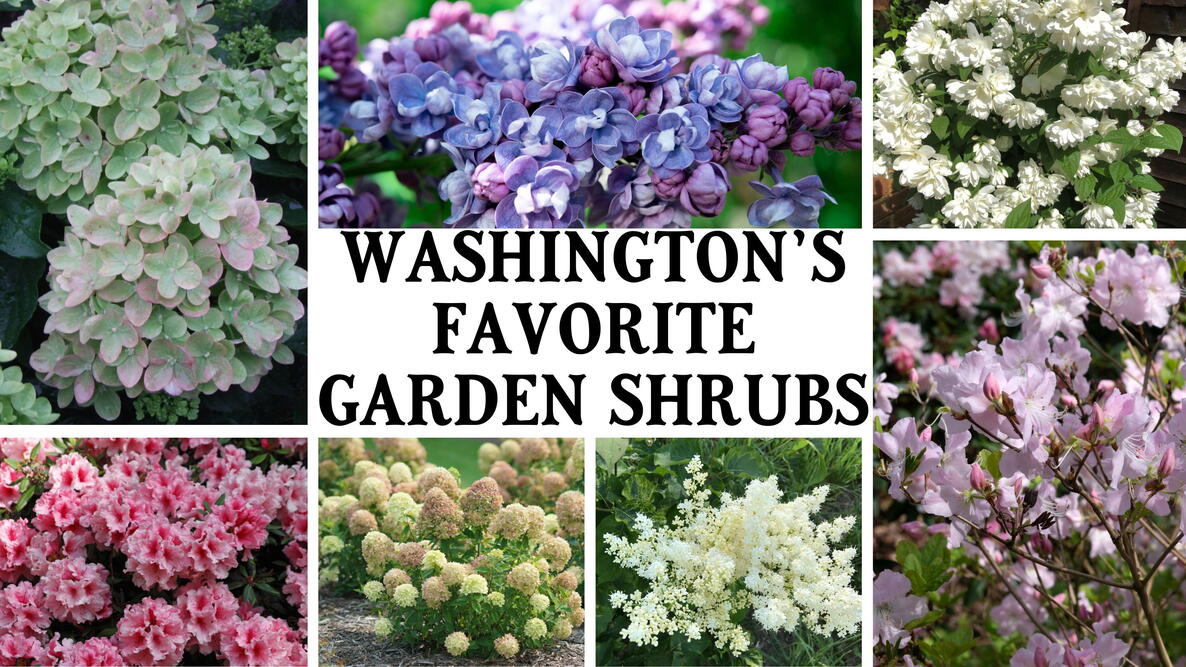
As America nears its 250th Independence Day, consider the shrubs that George Washington chose for Mount Vernon. It turns out that the founder of our country had fine taste. These grand old shrubs are still worthy of a place in your garden today.
Historians agree that George Washington did not chop down a cherry tree. Yet he carefully planned his Potomac landscape. At the Bowling Green, the central lawn, he lined the walkways with shrubs and trees to showcase native American species.
In 1792—the same year The Old Farmer’s Almanac was founded—Washington ordered more than 100 types of plants from botanist John Bartram. Among them were these shrubs for the Bowling Green and beyond:
- Philadelphus coronarius, a sweet flowering shrub (mock orange)
- Rhododendron maximum, an evergreen with large rose-colored blossoms (also called mountain laurel or rosebay)
- Viburnum alnifolium, a handsome flowering shrub (hobblebush)
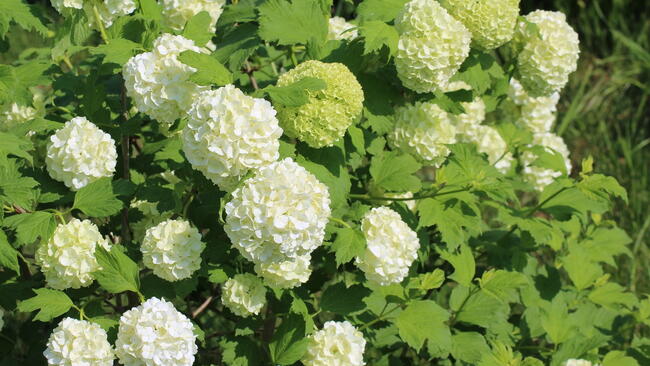
- Hydrangea arborescens, ornamental in shrubberies, with large white flower clusters
Over the centuries, they have been naturalized and hybridized as plant breeders sought to enhance color, fragrance, hardiness, size, and resilience. With garden centers awash in enticing new varieties every spring, how do you choose the right one? Hint: Like wine and cheese, some shrub varieties improve with age.
1. Hydrangeas
Washington planted a native hydrangea, Hydrangea arborescens, in the spring of 1792. His contemporaries—Thomas Jefferson at nearby Monticello and James Madison at Montpelier in Virginia—were experimenting with these “new” shrubs as well.
Today, hydrangeas remain among the most dependable shrubs in the garden, valued for their longevity and late-season beauty.
- For Zone 3 or 4, and a long life in your landscape, look for H. arborescens (smooth-leaved hydrangea) and H. paniculata (panicle hydrangea). Both thrive in a mix of sun and shade and will live for decades with minimal care.
In my New Hampshire garden, hydrangeas come into their own in September, when the light is perfect and the heat of summer has usually passed.
- Two old and reliable H. paniculata cultivars, ‘Unique’ and ‘Limelight’, gradually turn pink, then rose, then mauve. I cut bouquets as the color deepens and let them air dry for winter color in the house.

Photo: Proven Winners
- Also worth noting: The climbing hydrangea, H. anomala ssp. petiolaris, is a vigorous woody vine well suited to narrow, shady spaces. It will climb on practically anything, including my garden rake left out too long. The lacy, slightly fragrant flowers look beautiful floating in a shallow bowl. Hardy to Zone 4.

Photo: Organic India Seeds
For smaller spaces:
- H. paniculata ‘Little Lime’, ‘Little Quick Fire’, ‘Strawberry Sundae’, and ‘Bobo’; all grow 3 to 5 feet tall and wide at maturity
- H. quercifolia ‘Pee Wee’ and ‘Ruby Slippers’, oakleaf varieties; both grow 3 to 4 feet tall

Photo: Proven Winners
2. Lilacs
Washington had lilacs planted at Mount Vernon, including Syringa vulgaris, the common lilac, with its unforgettable fragrance and range of colors. He made three diary entries during February and March of 1785 detailing the transplanting of mature lilacs to the north and south garden gates and later noted that they opened on April 16 of that year.
While lilacs bloom for only about two weeks in spring, those are glory days for aromatic bouquets. The old-fashioned types can reach 10 to 15 feet in height and can be pruned after blooming. Deadheading is optional, done mostly for appearance. Most varieties are hardy to Zone 3, tolerate reasonably dry summers, and perform best in full sun.
Classic and heirloom favorites include:
- S. vulgaris ‘Charles Joly’, a true antique, magenta-purple with classic fragrance
- S. vulgaris ‘Mme. Lemoine’, an old French cultivar, double white and highly fragrant
- S. vulgaris ‘Sensation’, prolific single purple blooms edged in white
- S. vulgaris ‘Katherine Havemeyer’, large double clusters in lavender, very fragrant
- S. × prestoniae ‘James MacFarlane’, hardy to Zone 2, brilliant pink and fragrant
- S. × prestoniae‘Donald Wyman’, similar to ‘James MacFarlane’, with deep pink-purple flowers and late bloom

Photo: Vera-g/GettyImages
For compact gardens, consider these smaller-growing lilacs:
- S. vulgaris ‘Marie Frances’, true pink, fragrant, grows to about 5 feet
- S. vulgaris ‘New Age White’, vivid white blossoms, mildew resistant, tops out at about 5 feet
- S. × hyacinthiflora ‘Blanche Sweet’, bluish buds with lavender-blue flowers tinged with pink, grows up to 8 feet

Photo: Dmitrii Maslov/GettyImages
3. Rhododendrons and Azaleas
In March 1792, Washington received rhododendron plants from botanist William Hamilton’s estate, The Woodlands.
All azaleas are rhododendrons, but not all rhododendrons are azaleas. (You knew that.) The genus Rhododendron encompasses azaleas and includes more than 800 species, all of which can freely hybridize to create new cultivars.
As the ease of hybridizing made the plants more accessible, their incredible versatility became apparent. Some are evergreen, some deciduous, with an enormous range of color, size, and zone hardiness. Although they favor a moderate maritime climate, acidic soil (i.e., soil pH 4.5–6.0), and woodland and shady spots, rhodies and azaleas can thrive in nearly any garden.
If you’re thinking smaller scale, we suggest planting evergreen types where they are sheltered from cold, dry winter winds and the up-and-down temperatures of south-facing sites, or choose from the huge array of deciduous cultivars, some of which are bud-hardy to –25°F and even colder.
- Rhododendron ‘P.J.M.’, a compact shrub perfect for small spaces and shady corners, especially the Compact and Elite varieties; burgundy foliage in winter; grows 3 to 6 feet; hardy in Zones 4–8
- Northern Lights series, deciduous azaleas that are extremely cold-hardy to –40°F, including ‘Orchid Lights’ and ‘Northern Hi-Lights’
- For warmer climates: R. ‘Robles’, dwarf, lavender blooms with purple speckles and dark pink stamens; ‘Hydon Dawn’, pink, tolerates full sun; Zones 7 to 9

Photo: Pride’s Corner Farm
4. Viburnums
Prior to his 1792 request, Washington received in 1785 some young guelder rose plants, Viburnum opulus, from his neighbor George Mason, an avid plantsman and an architect of the American Revolution.
For those who love viburnums (and who doesn’t?), this plant family ranges from Washington’s chosen native woodland hobblebush, V. lantanoides, so-named for its low, scraggly branches that can trip a horse (or a hiker), to the stately V. plicatum, or doublefile viburnum, thought by some to be the most elegant of flowering shrubs.
Today, this diverse group ranges from low native woodland species to larger, more structured shrubs. Viburnums offer interest across the seasons, with spring flowers, summer foliage, and often striking fall color and fruit.
High-performing, aromatic viburnums:
- V. carlesii, Koreanspice viburnum, an early spring blooming, 4- to 6-foot-tall shrub with a powerful spicy-sweet scent and dozens of pink flowers, hardy to Zone 4
- ‘Spice Baby’, a dwarf variety, 3½ to 5 feet tall, with white flowers and dark green foliage, hardy to Zone 4

Photo: Proven Winners
Large and lovely:
- Doublefile varieties such as ‘Mariesii’ or ‘Shasta’ become landscape centerpieces, with tiered flowers in spring, bright red fruit, and red-purple fall foliage; 6 to 12 feet tall; hardy to Zone 5

Photo: Al’s Garden Center
5. Mock Oranges
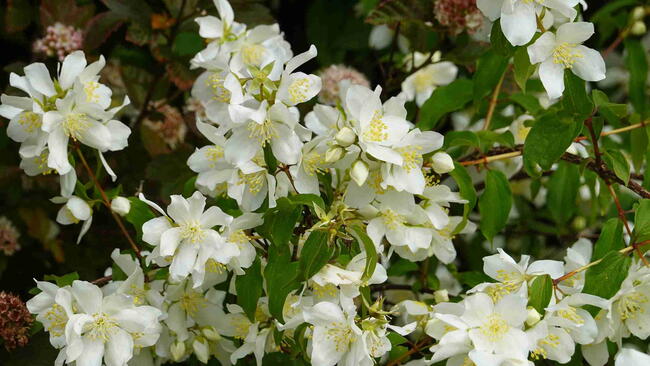
Perhaps your grandmother had a mock orange (Philadelphus) growing near her house. Every June, the sweet perfume of orange blossoms wafted through open windows.
Washington had a mock orange planted near the north outhouse in 1785. It was smart thinking to put this fragrant shrub to work near a potentially odiferous outbuilding!
Cultivated in Europe since the 16th century, the plant blooms best in full sun; its dark green leaves make a pleasing backdrop to roses and other plants. It is excellent as a cut flower or in bridal bouquets.
The plants can handle summer humidity but do not like poorly draining soil. They often have large root systems and can be hard to move. Mock orange flowers can be single or double; all are fragrant (except P. inodorus, rarely found in garden centers).

Photo: Milan Havlis
Like Grandma’s (classic varieties):
- P. ‘Galahad’, single, compact, 4 to 6 feet tall, hardy to Zone 3
- P. ‘Snowgoose’, double-flowered and fragrant, 5 feet tall, hardy to Zone 4
- P. ‘Manteau d’Hermine’, smaller habit, double, hardy to Zone 5
For small gardens:
- P. × virginalis ‘Miniature Snowflake’, ‘Snowbelle’, and ‘Snow-dwarf’; all grow smaller than 6 feet

Photo: GardenTags
Why These Shrubs Still Work Today
Washington’s selections were not merely ornamental—they were practical, durable, and well suited to the American landscape.
More than two centuries later, many of these same shrubs remain mainstays of the garden, valued for their reliability as much as their beauty. They ask for little, adapt to a range of conditions, and reward the gardener year after year.
Over time, breeders have refined them for better color, stronger fragrance, and greater resilience. Yet their essential qualities endure—proof that good plants, like good ideas, stand the test of time.
If you’re choosing shrubs for a long-lived landscape, you could do worse than follow Washington’s lead.
More Like This

Comments