Caption
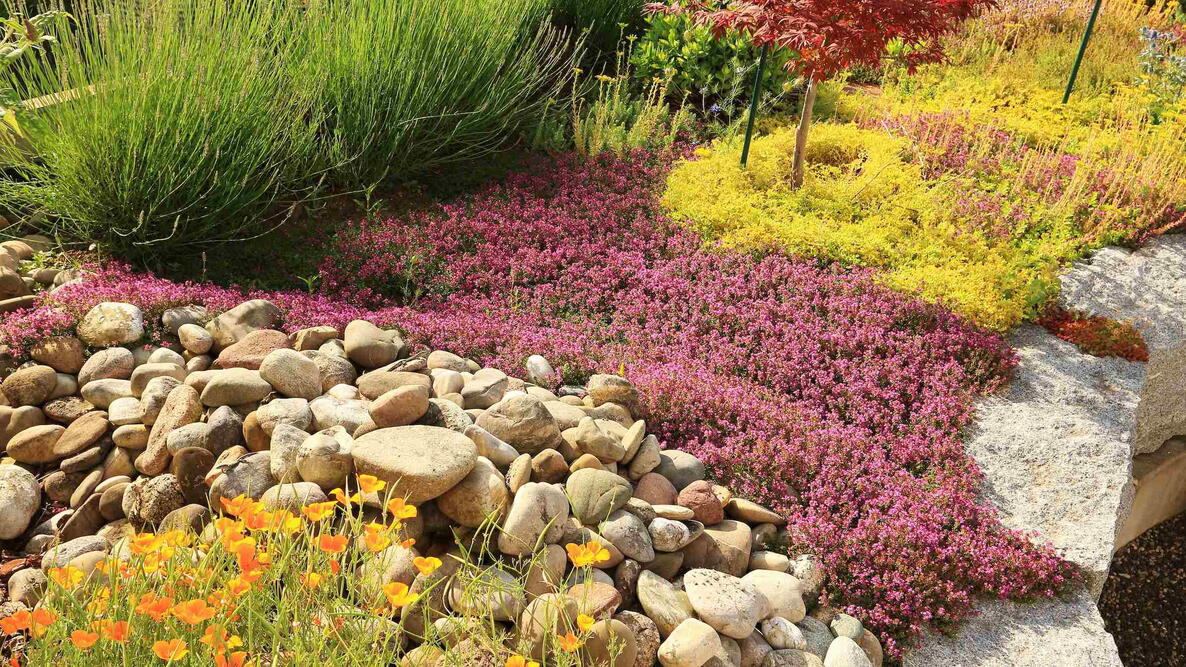
A drought-tolerant garden featuring thyme, sedum, lavender, and California poppies planted among stones and gravel to reduce water use.

Keeping a garden thriving through hot, dry weather isn’t always easy—especially when some plants wilt as soon as the soil dries out. I’ve found that others keep growing and blooming with very little help once they’re established. Here are 22 drought-tolerant plants that handle heat and dry soil, plus a few simple ways to keep your garden healthy with less watering.
Key Points
- Drought-tolerant plants help gardens stay healthy during hot, dry summers and reduce the need for frequent watering.
- Many native plants are naturally adapted to dry conditions, especially those with deep roots, woody stems, or thick leaves.
- Simple practices like mulching, watering at the soil line, and watering early in the morning help conserve moisture and make gardens more resilient.
- Drought-tolerant plants are often native to the hot, dry areas of the world, like the Mediterranean coast, South Africa, Australia, and our own prairies and deserts of the Southwest.

While some drought-tolerant plants are hardy enough for desert landscapes, many are even happier in standard gardens, raised beds, and planters.
The difference often comes down to how plants are adapted to heat and dry soil. Native plants, woody perennials, and species with thick or leathery leaves often tolerate drought far better than tender annuals.
If you want to reduce water use and make your garden easier to maintain, consider growing plants that naturally thrive in drier conditions. Below are 22 drought-tolerant plants to include in your landscape, along with gardening tips that can help conserve water during hot weather.

22 Drought-Tolerant Plants That Thrive With Little Water
Native plants are often among the best choices for drought-tolerant gardens, and many are flowering varieties that add color even in dry conditions. Because every region has its own adapted species, researching local options can reveal even more plants suited to your area.
To make things easier, here’s a quick-glance chart comparing zones and sun needs before diving into each plant:
Quick Reference: Drought-Tolerant Plants
| Plant Name | Zones | Exposure |
|---|---|---|
| Stonecrop (Sedum spp.) | 3 to 10 | Full sun to partial shade |
| Black-eyed Susan (Rudbeckia hirta) | 3 to 9 | Full sun to partial shade |
| Milkweed (Asclepias spp.) | 3 to 9 | Full sun |
| Lavender (Lavandula spp.) | 5 to 11 | Full sun |
| Blazing Star (Liatris spp.) | 3 to 9 | Full sun |
| Adam’s Needle (Yucca filamentosa) | 4 to 11 | Full sun |
| Hen and Chicks (Sempervivum tectorum) | 3 to 11 | Full sun |
| Blanket Flower (Gaillardia spp.) | 3 to 10 | Full sun |
| Little Bluestem (Schizachyrium scoparium) | 3 to 9 | Full sun to partial shade |
| Coreopsis (Coreopsis spp.) | 3 to 9 | Full sun to partial shade |
| Goldenrod (Solidago spp.) | 3 to 9 | Full sun to partial shade |
| Asters (Aster or Symphyotrichum spp.) | 3 to 9 | Full sun to partial shade |
| Thyme (Thymus spp.) | 5 to 9 | Full sun |
| Yarrow (Achillea millefolium) | 3 to 9 | Full sun |
| Coneflower (Echinacea spp.) | 3 to 9 | Full sun |
| St. John’s Wort (Hypericum spp.) | 3 to 9 | Full sun to partial shade |
| Evening Primrose (Oenothera biennis) | 3 to 9 | Full sun to partial shade |
| Lamb’s Ear (Stachys byzantine) | 4 to 9 | Full sun to partial shade |
| Prickly Pear (Opuntia spp.) | 4 to 9 | Full sun |
| Russian Sage (Salvia yangii) | 4 to 9 | Full sun |
| Woodland Sunflower (Helianthus divaricatus) | 3 to 8 | Partial shade |
| Bee Balm (Monarda spp.) | 3 to 9 | Full sun to partial shade |
1. Stonecrop (Sedum spp.)
Stonecrop plants come in a wide range of shapes, sizes, and colors, but they all share one useful trait: their fleshy, succulent leaves store water. Once established, many sedums thrive in sunny spots where other flowers struggle—I’ve grown them in shallow, rocky soil where almost nothing else would take hold.
- Zones: 3 to 10
- Exposure: Full sun to partial shade
- Bloom Time: Summer to fall
Tall varieties like ‘Autumn Joy’ can be used as flower bed focal points, while ground-covering stonecrops like ‘Blue Spruce’ make a colorful living mulch!

2. Black-eyed Susan (Rudbeckia hirta)
A top choice for mass plantings, mini meadows, and xeriscapes, Black-eyed Susan needs very little extra water once established. I’ve found it’s one of the easiest ways to add reliable summer color without much effort. Allowing the golden blooms to go to seed in autumn can also attract birds to the garden.
- Zones: 3 to 9
- Exposure: Full sun to partial shade
- Bloom Time: Summer to fall

3. Milkweed (Asclepias spp.)
North America is home to many native milkweed species, including common milkweed and butterfly weed. These plants tolerate dry soil surprisingly well and are essential for monarch butterflies. They are the only plants monarch butterflies lay their eggs on! I always make room for at least one variety—they’re one of the most rewarding plants to grow if you want to support pollinators.
- Zones: 3 to 10
- Exposure: Full sun
- Bloom Time: Summer

4. Lavender (Lavandula spp.)
Although lavender is native to the Mediterranean, it grows well in many North American gardens. Its fragrant foliage, purple flowers, and ability to thrive in dry conditions make it a favorite for drought-tolerant landscapes. Lavender performs best in full sun and well-draining soil and often struggles in heavy or consistently wet ground. In humid climates, I’ve had the best success growing it in raised beds or gravelly soil.
- Zones: 5 to 11
- Exposure: Full sun
- Bloom Time: Spring to summer

5. Blazing Star (Liatris spp.)
There are about 50 native blazing star species in North America, and their flower shapes and bloom times vary. These prairie plants tolerate dry soil well and are especially attractive to pollinators. Their upright purple flower spikes add height and structure to sunny borders and meadow plantings.
- Zones: 3 to 9
- Exposure: Full sun
- Bloom Time: Summer
6. Adam’s Needle (Yucca filamentosa)
Adam’s needle looks like it belongs in a desert, but it can be kept in ornamental beds in Zones 4 and up. These plants grow best in full sun and produce big, showy flowers about once every other year—but they shouldn’t be planted near walkways, as their succulent leaves are sharp.
- Zones: 4 to 11
- Exposure: Full sun
- Bloom Time: Summer

7. Hen and Chicks (Sempervivum tectorum)
Another succulent option, hen and chicks, can be used as a living groundcover in in-ground gardens, but they grow well in pots, too. These tough plants are unfazed by drought and can rot quickly if they get too much water.
- Zones: 3 to 11
- Exposure: Full sun
- Bloom Time: Summer

8. Blanket Flower (Gaillardia spp.)
Native to North and South America, blanket flower’s yellow and red blooms are bright and showy, and they look best when grown in groups or “drifts.” Blanket flower earned its name from its habit of blanketing the earth with bright flowers all summer long. For that “wow” factor, look for AAS winner ‘Arizona Sun’, which has wide, mahogany-red petals tipped with yellow; or ‘Fanfare’ whose tubular red and yellow petals flare like little trumpets.
- Zones: 3 to 10
- Exposure: Full sun
- Bloom Time: Summer to fall

9. Little Bluestem (Schizachyrium scoparium)
North America has a number of native grasses that can withstand dry soil, but little bluestem is one of the most popular picks. You can also try out other perennial native grasses, like big bluestem or blue fescue, or grow a mix of ornamental grasses for more color and variety.
- Zones: 3 to 9
- Exposure: Full sun to partial shade
- Bloom Time: Summer to fall

10. Coreopsis (Coreopsis spp.)
Despite their delicate look, coreopsis plants are surprisingly rugged and dependable—even in times of drought. Many varieties are also native to coastal areas and are unfazed by salty soil. Although there are lots of charming coreopsis plants to choose from, lance-leaf coreopsis is native to the Eastern and Central United States, and it works best in mass or group plantings. Its bright yellow flower pair beautifully with other drought-tolerant natives, like blanket flower and woodland sunflower.
- Zones: 3 to 9
- Exposure: Full sun to partial shade
- Bloom Time: Spring to summer

11. Goldenrod (Solidago spp.)
Although goldenrod is often blamed for hay fever symptoms, goldenrod pollen is actually too heavy to be airborne! These easy-to-grow native plants bloom late in the season when most gardens could use a splash of gold, and they pair nicely with other late bloomers, like asters and coneflowers. For a spectacular show, look for Solidago rugosa ‘Fireworks’, which has arching branches covered with yellow flowers, or dwarf S. sphacelata ‘Golden Fleece’, which blooms profusely and stays under 15 inches high.
- Zones: 3 to 9
- Exposure: Full sun to partial shade
- Bloom Time: Summer to fall

12. Asters (Aster or Symphyotrichum spp.)
Asters flower around the same time as goldenrod, which is why these two native plants are often grown together in autumn gardens. Many types of asters prefer moist soil; however, there are a few drought-tolerant aster varieties that thrive in dry gardens. Heath asters, for example, are a native North American aster that grows 1 to 3 feet tall and produces white, daisy-like flowers that look particularly pretty when paired with goldenrods and other native wildflowers. Alpine asters, another drought-tolerant option, are a smaller variety that typically stays under 1 foot high and has pale purple blooms.
- Zones: 3 to 9
- Exposure: Full sun to partial shade
- Bloom Time: Summer to fall
13. Thyme (Thymus spp.)
Although most growers cultivate thyme purely as an edible herb, its spring-blooming flowers have a lot of ornamental appeal, and the plant works well in gardens or containers. You can also try out creeping thyme as a fragrant groundcover for sunny spots!
- Zones: 5 to 9
- Exposure: Full sun
- Bloom Time: Spring to summer

14. Yarrow (Achillea millefolium)
Undemanding yarrow plants often grow as wildflowers along hiking trails and road margins, but they can be cultivated in sunny gardens too. These plants are often grown in groups or in garden bed borders, and their broad flat flowers are highly attractive to butterflies. Several cultivars to look for are ‘Moonshine’, which grows to about 18 inches tall and offers lemon-yellow flowers that are good for cutting or drying and attractive, finely cut, gray foliage. There’s also ‘Coronation Gold’, a taller variety that reaches 3 feet high and has bright yellow flowers.
- Zones: 3 to 9
- Exposure: Full sun
- Bloom Time: Summer to fall

15. Coneflower (Echinacea spp.)
A tough prairie native, purple coneflowers are the queens of low-maintenance gardens. These plants produce long-lasting, purple, daisy-like flowers on sturdy, 3- to 4-foot-tall stems that can withstand even the harshest wind and weather. Coneflowers also self-seed readily, and they’re reliable performers that bloom regardless of heat or drought.
- Zones: 3 to 9
- Exposure: Full sun
- Bloom Time: Summer
16. St. John’s Wort (Hypericum spp.)
Some varieties of St. John’s wort are small plants that are perfect for mixed flower beds, while others grow as larger shrubs. Whichever variety you choose, these adaptable plants can tolerate sun to light shade, and they rarely need water once their roots are settled in.
- Zones: 3 to 9
- Exposure: Full sun to partial shade
- Bloom Time: Summer to fall
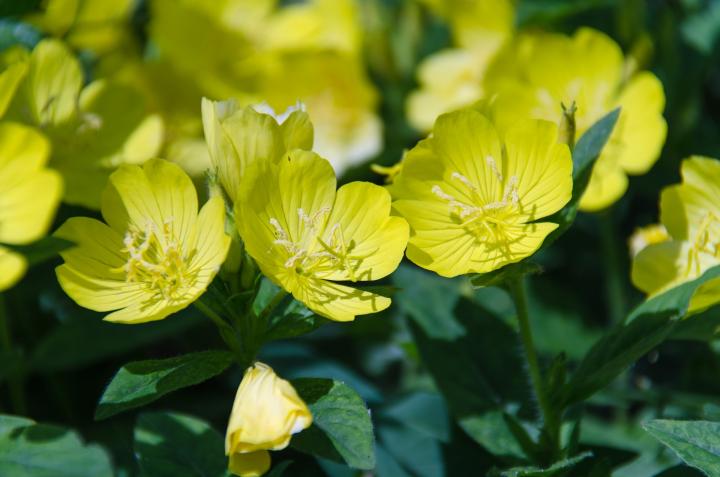
17. Evening Primrose (Oenothera biennis)
As its name suggests, evening primrose is an unusual plant that flowers at night and is a magnet for nocturnal pollinators, like moths. However, these plants get quite large and should be located towards the rear of gardens or grown on their own to ensure they don’t block light from reaching other plants.
- Zones: 3 to 9
- Exposure: Full sun to partial shade
- Bloom Time: Summer to fall
18. Lamb’s Ear (Stachys byzantina)
Lamb’s ear isn’t native to North America, but it’s still attractive to pollinators of all kinds. This plant’s fuzzy leaves also make it a fine choice for touch gardens, and it’s often a popular plant among children.
- Zones: 4 to 9
- Exposure: Full sun to partial shade
- Bloom Time: Spring to summer

19. Prickly Pear (Opuntia spp.)
When most people think about drought-tolerant plants, they envision cactuses. And there are few better cactus plants to grow than the prickly pear! Not only is this plant native to the Americas, but it’s cold-hardy and produces edible fruit and cactus paddles, as well as bewitching flowers that bloom in vivid shades of pink, yellow, orange, and red. Just be sure to remove the cactus spines from the paddles and fruit before making classic treats, like nopales.
- Zones: 4 to 9
- Exposure: Full sun
- Bloom Time: Spring to summer

20. Russian Sage (Salvia yangii)
Russian sage has airy, soft gray foliage that provides a beautiful background for other drought-tolerant plants, like agastache, rudbeckia, and penstemon. Often called the backbone of the summer garden, Russian sage’s long branches are covered with sprays of small, blue flowers in mid- to late summer. Pollinators love this plant, and it’s deer-resistant and easy to grow.
- Zones: 4 to 9
- Exposure: Full sun
- Bloom Time: Summer to fall
21. Woodland Sunflower (Helianthus divaricatus)
Most sunflowers need bright sun to be happy, but the woodland sunflower is a native North American plant that can grow in shady gardens. These plants can reach up to 6 feet tall and can be planted in groups or as colorful backdrop plants in mixed flower beds.
- Zones: 3 to 8
- Exposure: Partial shade
- Bloom Time: Summer to fall

22. Bee Balm (Monarda spp.)
There are several types of native bee balm, with flowers ranging from red to purple. Many varieties can tolerate short dry periods once established, although they generally prefer more consistent moisture than some other drought-tolerant plants. These plants are bee favorites, of course, but most also have fragrant leaves and work well in containers, mass plantings, and raised beds that help control their spreading roots.
- Zones: 3 to 9
- Exposure: Full sun to partial shade
- Bloom Time: Summer to fall
Why Plant Drought-Tolerant Plants in Your Garden?
It’s no secret that summers are getting hotter and drier, and heat waves and drought-like conditions are only expected to become more common in the coming years. This is especially true in parts of the Southeastern and Western United States, but gardeners in cooler regions of the Midwest and New England may also encounter longer dry conditions in the future, too.
Watering plants by hand or with a sprinkler system can help during dry weather, but it often requires significant time and can lead to unnecessary water use. Choosing plants that tolerate dry conditions can make gardens far more resilient while reducing the need for constant watering.
By growing drought-tolerant plants and taking simple steps to conserve moisture in the soil, gardeners can create outdoor spaces that remain attractive even when rainfall is limited. Water-wise gardens can also support pollinators and other wildlife that rely on flowers and vegetation for food and shelter.
Choosing Drought-Tolerant Plants for Your Garden
The first step toward a drought-tolerant garden is choosing plants that naturally require less water. Annuals and tropical flowers may look beautiful, but many wilt quickly in dry weather and often need frequent watering to thrive.
Instead, look for plants that are naturally adapted to dry environments. These are often native plants from your region or species that evolved in climates with hot summers and limited rainfall. Plants with deep or fibrous root systems, thick leaves, or woody stems are also more likely to tolerate drought.
Once you’ve chosen your plants, consider how your garden space is arranged. In very hot climates, I’ve found even drought-tolerant plants benefit from a bit of afternoon shade, especially in their first season.
Improving the soil with compost before planting, keeping weeds under control, watering at the soil line, and covering the soil with a 2- to 3-inch layer of mulch can all help reduce evaporation and keep plants hydrated longer.
In very hot climates, I’ve found even drought-tolerant plants benefit from a bit of afternoon shade, especially in their first season.
Simple Tips for a Drought-Tolerant Garden
Choosing plants that tolerate dry soil is the first step toward a resilient garden, but good design can make drought-tolerant plantings even more attractive and effective. With thoughtful placement and a mix of plant shapes, heights, and bloom times, drought-tolerant gardens can stay colorful and interesting throughout the growing season.
Gardener’s Tip
Even drought-tolerant plants need regular watering during their first growing season while their roots establish. Once established, many of these plants will thrive with far less supplemental water.

- Grow plants in groups. Planting flowers in groups of three or more creates a fuller, more natural look and helps build stronger blocks of color in garden beds. This technique—often called drift planting—also makes it easier for pollinators to find flowers.
- Plan for a long season of bloom. Choose plants that flower in spring, summer, and fall so your garden stays colorful throughout the growing season.
- Mix flower shapes and colors. Combining plants with different flower forms and colors adds visual interest and supports a wider variety of pollinators. Looking at a basic color wheel can help you discover combinations that work well together.
- Consider sun exposure. Place taller plants toward the back or north side of garden beds and shorter plants toward the front or south side. This prevents taller plants from shading their neighbors and ensures all plants receive enough light.
- Layer plants by height. For a more natural and visually appealing garden, layer plants of different heights together. Start with taller backdrop plants or shrubs, then add mid-height flowers and finish with low-growing border plants or groundcovers.

More Like This

Comments