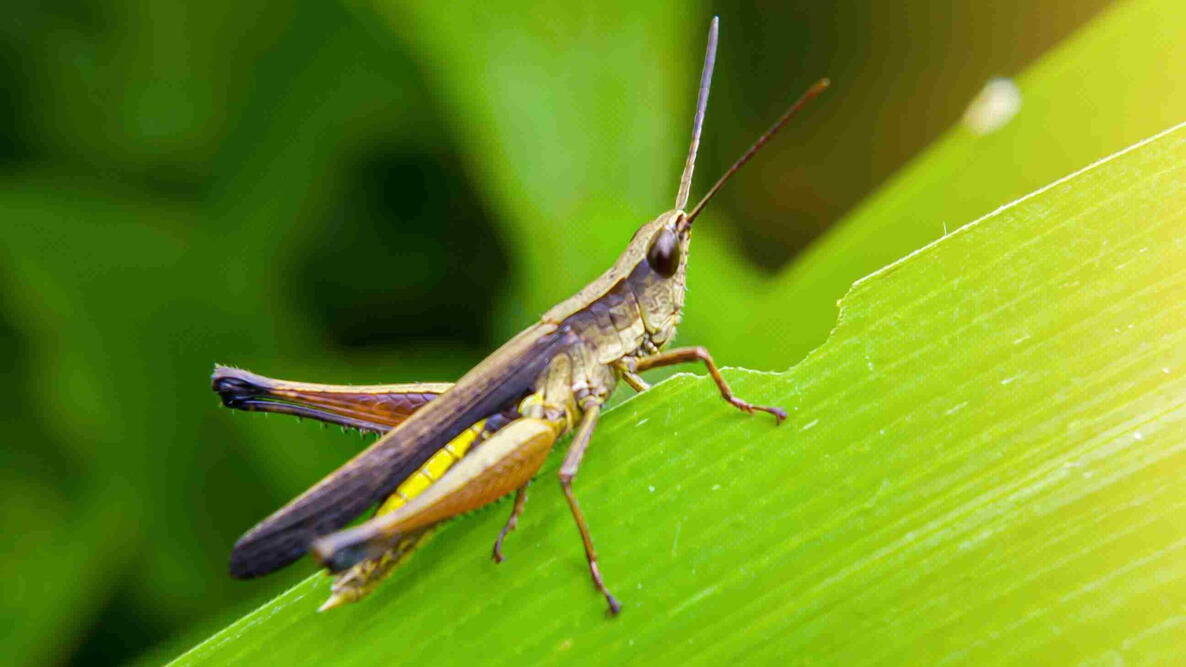
Caption
Lunch is served—for a hungry grasshopper.
Maybe you tried to catch them as a kid. Maybe you still do. Hold a live one in your hand, and the brown, “tobacco spit” they emit won’t wash off as easily as you’d like. We’re talking about grasshoppers. Not the minty ice cream drink, but the leaf and stem gnawing insect.
What are Grasshoppers?
Grasshoppers are a group of insects that feed on plant material. There are hundreds of species of grasshoppers in North America, which is why you may struggle to describe their coloring. Some are vibrant green, some yellow and black, and others dusty brown. The unique and obvious characteristic is their powerful, large rear legs, which they use to propel themselves in huge jumps.
While grasshoppers are a common sight, and a garden pest that feeds on many plants in our gardens, they’re normally not a significant issue for home gardeners. Our plants can stand a few holes or a munched leaf, and when grasshopper numbers are normal, they aren’t too much of a problem. But when populations are high, they can become a significant pest.
Grasshopper populations vary widely year to year or even from one part of the season to another. They are highly susceptible to the weather, with damp, cool conditions causing mortality. Grasshoppers are susceptible to a fungal infection, which is encouraged by damp weather. The fungus causes the grasshopper to climb high up on a plant, where it dies, and the fungal spores have a better chance of hitching a ride on the wind to their next meal. How strange is that?
Many grasshopper species overwinter in the egg stage in the soil, but some will overwinter as nymphs, and a few migrate. Grasshopper eggs hatch in late spring when the soil warms. They are diurnal insects, which means they’re active during daylight hours.
Grasshoppers or Locusts?
You’ve probably heard of a plague of locusts, or a swarm of locusts. So what’s the difference between grasshoppers and locusts?
A few grasshopper species can transform into locusts. Locusts are grasshoppers that can undergo behavioral and biological changes when conditions are met. Not all grasshopper species can become locusts. Basically, a few grasshopper species act like grasshoppers when their numbers are low. As their population density increases, crowding triggers physiological and behavioral changes, and they form large swarms that eat everything in their path.
To make matters more confusing, the word locust can refer to swarming grasshoppers or to annual cicadas, depending on the region. It’s an inaccurate name, since cicadas are a different order of insects, but you may hear it used in the Northeast area of the country.

Identification
If it hops like a grasshopper, and looks like a grasshopper…
While identifying exactly which species of grasshopper you have is difficult, it is possible. Catch one and search online for grasshopper species in your state, and you’ll likely find a picture to match. But it’s academic to gardeners. A grasshopper is a grasshopper.
Grasshoppers have the three-part body of an insect: head, thorax, and abdomen. The compound eyes on the front of the head look huge, and of course, so do the powerful rear legs. The thorax and abdomen are covered in segmented plates of chitin, looking like overlapping pieces of armor on a dragon.
Grasshopper eggs are laid in little clusters in the soil and look like a basket of chicken eggs, only the eggs are the size of a tomato seed. In late spring to early summer, the freshly hatched nymphs, which resemble tiny adult grasshoppers, begin feeding on tender plant material.

Identifying Grasshopper Damage
Grasshopper feeding damage typically appears as ragged holes along leaf edges. If populations increase, more and more foliage may be damaged, eventually stripping plants of leaves and flowers. Quite a few of our favorite garden crops and flowers are on their list of preferred plants, although some grasshopper species primarily feed on tall grasses, weeds, and turf. It’s worth noting that if your garden is on the edge of a field, you might get an extra dose of grasshoppers as they wander over in search of food.
Since many insects can chew a few holes in leaves, you are more likely to notice grasshoppers when you walk through the garden in the afternoon and they hop or take flight. The jumps are spectacular but their flights are usually short and erratic.
Control and Prevention
Preventing Grasshoppers
The best way to keep grasshoppers out of your garden is to keep tall grass and weeds in check at your garden edges.
If you have space, another idea is to grow a trap crop to provide food and shelter for grasshoppers, and lure them away from your veggies and flowers. They tend to favor tall grasses and grain crops; your local Extension office may be able to provide advice on trap crops for your specific region. Don’t plant a trap crop immediately adjacent to your garden; the idea is to lure them elsewhere, not create a nearby grasshopper hotel.

How to Get Rid of Grasshoppers
Chocolate-covered grasshoppers, anybody? In most years, gardeners don’t need to take any action to control grasshoppers. Our plants can tolerate some leaf chewing without much impact on yields. But you may still want to get rid of them when possible for aesthetic reasons. However, once they are nimble jumpers and can fly, complete control is not realistic.
- Hand catch them. This sounds hard, and it is, but you’ll be more successful in the cool early morning hours when they’re a bit slower. Wearing gloves, gently place them in a container and relocate them away from the garden. If they’re too jumpy for you to approach, try a butterfly net.
- Encourage songbirds. Many of our favorite backyard birds like chickadees, wrens, bluebirds, and swallows will happily dine on grasshoppers. Provide water (bird baths), bird feeders, and nest boxes, and leave plenty of perching spots, like tall sunflowers, in the garden.
- If you have a sudden influx of hoppers, floating row covers can sometimes help. However, grasshoppers may chew through them. Metal screen material meant for repairing window screens is more resistant to their chewing mouthparts, though more difficult to use.
- Pesticides for home garden use are generally discouraged and are often ineffective at controlling adult grasshoppers. A few bait products are available, but they are typically expensive. Most bait products on the market target grasshopper nymphs in early summer. If you haven’t noticed the grasshoppers until they are flying around and are an inch or more long, it’s likely too late to try bait.


Comments