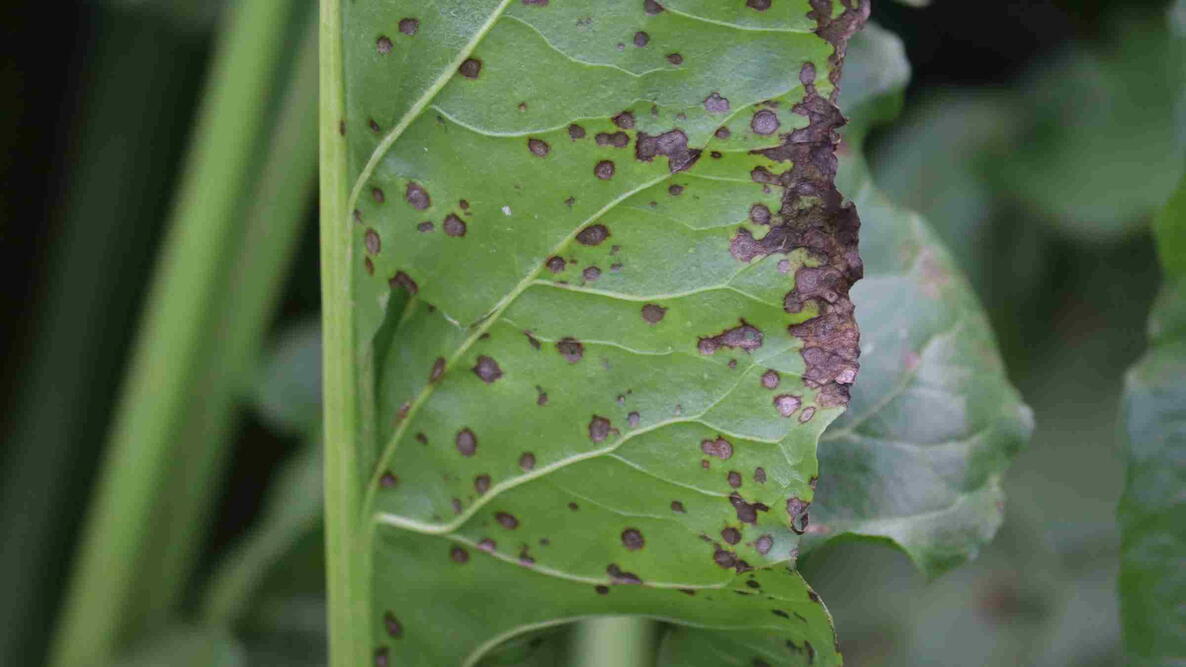
Caption
The telltale target-like spots of Cercospora leaf spot mark this sugar beet leaf—a reminder of how quickly fungal diseases can spread in humid gardens.

Identification
How to Identify Leaf Spot
Identifying leaf spot can be tricky since symptoms vary between species. The good news? Treatment and leaf spot control methods are similar for most pathogens. If you’d like to narrow it down for pure morbid curiosity, start with the host plant, then look at not only the spots and their internal patterns, but also whether they appear on only the leaves, the leaves and stems, and the fruit.

Leaf Spots on Beets, Spinach, and Chard
If your leafy greens like beets or spinach show grayish-white, irregular spots with dark edges, you’re likely dealing with Cercospora leaf spot (Cercospora beticola). This fungal disease also affects Swiss chard and common weeds such as lambsquarters and pigweed, which serve as alternate hosts. Spots may merge, causing yellowing leaves and eventual withering. The centers often show concentric rings, like a target — a classic symptom of Cercospora leaf spot.
Leaf Spots on Broccoli, Cucurbits, and other Brassicas
Members of the Alternaria fungus group are responsible for many brassica leaf spot infections. Several species commonly affect our garden crops, with A. brassicicola and A. brassicae frequently bothering our favorite brassicas, such as kale, broccoli, and cabbage. On susceptible plants, spots caused by Alternaria often appear as brown spots with yellow halos. Eventually, on older spots, the central brown portion may crack. The disease usually first shows up on older, lower leaves. Check out this page from Cornell University for some great pictures to help you identify Alternaria problems.

Leaf Spots on Tomatoes
One of the most frequent tomato leaf diseases is Septoria leaf spot, caused by Septoria lycopersici. This fungal leaf spot overwinters in infected debris, so garden sanitation in autumn is crucial. Symptoms usually appear when the first fruit sets — small spots with gray centers and brown edges that merge over time. Unlike some other tomato spotting diseases, Septoria typically doesn’t affect the fruit, so if your fruit is also showing symptoms, it’s likely a different problem.

More Like This

Comments