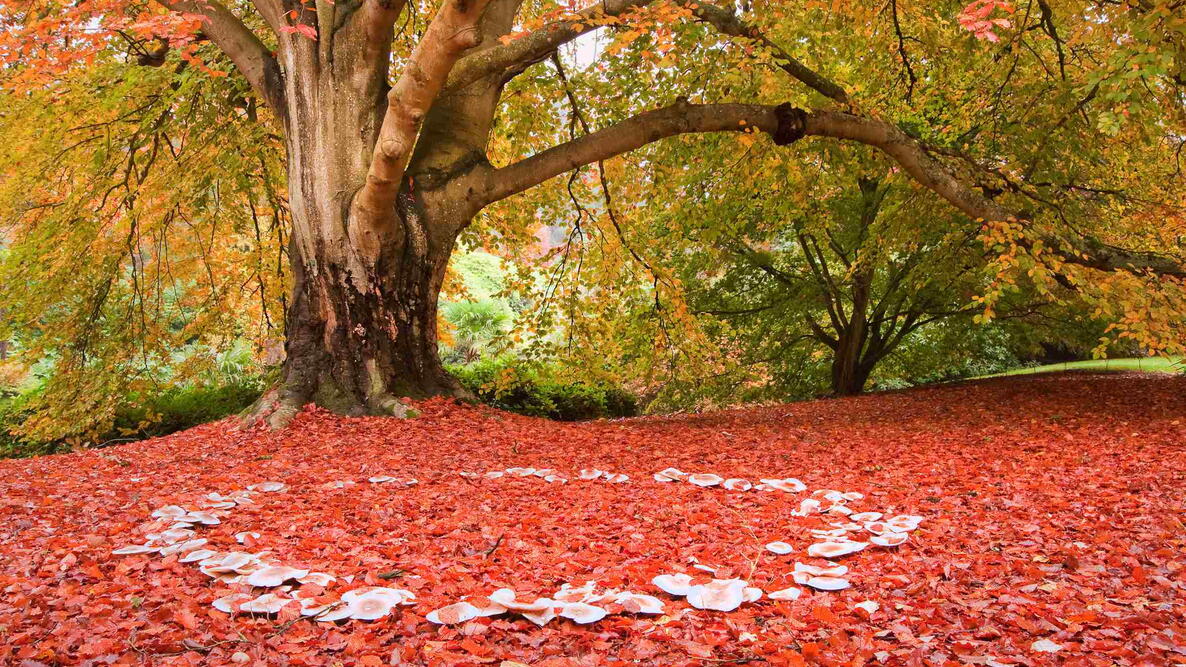
Caption
Fairy ring of mushrooms in autumn leaves.

Have you ever found a ring of mushrooms in your yard and wondered how they got there? Although science has its explanations, these “fairy rings” have lots of folklore behind them, and if you step inside one, you may just find yourself tran-spore-ted to another world where fairies dance in the moonlight and dragons are afoot. Here’s a look at some of the fascinating lore around fairy rings and some fun facts about mushroom circles, too!
Quick Facts About Fairy Rings
- Fairy rings are also known as fairy circles or elven rings.
- Over 60 species of mushrooms can grow in ring formations.
- The oldest known fairy ring—in France—measures about 2,000 feet in diameter and is estimated to be 700 years old!

What are Fairy Rings?
There’s a bit of real magic behind these mysterious circles—even if science offers a logical explanation.
From a scientific perspective, fairy rings occur when mushrooms grow in a circle, arch, or other pattern that looks almost deliberately planted. These circles often seem to pop up overnight, but they actually emerge only when conditions are just right for mushrooms. That usually means lots of rain and cool weather!
Like fruit on an apple tree, the mushrooms that sprout above ground are the “fruiting bodies” of a much larger mycelial network in the soil that feeds on organic matter. However, as the organic matter is depleted by hungry mushrooms, the mycelial network spreads outward in search of more nutrients. This creates the circle-like formation, which we know as fairy rings.
It’s a natural process—but one that feels almost enchanted when it appears overnight on your lawn.
Folklore and Legends: The Myths and Meanings Behind Fairy Rings
While science has an explanation for fairy circles today, cultures across the globe have been creating interesting folklore about fairy rings for generations. From the British Isles to the Americas, here’s some of the supernatural and spooky lore associated with fairy rings and why the peoples of the past often did their very best to avoid stepping in one!
British Isles and Scandinavia
According to the lore of these regions, fairy rings were created by elves or fairies dancing beneath the Full Moon. When the merry dancers grew weary, they used the toadstools as seats to rest on or as tables for feasting.
Because these rings were associated with magic, it was widely believed that entering or disturbing one could only bring ill fortune. Some tales held that entering a fairy circle would allow you to see supernatural beings. However, darker legends claimed that fairies could also entice unsuspecting victims into the rings for dancing and merriment. But once inside, the hapless visitors would be forced to dance until madness set in… or they perished!
France
Known as ronds de sorcières or witches’ circles in France, lore says that fairy rings were created by witches at work and were guarded by toads that cursed anyone who entered one.
Germany
Fairy rings are also known as witches’ rings or Hexenringe in traditional German lore and marked the locations where witches did their dancing on Walpurgis Night (April 30).
Austria
In Austria, it was believed that fairy rings were created by a slumbering dragon who burned the earth with his fiery tail. For the next 7 years, only toadstools could grow on the dragon-scorched earth.
The Netherlands
According to Dutch lore, fairy rings occurred where the devil churned his milk, and grazing cattle near one would turn milk sour.
The Americas
Some indigenous tribes held that fairy rings were created by dancing bison!

Fairy Ring Folklore
Here are just a few more bits of folklore associated with fairy rings from other parts of globe:
- Entering a fairy ring wasn’t just associated with bad luck. Some legends claimed it could also cause you to lose an eye or turn invisible!
- Fairy rings were believed to be particularly dangerous on the nights of Beltane or Walpurgis Night (April 30) and Samhain or Halloween (October 31).
- Throwing wild marjoram or thyme inside a fairy ring could free anyone trapped by fae magic. Victims could also be “saved” by the touch of a rowan twig or piece of iron.
- Running exactly 9 times clockwise around a fairy ring on a Full Moon could allow you to see the supernatural beings within. But running a tenth time around the circle would only bring ill fortune.
- Wearing a hat backwards near a fairy ring could keep fairies from luring you in.
- More modern lore holds that fairy rings form in spots where UFOs have landed!
By the way, learn why you shouldn’t fear the mushrooms in your lawn!

More Like This


Comments